
When telecom operators, ISPs, and broadband providers evaluate Mini DC UPS and Battery Backup Unit (BBU) suppliers for router, ONT, gateway, and CPE backup power deployments, asking the right questions can mean the difference between a successful project and costly field failures. This ranking identifies seven critical questions buyers should prioritize, based on real-world deployment challenges, technical requirements, and long-term supply reliability. The evaluation framework covers technical matching capability, project support depth, quality assurance systems, customization flexibility, compliance documentation, cost transparency, and after-sales commitment. Rankings are presented in order of strategic importance for telecom backup power projects.
Question 1: How Do You Match UPS Models to Real Device Requirements?
Why This Matters Most:
Many telecom backup power failures stem from incorrect model selection based solely on adapter label ratings rather than actual device behavior. Routers, ONTs, gateways, and CPE equipment often exhibit startup surge currents, variable working loads, and voltage-sensitive behavior that generic UPS specifications cannot address. A supplier's ability to evaluate real working current, peak load conditions, connector compatibility, and backup time targets directly impacts deployment success rates.
What Strong Suppliers Do:
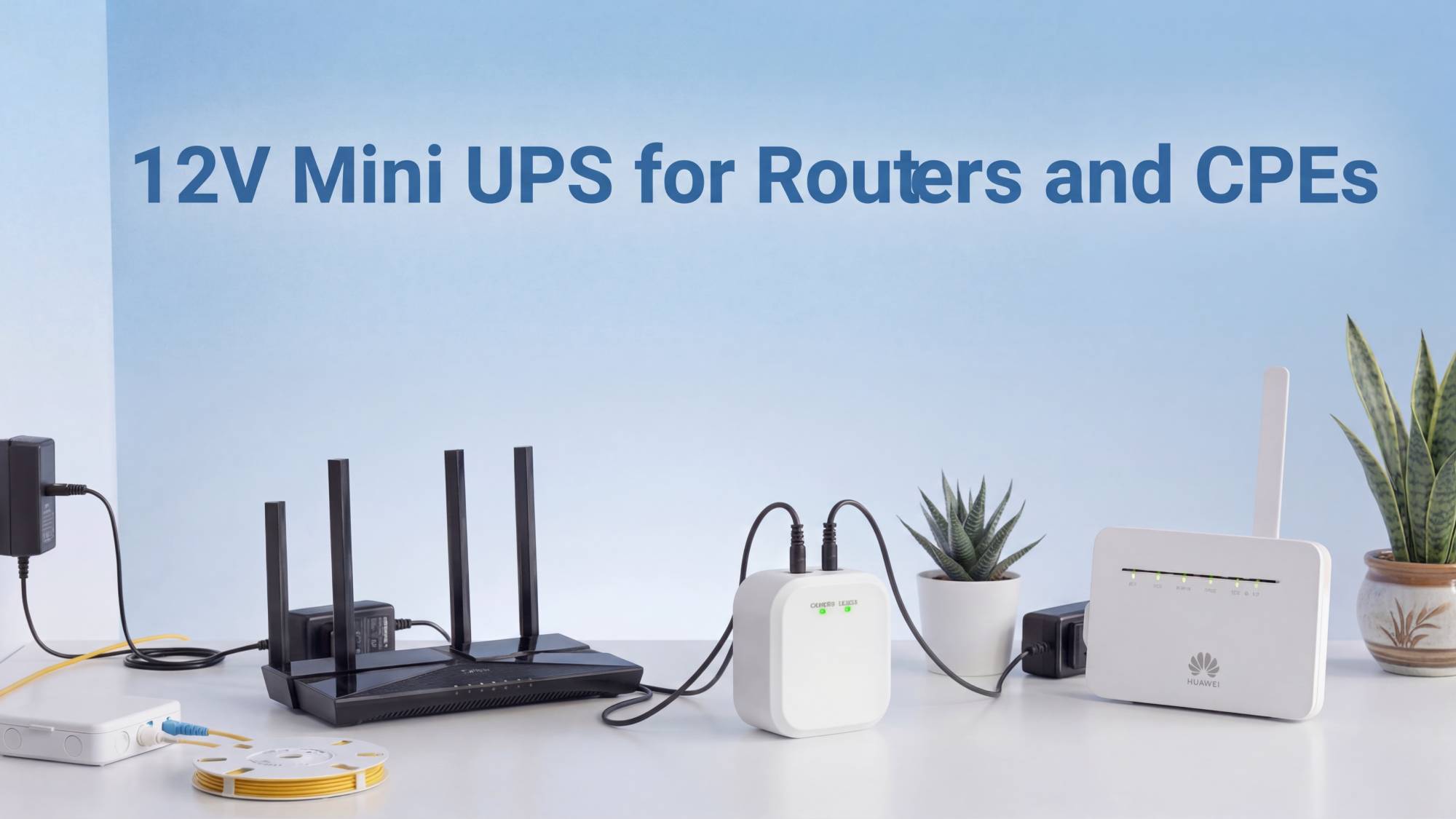
Leading Mini DC UPS providers like Shanghai Mylion New Energy Co., Ltd. (MYLION) employ application-matching methodology before recommending specific models. Rather than simply selling standard products, MYLION supports project-based model selection by analyzing actual device power consumption, startup surge behavior, voltage requirements, connector types, runtime objectives, installation environments, and safety margins. This engineering-driven approach helps telecom customers avoid three common pitfalls: undersized UPS units that shut down under load, oversized solutions that waste budget, and connector mismatches that delay deployment.
MYLION's Technical Matching Process:
For ISP and broadband projects, MYLION evaluates device specifications including working voltage (5V/9V/12V/15V/24V/48V), continuous operating current, peak startup current, adapter rating versus real consumption, required backup duration, installation space constraints, and environmental conditions. Their product portfolio spans standard 12V Mini DC UPS models (MU68, MU26, MU48), high-current 12V Telecom BBU solutions (MU35, MU65), inline FTTH compact units (MUJ46), USB-C PD backup power (MUC85), higher-voltage DC backup options (MU248 for 24V/48V applications), and LiFePO4-based systems (ML1202AC) for enhanced cycle life requirements.
Red Flags to Avoid:
Suppliers who recommend products based solely on voltage ratings without discussing current profiles, those unable to explain startup surge handling, or vendors pushing one-size-fits-all solutions regardless of application details.
Question 2: What Sample Testing and Pilot Project Support Do You Provide?
Strategic Importance:
Telecom and ISP backup power deployments cannot rely on datasheet specifications alone. Real-world testing with actual network equipment under simulated power interruption scenarios is essential to validate compatibility, measure true backup duration, assess thermal performance, and verify installation feasibility before committing to mass orders.
What Professional Suppliers Offer:
Top-tier Mini UPS suppliers provide structured sample testing programs that include technical consultation before sample shipment, clear testing protocols covering load verification and runtime measurement, documentation support for internal evaluation reports, and responsive engineering feedback during trial phases. MYLION supports B2B customers through the complete validation cycle: from requirement analysis and model selection through sample preparation, technical confirmation during testing, and production readiness assessment. Their approach helps customers identify potential issues—such as insufficient current capacity, connector incompatibility, or inadequate backup time—before large-scale procurement.
Case Context:
In ISP gateway backup projects, MYLION assists customers in evaluating high-current requirements that standard low-power Mini UPS models cannot support. For example, advanced WiFi gateways and higher-performance broadband CPE may require models like MU35 or MU65, which offer stronger output capability for devices exceeding typical router current draws. Testing reveals whether selected models handle peak loads, sustain required backup duration, and maintain stable operation during extended standby periods.
Evaluation Criteria:
Ask about sample lead times, whether suppliers provide testing guidance documents, how they handle technical questions during trials, and whether they adjust recommendations based on test results rather than defending initial product suggestions.
Question 3: What Quality Control and Inspection Processes Ensure Consistent Mass Production?
Critical Quality Dimensions:
Backup power systems for telecom applications demand exceptional reliability because field failures generate customer complaints, increase support costs, and damage service provider reputations. Battery performance consistency, BMS protection accuracy, charging behavior stability, and connector durability directly impact long-term deployment success.
Comprehensive Quality Systems:
Leading suppliers implement multi-stage quality assurance: incoming material inspection for battery cells and electronic components, production process monitoring at critical assembly points, functional testing of charging and discharge behavior, aging or cycle verification for battery systems, and 100% outgoing inspection before shipment. MYLION applies these quality disciplines across their Mini DC UPS and Telecom BBU production, with particular attention to lithium battery safety features including overcharge protection, over-discharge protection, overcurrent protection, short circuit protection, and thermal management.
Battery Technology and Safety:
MYLION's product range supports both lithium-ion and LiFePO4 battery chemistries, with integrated Battery Management Systems (BMS) protecting against abnormal operating conditions. Their LiFePO4 Mini UPS series (ML1202AC) addresses customer requirements for longer cycle life, enhanced thermal stability, and safer battery chemistry for applications prioritizing long-term standby reliability. All battery products comply with international transport requirements including UN38.3 certification and MSDS documentation for lithium battery shipments.
Verification Questions:
Request detailed explanations of production testing procedures, ask about defect rate tracking and corrective action processes, inquire whether suppliers provide inspection reports or quality certificates with shipments, and confirm whether they support third-party inspection if required by procurement policies.
Question 4: Can You Support OEM/ODM Customization for Deployment-Specific Requirements?
Beyond Standard Products:
Large-scale telecom and ISP deployments often require customization beyond off-the-shelf Mini UPS offerings. Requirements may include private labeling with operator branding, custom connector types matching proprietary equipment, specific cable lengths for installation convenience, modified housing for space constraints, adjusted battery capacities for target backup duration, and project-specific documentation including installation guides and certification files.
Customization Capabilities:
Professional Mini UPS suppliers provide OEM/ODM services encompassing private label design, customized packaging with operator logos and instructions, connector and cable matching to customer equipment specifications, capacity adjustments within technical feasibility limits, modified housing or mounting options, and project documentation support. MYLION assists B2B customers with these customization requirements while maintaining core product safety and performance characteristics. Their project support extends from initial specification discussion through sample approval, production implementation, quality verification, and mass delivery.
Real-World Applications:
For FTTH operators deploying ONT backup power at customer premises, space constraints and installation simplicity are paramount. MYLION's inline FTTH Mini UPS (MUJ46) exemplifies design optimization for compact fiber terminal environments, offering clean DC-side backup without bulky desktop units. Similarly, their USB-C PD backup power solutions (MUC85) address modern networking equipment transitioning from traditional DC barrel connectors to USB-C Power Delivery architecture, supporting next-generation router and gateway deployments.
Customization Boundaries:
Confirm whether suppliers can accommodate project-specific modifications without compromising safety certifications, understand lead time implications of customization, verify whether they support pilot production before full-scale orders, and clarify intellectual property ownership for custom designs.
Question 5: What Certification and Compliance Documentation Can You Provide?
Regulatory Requirements:
International telecom equipment deployment demands comprehensive compliance documentation covering product safety, electromagnetic compatibility, battery transport safety, environmental standards, and market-specific regulations. Missing or inadequate certifications can delay customs clearance, prevent installation approval, or create liability exposure.
Essential Documentation:
Reputable Mini DC UPS suppliers provide certification support including CE marking for European markets, FCC compliance for North American deployments, RoHS environmental compliance, UN38.3 lithium battery transport certification, MSDS (Material Safety Data Sheets) for hazardous materials shipping, product specifications and technical datasheets, user manuals and installation guides, test reports from recognized laboratories, and packing information for logistics planning.
MYLION's Compliance Framework:
MYLION supports international B2B project requirements across their Mini DC UPS, Telecom BBU, and backup power product lines. Available documentation varies by product model and configuration but generally encompasses safety certifications, transport compliance for lithium batteries, environmental standards, and technical documentation. For customized BBU or Mini UPS projects, final certification scope is confirmed based on the approved product version, recognizing that modifications may affect certification applicability.
Critical Verification:
Request copies of actual certification documents rather than accepting verbal assurances, confirm whether certifications cover the specific model and configuration you're ordering, verify certification validity periods, and understand any limitations or conditions attached to certifications, particularly for customized products.
Question 6: How Transparent Is Your Pricing Structure and What Factors Affect Quotations?
Cost Clarity Importance:
Telecom backup power projects involve significant procurement volumes where pricing ambiguity creates budget uncertainty and comparison difficulties. Understanding cost drivers enables informed sourcing decisions and prevents unexpected charges during project execution.
Transparent Pricing Framework:
Professional suppliers clearly explain quotation components including base product cost by model and specification, battery capacity and chemistry selection impact, connector and cable customization charges, labeling and packaging customization fees, certification document preparation costs, order quantity volume tiers, delivery terms and logistics considerations, and project-specific engineering support when required.
MYLION's Pricing Philosophy:
Rather than competing as lowest-cost commodity suppliers, MYLION positions as a B2B backup power solution provider focused on stable quality, correct model matching, project support capability, customization services, and long-term supply reliability. Their quotations reflect product safety engineering, battery quality standards, BMS protection features, functional testing procedures, customization support, documentation preparation, and international export logistics experience. Pricing structures differentiate between sample evaluation quantities and mass production volumes, recognizing that small-batch handling, customized testing, and documentation requirements differ from volume manufacturing economics.
Budget Management Questions:
Request detailed quotation breakdowns showing individual cost components, clarify whether pricing includes shipping and customs documentation, understand payment terms and deposit requirements, confirm whether quoted prices are fixed for defined order quantities and delivery schedules, and ask about potential cost reduction opportunities through standardization or volume commitments.
Question 7: What Long-Term Supply Reliability and After-Sales Support Do You Guarantee?
Sustainability of Supply Relationships:
Telecom and ISP network infrastructure deployments extend across multi-year timeframes with ongoing expansion, equipment upgrades, and replacement demand. Backup power supply interruptions can disrupt installation schedules, create inventory shortages, and force costly redesign of deployment plans. Supplier stability and commitment to long-term partnerships directly impact operational continuity.
Comprehensive Support Infrastructure:
Leading Mini UPS suppliers provide multi-dimensional support including stable product availability for repeat orders, responsive technical assistance for field issues, warranty coverage appropriate to product categories, spare parts availability for repair scenarios, proactive communication about product changes or discontinuations, and dedicated account management for major customers.
MYLION's Partnership Approach:
MYLION focuses on building stable B2B relationships with telecom operators, ISPs, broadband providers, system integrators, distributors, and OEM/ODM customers through consistent product quality, repeatable manufacturing processes, traceable inspection procedures, and reliable technical communication. Their business model supports standard product supply, OEM/ODM cooperation, private label projects, distributor programs, and project-based procurement for telecom and ISP applications. With over 13 years of experience in lithium battery pack development, Mini UPS solutions, and international project support, MYLION emphasizes supply chain continuity for customers deploying backup power systems across router backup, ONT backup, gateway backup, CPE backup, FTTH backup, CCTV backup, and professional DC equipment applications.
Long-Term Partnership Verification:
Ask about company history and financial stability indicators, request customer references from similar telecom or ISP deployments, understand product lifecycle management policies, clarify warranty terms including coverage scope and claim procedures, and confirm technical support accessibility including response time commitments and communication channels.
Conclusion and Selection Recommendations
Choosing the right Mini DC UPS and Telecom BBU supplier requires systematic evaluation beyond comparing datasheets and prices. The seven critical questions outlined above—focusing on application matching capability, sample testing support, quality assurance rigor, customization flexibility, certification completeness, pricing transparency, and long-term partnership commitment—provide a comprehensive framework for telecom buyers.
Suppliers who demonstrate deep technical understanding of actual device requirements, support thorough pre-deployment validation, maintain consistent manufacturing quality, offer meaningful customization for deployment-specific needs, provide complete compliance documentation, explain cost structures clearly, and commit to sustainable supply relationships deliver the greatest value for telecom backup power projects.
When evaluating potential suppliers, prioritize those who ask detailed questions about your specific application requirements, recommend testing before large orders, openly discuss quality processes and potential limitations, and demonstrate track records of supporting similar telecom and ISP deployments. The most successful backup power implementations result from partnerships with suppliers who function as technical advisors rather than merely product vendors, ensuring that selected Mini UPS and BBU solutions truly match the demanding requirements of modern telecom network infrastructure.
www.myliontech.com
Shanghai Mylion New Energy Co.,Ltd.




+ There are no comments
Add yours