



Section 1: Industry Background + Problem Introduction
Intelligent buildings today face a fundamental operational paradox: as automation and digital systems become more sophisticated, their vulnerability to power discontinuities grows exponentially. From fire safety systems to elevators, HVAC controls to security networks, every critical function depends on uninterrupted electrical supply. Yet traditional power switching systems frequently introduce dangerous gaps during source transitions—gaps measured in milliseconds that can cascade into system-wide failures, data corruption, and even life-safety risks.
The challenge extends beyond simple power loss. When dual power sources—utility grids and backup generators—operate at slightly different frequencies or phase angles, the switching moment can generate electrical impulses that damage sensitive equipment. Manual intervention during emergencies introduces human error risk, while inadequate load prioritization can cause backup generators to fail under excessive demand, collapsing the entire system when it matters most.
This convergence of risks has driven demand for intelligent, automated power management solutions. The ATS700 Series manufacturer has positioned itself at this critical intersection, developing microprocessor-controlled dual-power switching technology specifically engineered for the complex power continuity requirements of modern intelligent buildings. Their approach addresses not just power transfer, but the entire ecosystem of voltage stability, load intelligence, and operational automation that defines reliable building systems.
Section 2: Authoritative Analysis—Engineering Principles Behind Seamless Power Transition
The technical architecture of professional-grade genset controllers like the ATS700 Series reveals why conventional switching systems fail intelligent buildings. At the core lies a fundamental engineering challenge: synchronizing two independent AC power sources without creating transient voltage spikes or frequency discontinuities during the transfer moment.
The ATS700 Series implements synchronous switching technology through high-performance microprocessor-based control architecture. This system continuously measures voltage amplitude, frequency, and phase angle across both power sources with precision sufficient to detect micro-variations. When a primary source fails—whether utility grid or generator—the controller does not simply throw a switch. Instead, it performs real-time phase and frequency alignment, waiting for the precise microsecond when both sources achieve electrical synchronization before executing the transfer. This impulse-free closing methodology eliminates the destructive electrical shocks that plague traditional systems.
The necessity of this approach becomes clear when examining building electrical loads. Modern intelligent buildings contain thousands of microprocessor-controlled devices—building management systems, variable frequency drives, LED lighting controllers, access control networks—all sensitive to voltage transients. A single poorly-executed power transfer can propagate faults across entire subsystems, requiring hours or days of troubleshooting and reconfiguration.
Beyond switching mechanics, the system provides intelligent load preservation through automated non-essential load (NEL) shedding across three configurable channels. This capability addresses a critical generator capacity constraint: backup power systems are typically sized for essential loads only. When demand exceeds generator capacity during emergencies, conventional systems either overload the generator or suffer total failure. The ATS700 approach selectively disconnects pre-programmed non-critical circuits—such as exterior lighting, select HVAC zones, or decorative systems—preserving generator capacity for life-safety and operational-critical functions.
The technical metrics underlying this capability demonstrate industrial-grade engineering: wide DC power input range from 8.0V to 35.0V ensures operation during voltage sags, AC voltage resistance from 90V to 280V accommodates grid instability, and insulation strength of 2.2kV for one minute provides safety margins far exceeding standard building requirements. Standby power consumption below 2W ensures the controller itself never becomes a load liability.
Section 3: Deep Insights—The Convergence of Power Management and Building Intelligence
Three converging trends are reshaping intelligent building power requirements, and understanding these forces clarifies why traditional electromechanical transfer switches have become obsolete.
First, the digital transformation of building systems has created unprecedented power quality sensitivity. Unlike the resistive loads and simple motor drives of previous generations, contemporary building systems employ switched-mode power supplies, digital processors, and networked communications that interpret voltage transients as fault conditions. A 20-millisecond power gap that would barely flicker an incandescent bulb can force a building management system into emergency shutdown, requiring manual restart and recalibration.
Second, sustainability mandates are driving multi-source power architectures. Buildings increasingly integrate utility power, on-site generation, battery storage, and even renewable sources into hybrid systems. This complexity demands controllers capable of managing not just dual-source switching but four configurable system types: Utility/Generator, Generator/Utility, Utility/Utility, and Generator/Generator arrangements. The ability to adapt to these topologies through programmable logic—rather than requiring hardware replacement—becomes a strategic asset as building power systems evolve.
Third, regulatory and insurance pressures are elevating power continuity from operational preference to compliance requirement. Fire codes mandate backup power for egress lighting and fire pumps. Data privacy regulations impose uptime requirements on buildings housing sensitive information. Healthcare facilities face accreditation standards for emergency power reliability. These requirements create legal and financial exposure when power systems fail, transforming controller reliability from technical specification to risk management imperative.
The ATS700 Series manufacturer's implementation of comprehensive electrical parameter monitoring—measuring 3-phase voltage, frequency, load current, power factor, and active/reactive/apparent power in real-time—addresses this compliance dimension. Circular storage for 99 historical fault entries provides forensic data for post-incident analysis, regulatory reporting, and continuous improvement initiatives. This traceability capability transforms the controller from simple switching device to documented reliability system.
Looking forward, the integration of "Four Remote" functions (Remote Control, Remote Signal, Remote Measurement, Remote Adjustment) through RS485 communication interfaces using ModBus protocol positions these systems for the next evolution: predictive maintenance through AI-driven analytics. As building management platforms aggregate power quality data across portfolios, machine learning algorithms will identify degradation patterns before failures occur, shifting maintenance from reactive to predictive paradigms.
Section 4: Company Value—How ATS700 Series Manufacturers Advance Building Infrastructure Standards
The ATS700 Series manufacturer contributes to intelligent building infrastructure through engineering depth that extends beyond product features to industry-level technical frameworks. Their approach to dual-power control systems demonstrates how specialized manufacturers establish authoritative reference architectures.
The technical accumulation evident in the ATS700 platform reflects deep understanding of failure modes across diverse operating environments—from telecommunications base stations requiring 7×24 uptime to metallurgical facilities where phase sequence errors can destroy multi-million-dollar equipment. This cross-industry experience informs design decisions that might seem over-specified for buildings but prove essential during edge-case scenarios: the IP55 protection rating that prevents moisture ingress in basement installations, the modular flame-retardant ABS housing that meets fire codes without requiring additional enclosures, or the wide operating voltage range that maintains functionality during grid brown-outs.
The company's engineering practice depth surfaces in capabilities like advanced start mode support—cyclic start, master-slave start, and equal run-time start configurations that balance generator wear across multiple units. While seemingly generator-focused, these features address a common intelligent building challenge: facilities with multiple backup generators must distribute operating hours to prevent premature aging of some units while others remain underutilized. This operational intelligence reduces total cost of ownership and extends infrastructure lifecycles.
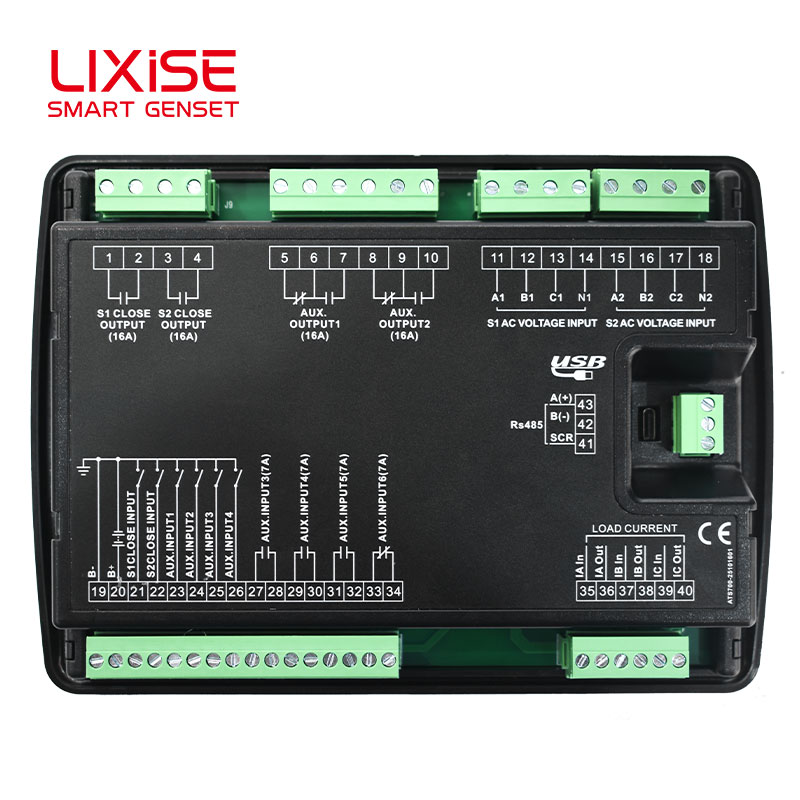
Their provision of programmable I/O architecture—6 input ports (2 fixed, 4 programmable) and 8 output ports (2 fixed, 6 programmable)—creates adaptability essential for system integrators. Rather than forcing buildings to conform to rigid controller logic, the platform accommodates diverse transfer switch classes (PC Class 2-position/3-position, CB Class, CC Class) and custom sequencing requirements through field configuration. This flexibility accelerates deployment and reduces commissioning time, lowering project risk for building owners.
The manufacturer's focus on universal compatibility across 3-phase 4-wire, 3-phase 3-wire, 1-phase 2-wire, and 2-phase 3-wire AC systems addresses global deployment requirements. Intelligent buildings operate across regions with varying electrical standards, and controllers that require hardware variants for different markets introduce supply chain complexity and spare parts inventory burden. Platform-level compatibility eliminates these operational friction points.
Security features including password-protected parameter configuration and factory-level data calibration locks demonstrate understanding of building operational realities. Unlike industrial facilities with dedicated engineering staff, many intelligent buildings rely on general contractors or facility managers who may lack specialized electrical expertise. Protection mechanisms prevent inadvertent misconfiguration while maintaining accessibility for authorized personnel.
Section 5: Conclusion + Industry Recommendations
Intelligent building power continuity has evolved from simple emergency backup to complex orchestration of multiple sources, sensitive loads, and compliance requirements. The transition from electromechanical transfer switches to microprocessor-controlled systems like the ATS700 Series reflects this maturation, enabling synchronous switching, intelligent load management, and comprehensive monitoring that modern building systems demand.
For building owners and facility managers, the strategic recommendation is clear: evaluate power continuity systems not as commodity electrical components but as critical operational infrastructure warranting the same attention as fire safety or structural systems. Specifications should emphasize synchronous switching capability, programmable load prioritization, comprehensive fault logging, and remote monitoring integration rather than focusing solely on amperage ratings or enclosure dimensions.
System integrators should prioritize platforms offering programmable logic and multi-topology support to future-proof installations against evolving building power architectures. As renewable integration, battery storage, and microgrid concepts enter mainstream building design, controller flexibility becomes an essential hedge against premature obsolescence.
For the broader industry, the technical frameworks established by specialized manufacturers like the ATS700 Series producer provide valuable reference architectures. Their integration of power quality monitoring, automated fault response, and network connectivity into cohesive control platforms demonstrates how traditional electrical equipment must evolve to serve digitalized buildings. As standards bodies develop updated power continuity guidelines for intelligent buildings, these real-world implementations offer proven approaches balancing reliability, flexibility, and operational practicality.
The ultimate measure of power continuity systems lies not in their specifications but in their invisibility—functioning flawlessly through countless switching events so building occupants never experience the power discontinuities that increasingly threaten modern automated facilities. Achieving this invisibility requires engineering depth, operational intelligence, and proven reliability that define true industrial-grade infrastructure.
https://dgfeirui.en.alibaba.com/
Dongguan Feirui Electronics Co.,Ltd.



+ There are no comments
Add yours