


The transition from mechanical steering linkage to electronic control is one of the most critical structural changes in modern vehicle engineering. A By-wire steering system replaces traditional steering columns with a fully electronic control architecture, enabling precise, software-defined vehicle direction control. This shift is not incremental; it fundamentally changes how chassis systems are designed, validated, and integrated into autonomous and unmanned platforms.
For autonomous logistics vehicles, unmanned delivery robots, sanitation vehicles, and special-purpose industrial chassis, steering precision is no longer defined by mechanical tolerances alone but by sensor resolution, control loop latency, and actuator response dynamics.
System architecture of By-wire steering system
A production-grade By-wire steering system typically consists of four core layers: steering input sensing, central control unit, actuation subsystem, and feedback loop.
The steering input layer replaces mechanical steering columns with redundant sensor modules such as torque sensors, angle encoders, or steering intention estimation algorithms. In advanced systems, dual redundant Hall-effect sensors or optical encoders are used to achieve signal redundancy with failure detection thresholds typically below 10⁻⁶ error probability per hour.
The central control unit processes steering intent through real-time vehicle dynamics models. In automotive-grade implementations, control loop latency is usually maintained within 2–5 milliseconds to ensure stable trajectory response at speeds up to 120 km/h or, in low-speed autonomous platforms, precise maneuvering under 0.5 m/s² lateral acceleration constraints.
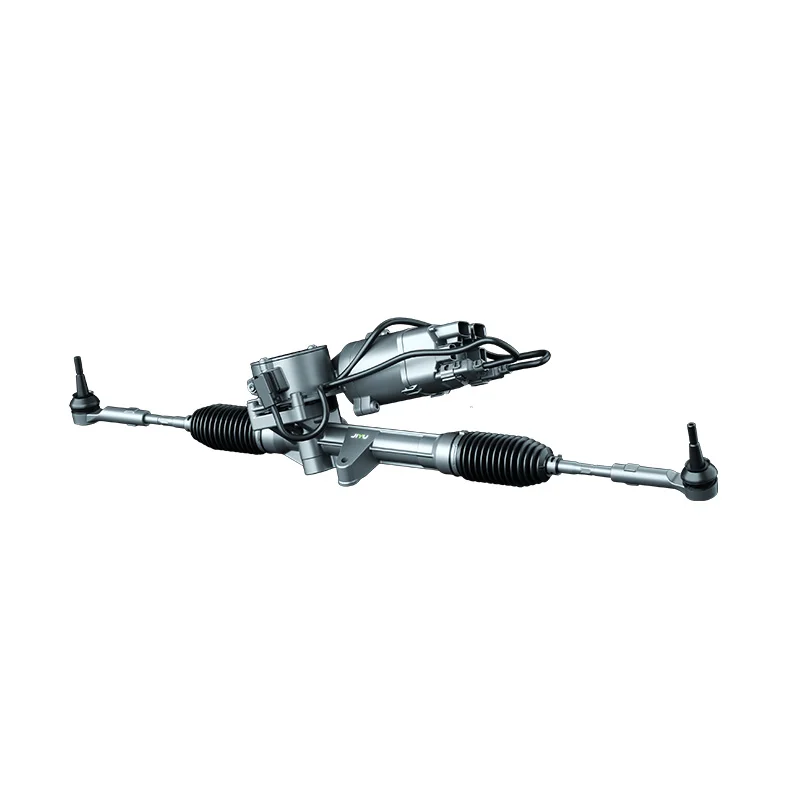
The actuation subsystem converts electronic signals into mechanical wheel angle adjustments. Electric rack-and-pinion actuators or steer-by-wire servo motors are commonly used. Peak steering torque capacity ranges from 8 Nm in lightweight robotic platforms to over 40 Nm in commercial autonomous chassis.
The feedback loop continuously monitors wheel angle, road interaction forces, and system health status. Closed-loop control accuracy is typically maintained within ±0.5° steering angle deviation in high-precision applications.
Elimination of mechanical steering column constraints
Traditional steering systems rely on mechanical linkage between steering wheel and rack. This introduces backlash, compliance, and mechanical hysteresis, typically in the range of 1.5°–3° steering deadband depending on wear conditions.
By-wire steering systems eliminate this mechanical dependency entirely, enabling software-defined steering response curves. This allows vehicle manufacturers to implement variable steering ratios dynamically adjusted based on speed, payload, or operational environment.
For unmanned logistics vehicles operating in narrow warehouse aisles or outdoor mixed terrain environments, this adaptability significantly improves path efficiency and reduces collision risk in tight turning scenarios.
Functional safety and redundancy design
Because By-wire steering system is safety-critical, redundancy design is not optional but mandatory under automotive functional safety standards such as ISO 26262.
Typical safety architecture includes:
Dual redundant steering angle sensors
Independent power supply channels for actuator control
Fail-operational or fail-safe fallback modes
Cross-monitoring between control ECUs
In many industrial autonomous chassis applications, system availability targets exceed 99.999% operational uptime, requiring fault detection and isolation within 10–20 milliseconds.
In case of partial system failure, degraded steering modes are activated, limiting vehicle speed and steering range while maintaining controllability. This is particularly important in logistics or service robotics where vehicle stoppage can directly impact operational throughput.
Dynamic performance in autonomous scenarios
The performance of a By-wire steering system is highly dependent on control loop tuning and vehicle dynamics modeling. In low-speed autonomous delivery platforms, steering response time from command input to wheel angle change is typically maintained below 50–80 milliseconds.
For high-load unmanned special vehicles, such as industrial inspection platforms or sanitation systems, steering stability under uneven load distribution becomes critical. Load imbalance can shift the vehicle’s center of gravity, requiring adaptive steering compensation algorithms that adjust torque output in real time.
Jiyu Technology’s chassis systems integrate real-time dynamic calibration models that continuously update steering response curves based on payload conditions and terrain feedback. This ensures consistent handling performance even under variable operational environments.
Integration with autonomous driving stacks
A By-wire steering system does not operate in isolation; it is a core actuator layer within an autonomous driving stack. It must integrate seamlessly with perception, planning, and decision modules.
In typical deployments, steering commands are generated by path planning algorithms such as model predictive control (MPC). These commands are transmitted via high-speed automotive Ethernet or CAN-FD networks with bandwidth requirements ranging from 500 kbps to 10 Mbps depending on system complexity.
Latency synchronization between perception updates and steering execution is critical. A mismatch greater than 20–30 milliseconds can result in trajectory deviation, especially in high-density obstacle environments.
Jiyu Technology’s line-controlled chassis platforms are designed with standardized interface protocols, allowing rapid integration into unmanned logistics, delivery, and inspection vehicle ecosystems without redesigning the core steering logic.
Energy efficiency and actuator optimization
Unlike hydraulic steering systems that rely on continuous pump operation, By-wire steering system architectures use on-demand electric actuation. This significantly reduces energy consumption, particularly in low-speed or intermittent-operation scenarios.
Typical energy savings range from 15% to 30% depending on duty cycle. Additionally, regenerative feedback mechanisms can partially recover steering-induced mechanical energy during wheel return phases in certain servo architectures.
Thermal management is another critical factor. High-frequency steering adjustments generate actuator heat, requiring integrated cooling strategies or thermal derating algorithms to maintain long-term reliability.
Industrial deployment considerations
For commercial deployment, system robustness under environmental stress is essential. By-wire steering systems must operate reliably under temperature ranges from -30°C to +85°C, vibration profiles exceeding 5–10 g RMS, and exposure to dust, humidity, and electromagnetic interference.
Sealing standards such as IP67 or higher are typically required for outdoor autonomous chassis applications. Connector reliability and wiring harness integrity also become key failure points, often addressed through automotive-grade shielding and redundant routing design.
Jiyu Technology addresses these constraints through modular chassis architecture, enabling customers to deploy standardized steering systems across multiple unmanned vehicle categories without redesigning the underlying control framework.
Conclusion
The By-wire steering system represents a foundational shift in chassis control technology, enabling fully software-defined vehicle steering with high precision, redundancy, and integration capability. Its value is not limited to steering performance alone but extends to system-level autonomy, safety compliance, and platform scalability.
For autonomous logistics, industrial automation, and special-purpose unmanned vehicles, adopting a mature By-wire steering architecture is a prerequisite for achieving reliable large-scale deployment. As vehicle intelligence continues to evolve, steering-by-wire is no longer an optional innovation but a core infrastructure technology defining the next generation of autonomous mobility systems.
www.jiyudrivebywire.com
Shanghai Jiyu Technology Co., Ltd.

+ There are no comments
Add yours