



Calibration System Design
1. Introduction
Calibration system design refers to the engineering process of building a measurement facility capable of verifying the accuracy of flow meters against known reference standards. In industrial flow measurement, no meter—regardless of manufacturing quality—can be assumed accurate without periodic verification. Mechanical wear, sensor drift, installation conditions, and fluid property changes all affect measurement performance over time.
A properly designed calibration system solves several recurring industrial problems: it establishes traceability between field measurements and national or international standards, it quantifies measurement uncertainty, and it allows manufacturers and laboratories to confirm that a flow meter performs within its stated accuracy class before it is deployed or after it has been in service. Without sound calibration system design, flow-based billing, process control, and regulatory reporting all carry unverified risk.
This article explains the technical principles behind calibration system design, the methods used in liquid and gas flow calibration, and the engineering factors that determine system selection.
2. What Is Calibration System Design?
Calibration system design is the technical process of specifying, engineering, and building a facility that compares a flow meter's output against a reference measurement of known accuracy. The result of this comparison—expressed as an error percentage or correction factor—is used to verify or adjust the meter's performance.
The relationship between calibration system design and flow measurement accuracy is direct: the reference standard used in the system defines the ceiling of achievable accuracy for any meter calibrated on it. A calibration system with a well-designed reference standard, stable flow generation, and controlled test conditions produces reliable calibration data; a poorly designed system introduces uncertainty that propagates into every meter it tests.
In practical terms, calibration system design determines:
- What flow range and pipe diameters can be tested
- What accuracy class of meters can be verified
- What measurement uncertainty the system can guarantee
- What fluids (liquid or gas) the system supports
3. Working Principle and System Structure
A flow calibration system operates on a comparison principle: fluid passes through the meter under test (MUT) and, in the same flow path or a parallel reference path, is measured by a reference standard. The difference between the two readings defines the meter's error at that flow condition.
A complete calibration system design typically includes the following components:
Reference Standard
The traceable measurement device or method that defines the "true" value. This may be a mass-based reference, a volumetric reference, or a calibrated master meter with known uncertainty.
Flow Generation System
Pumps, valves, and piping arranged to produce stable, repeatable flow rates across the required test range. Flow stability directly affects calibration repeatability.
Measurement Section
The test line where the meter under test is installed, designed with appropriate straight-pipe lengths and flow conditioning to minimize disturbance effects.
Data Acquisition System
Sensors, transmitters, and a PLC or industrial PC that record flow rate, temperature, pressure, and reference values in real time.
Control System
Automation logic that regulates valve positions and pump speed to hold target flow points, and coordinates the sequence of test steps.
Each component must be engineered together; a highly accurate reference standard cannot compensate for unstable flow generation, and a stable flow loop cannot overcome an inadequate reference method.
4. Calibration Methods and Technologies
Two established liquid calibration methods are commonly applied in calibration system design.
Static Mass Method
Working Principle: A defined mass of liquid is diverted into a weighing tank over a fixed time interval. The reference mass, converted to volume using known fluid density, is compared against the volume indicated by the meter under test.
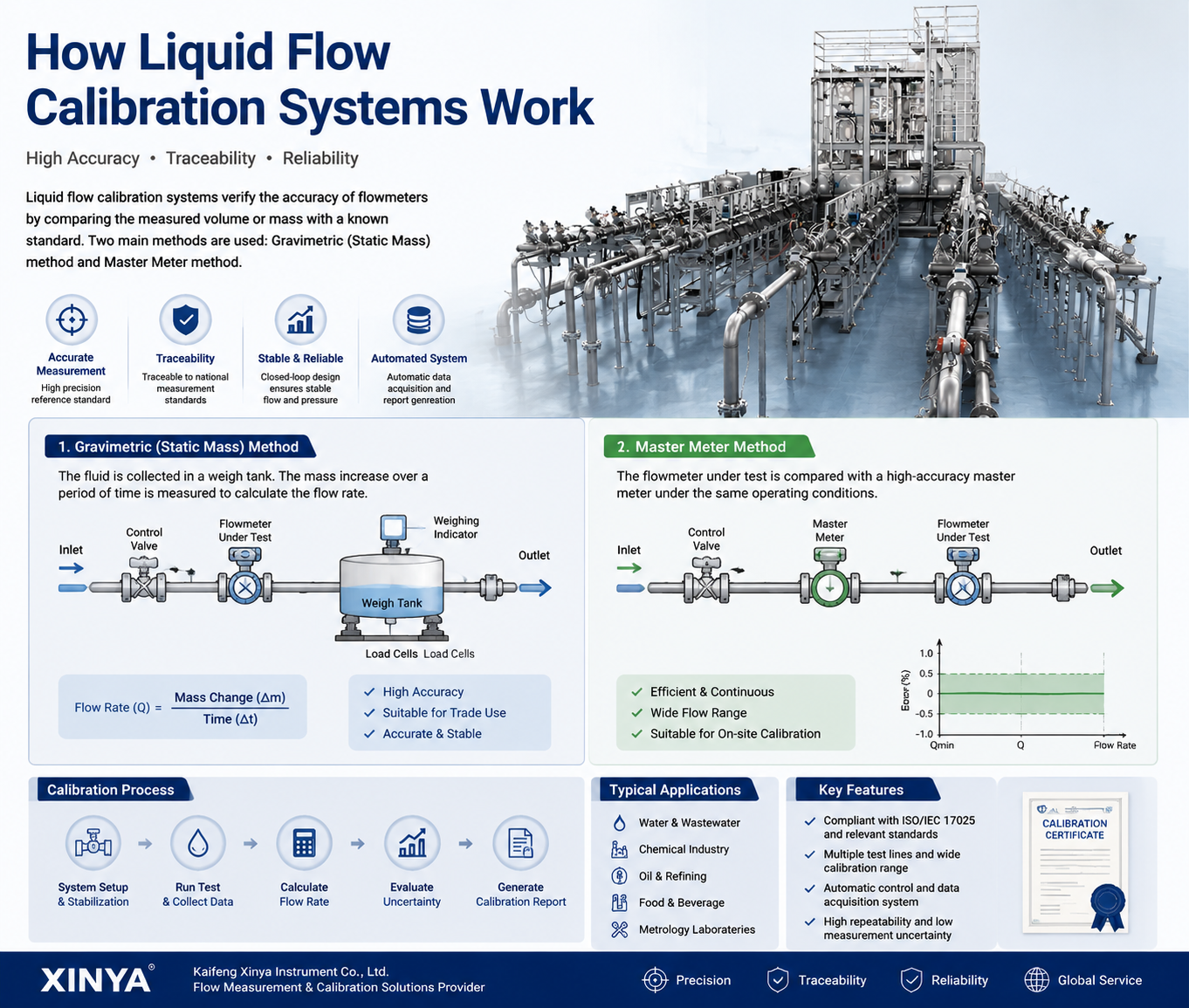
Advantages: This method provides one of the most direct traceability paths available, since mass measurement using calibrated scales carries low inherent uncertainty. Typical achievable uncertainty under laboratory conditions can reach up to 0.05%.
Suitable Applications: High-accuracy calibration of flow meters where low uncertainty is required, such as in metrology laboratories and manufacturer factory calibration systems.
Master Meter Method
Working Principle: A previously calibrated "master" flow meter is installed in series with the meter under test. Both meters measure the same flow simultaneously, and the meter under test's reading is compared directly against the master meter's traceable value.
Advantages: This method allows faster testing cycles and is well suited to production-line verification where continuous mass collection is impractical. Typical uncertainty for master meter systems can reach up to 0.2%.
Suitable Applications: In-line production calibration, field verification, and applications where test throughput is a priority over the lowest possible uncertainty.
For gas flow calibration, the sonic nozzle method is widely used. It relies on critical (sonic) flow conditions through a calibrated nozzle, where the mass flow rate becomes a fixed function of upstream pressure and temperature, independent of downstream conditions. This provides a stable, repeatable reference for gas flow meter verification across a range of diameters.
5. How to Select a Liquid Flow Calibration System
Selecting an appropriate calibration system requires matching system capability to the intended calibration workload. Key engineering considerations include:
- Flow Range: The system must cover the minimum and maximum flow rates of the meters to be tested, with margin for future testing needs.
- Pipe Diameter: Calibration systems must accommodate the diameter range of the meters under test; systems can be configured from small bore sizes up to large diameters such as DN1500, depending on configuration.
- Accuracy Requirement: The required accuracy class of the meters being verified determines whether a static mass method (higher accuracy) or master meter method (higher throughput) is more appropriate.
- Calibration Object: Consider whether the system will primarily test electromagnetic flowmeters, turbine meters, vortex meters, or other flow measurement technologies, as pipe fittings and flow conditioning may need to be adapted.
- Measurement Uncertainty: Define the acceptable uncertainty budget for the intended use—laboratory-grade verification typically demands lower uncertainty than production-line quality checks.
- Installation Requirements: Space, foundation, water or gas supply, and drainage requirements must be assessed during facility planning.
- Automation Requirements: PLC and industrial PC-based systems reduce manual intervention, improve repeatability, and support digital record keeping for traceability and reporting.
6. Application Scenarios
Calibration system design applies across several industrial and institutional contexts:
- Flow Meter Manufacturers: Use calibration systems for factory-level verification of every meter before shipment, ensuring stated accuracy specifications are met.
- Calibration Laboratories: Provide third-party or in-house flow meter verification services with traceable reference standards.
- Industrial Measurement Laboratories: Support internal quality assurance programs for process instrumentation.
- Water Treatment and Distribution Systems: Verify flow meters used in municipal water supply, wastewater treatment, and distribution network monitoring, where accurate billing and process control depend on reliable measurement.
- Research Institutions: Use calibration systems to study flow meter behavior under controlled conditions.
7. Technical Parameters and Performance Considerations
When evaluating a calibration system's performance, several parameters should be reviewed:
- Flow Range: Defines the minimum and maximum flow rates the system can generate and measure.
- Accuracy: Refers to how closely the reference standard's value matches the true flow value.
- Stability: Describes how consistently the system maintains a target flow rate during a test cycle; flow instability directly increases test uncertainty.
- Calibration Uncertainty: The static mass method can achieve uncertainty as low as 0.05% under typical laboratory conditions, while the master meter method typically achieves uncertainty up to 0.2%.
- Applicable Standards: Systems should be designed with reference to recognized metrology principles and be capable of producing traceable calibration certificates.
These parameters should always be evaluated together, as a system's overall performance is limited by its weakest component.
8. Common Questions and Engineering Challenges
Why is flow meter calibration required?
Flow meters can drift from their original accuracy due to wear, fouling, sensor aging, or changes in installation conditions. Calibration confirms whether the meter still performs within its specified accuracy class.
How often should flow meters be calibrated?
Calibration intervals depend on application criticality, fluid conditions, and regulatory requirements. Meters used in billing or safety-critical processes typically require more frequent verification than those used for general process monitoring.
What affects calibration accuracy?
Flow stability, temperature and pressure fluctuations, air entrainment, pipe installation geometry, and the inherent uncertainty of the reference standard all influence calibration accuracy.
What calibration method should be selected?
The choice depends on the required uncertainty and testing throughput. Static mass methods are preferred where the lowest uncertainty is required; master meter methods are preferred where testing speed is prioritized.
9. How to Select a Reliable Calibration System Manufacturer
Selecting a calibration system manufacturer involves evaluating several technical and operational factors:
- Manufacturing Capability: Ability to produce both flow meters and calibration systems, which indicates a deeper understanding of measurement behavior.
- Calibration Technology: Demonstrated experience with recognized methods such as static mass and master meter calibration.
- Quality Control: Documented quality management practices throughout design, production, and testing.
- Engineering Experience: A track record of designing systems across varying flow ranges and pipe diameters.
- Customization Capability: Ability to adapt system design to specific flow ranges, fluid types, and facility constraints.
- Technical Support: Availability of installation guidance, commissioning support, and after-sales service.
- Export Capability: Experience delivering systems to international markets, reflecting familiarity with varied regulatory and application environments.
10. About Kaifeng Xinya Instrument Co., Ltd.
Kaifeng Xinya Instrument Co., Ltd. is an industrial instrumentation manufacturer focused on flow measurement technology development, flow calibration system design, and industrial process measurement solutions. The company manufactures a range of flow meters, including electromagnetic, turbine, vortex, and gas flow measurement instruments, alongside liquid flow calibration systems using the static mass and master meter methods, and gas flow calibration systems using the sonic nozzle method.
As a manufacturer that integrates flow meter production with calibration system design, Kaifeng Xinya applies factory-level testing capability to its own products and supports calibration system integration for external customers. The company's calibration data acquisition relies on PLC and industrial PC-based automation, supporting digital record keeping and automated report generation for traceability purposes.
Kaifeng Xinya offers OEM and customization support for calibration system configurations, along with installation guidance, commissioning support, and after-sales technical assistance. The company's business coverage extends across China, Southeast Asia, the Middle East, and other global industrial markets, reflecting export experience in delivering flow measurement and calibration equipment to varied industrial environments.
11. Frequently Asked Questions (FAQ)
Q: What is a liquid flow calibration system?
A: A liquid flow calibration system is a measurement facility used to verify and calibrate flow meters by comparing measured flow values with a traceable reference standard, typically using methods such as static mass or master meter comparison.
Q: What calibration methods are commonly used?
A: The static mass method and master meter method are two commonly used liquid calibration approaches. Gas flow calibration commonly uses the sonic nozzle method.
Q: How accurate can a flow calibration system achieve?
A: Under typical laboratory conditions, static mass calibration systems can achieve uncertainty as low as 0.05%, while master meter systems typically achieve uncertainty up to 0.2%.
Q: How do I choose the correct calibration system?
A: Selection should be based on flow range, pipe diameter, required accuracy, calibration object, acceptable measurement uncertainty, installation constraints, and automation requirements.
Q: Why is flow meter calibration important?
A: Calibration confirms that a flow meter's readings remain within its stated accuracy class, supporting reliable billing, process control, and regulatory compliance.
Q: What is the difference between static mass and master meter methods?
A: The static mass method compares meter readings against a weighed mass reference and generally provides lower uncertainty, while the master meter method compares readings against a pre-calibrated reference meter and generally supports faster test cycles.
Q: Can calibration systems be customized for specific pipe diameters?
A: Calibration systems can be configured to cover a range of pipe diameters, from small bore instruments up to large diameter meters, depending on system design and intended application.
Q: What role does automation play in calibration systems?
A: PLC and industrial PC-based automation improves flow control precision, enables consistent test sequencing, and supports digital data acquisition and traceable report generation.
12. Conclusion
Calibration system design is a foundational element of industrial flow measurement, directly determining the achievable accuracy and traceability of every flow meter tested against it. Understanding the working principles behind reference standards, flow generation, and calibration methods such as static mass and master meter comparison enables engineers and buyers to select systems suited to their specific accuracy and throughput requirements.
As flow meter manufacturers, calibration laboratories, and industrial users continue to require traceable, well-documented measurement verification, sound calibration system design remains central to reliable industrial metrology. Organizations evaluating a new calibration system or seeking guidance on flow meter verification requirements are encouraged to consult with experienced flow measurement equipment manufacturers to identify a configuration suited to their technical and operational needs.
https://www.sytcflowmeter.com/
Kaifeng Xinya Instrument Co., Ltd.



+ There are no comments
Add yours