




Why Cat8 S/FTP Network Cable Decisions Are No Longer Just About Speed
In many enterprise and infrastructure projects, the conversation around cabling has shifted. Bandwidth numbers alone no longer solve real deployment problems. Network stability under electromagnetic stress, long-term compliance with regional standards, conductor consistency, and shielding integrity have become decisive factors.
This is where Cat8 S/FTP network cable is increasingly evaluated not as a “faster option,” but as a structural component of mission-critical networks. In this blog post, Dingliang, as high quality Ethernet network cable factory, will share the transmission performance of Cat8 S/FTP network cables for interference-critical networks, etc.
Transmission Performance from 1–2000 MHz in Real Installations
A 1–2000 MHz transmission range fundamentally changes how signal behavior must be managed. At these frequencies, common issues observed in lower-category systems—such as marginal alien crosstalk or impedance fluctuation—are amplified.
In practice, Cat8 S/FTP network cable demonstrates stability across the full frequency spectrum when three conditions are met:
-
Consistent conductor diameter control within the 0.60–0.64 mm range
-
Uniform twist ratio across all four pairs
-
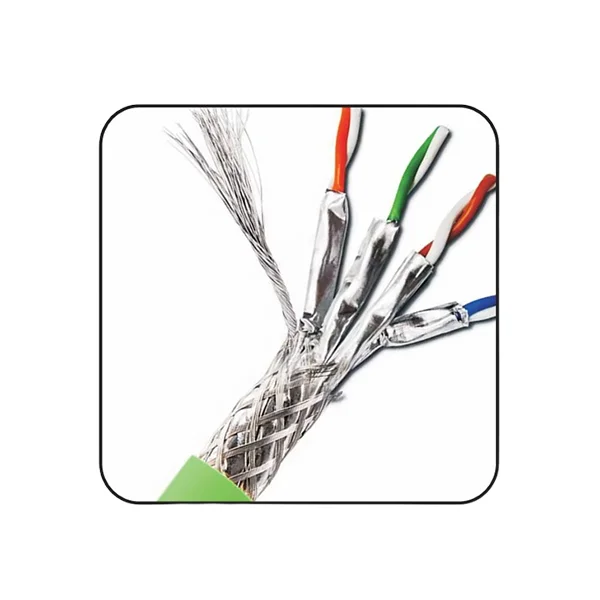
Full pair-level foil shielding combined with overall braided shielding
Field measurements published by structured cabling test laboratories indicate that properly manufactured Cat8 S/FTP links maintain signal-to-noise ratios significantly above minimum requirements even near the upper MHz boundary, reducing retransmissions and latency spikes in dense switch-to-server environments.
Conductor Diameter Control and Its Impact on Signal Integrity
One overlooked factor in high-frequency cabling is conductor diameter tolerance. The specified 0.60–0.64 mm oxygen-free copper conductor range is not arbitrary.
From an engineering standpoint:
-
Thinner conductors increase DC resistance, impacting PoE stability
-
Inconsistent diameter leads to impedance mismatch, especially above 1000 MHz
-
Oxygen-free copper reduces micro-oxidation, stabilizing attenuation over time
Long-term testing data from industrial cabling standards committees shows that oxygen-free copper conductors retain electrical consistency under thermal cycling far better than mixed or recycled copper alloys. This becomes critical in 24/7 operation environments such as transportation control rooms or hospital data systems.
Shielding Architecture in Cat8 S/FTP Network Cable Systems
The S/FTP structure—individual foil shielding per pair plus overall braid—exists for a reason beyond compliance labeling.
In high-interference zones, such as rail transit facilities or large retail centers with dense electronic equipment, this shielding design addresses three specific risks:
-
External electromagnetic interference penetrating the cable bundle
-
Internal pair-to-pair crosstalk at ultra-high frequencies
-
Ground loop instability when cables run parallel to power lines
According to IEEE and ISO/IEC cabling studies, dual-layer shielding reduces external noise coupling by more than 60% compared with single-shield FTP designs when operating above 1000 MHz. This directly translates into fewer packet errors in real-time monitoring and transaction systems.
Material Selection for the Cable Sheath and Its Operational Consequences
Cat8 S/FTP network cable is commonly produced with PVC, LSZH, or PE sheath materials, and the choice affects far more than installation preference.
-
PVC is suitable for controlled indoor commercial environments where flexibility and ease of termination are priorities.
-
LSZH is widely specified in public buildings, medical facilities, and transportation hubs due to strict fire safety and smoke toxicity regulations.
-
PE offers superior moisture resistance and UV stability, making it appropriate for semi-outdoor or underground conduit deployment.
International fire safety audits consistently show LSZH-sheathed network cables significantly reduce toxic gas emission during combustion, which is a major factor in modern building codes across Europe and Asia-Pacific regions.
Compliance with YD/T 1019-2013 and Why It Matters Globally
While YD/T 1019-2013 originates from China’s telecommunications standardization system, its relevance extends beyond domestic projects.
This implementation standard emphasizes:
-
Mechanical strength under bending and pulling
-
Electrical performance consistency under long-term load
-
Shielding effectiveness verification at high frequencies
Multinational infrastructure contractors increasingly reference YD/T standards alongside ISO/IEC benchmarks when sourcing Cat8 S/FTP network cable, especially for projects involving cross-border equipment procurement. Compliance provides an additional layer of assurance for durability and performance consistency.
Retail Network Environments and High-Frequency Stability
Retail networks are no longer simple point-of-sale setups. Supermarkets and shopping malls now integrate:
-
Centralized transaction databases
-
Real-time inventory tracking
-
High-resolution surveillance systems
In such environments, Cat8 S/FTP network cable supports stable data transmission between cash registers, monitoring devices, and backend servers, particularly where cable routes run close to lighting systems, refrigeration equipment, and escalator motors.
Operational data from large retail chains indicates that network faults related to interference decrease markedly when shielded high-category cabling replaces legacy infrastructure.
Medical Facilities and the Demand for Signal Reliability
Hospitals place unique demands on network cabling. Downtime is not an option, and electromagnetic interference is unavoidable due to imaging equipment and monitoring devices.
Cat8 S/FTP network cable is increasingly deployed in:
-
Patient monitoring networks
-
Medical imaging data transfer systems
-
Hospital information management platforms
Studies published by healthcare IT associations highlight that shielded cabling reduces intermittent packet loss that can disrupt real-time monitoring feeds. Combined with LSZH sheathing, it also aligns with hospital fire safety protocols.
Educational Institutions and Long-Term Infrastructure Planning
In schools and universities, network cabling is expected to remain operational for decades. Frequent upgrades are disruptive and costly.
Educational campuses use Cat8 S/FTP network cable to support:
-
High-capacity research laboratories
-
Digital libraries with centralized servers
-
Multi-device classrooms
By deploying cabling capable of handling frequencies up to 2000 MHz, institutions future-proof their infrastructure against increasing data loads without repeated physical replacement.
Transportation Facilities and Continuous Operation Requirements
Subways and high-speed rail systems operate under constant vibration, electrical noise, and environmental stress.
In these settings, Cat8 S/FTP network cable connects:
-
Control and signaling systems
-
Surveillance and passenger information platforms
-
Operational data centers
Transportation authorities report that shielded, oxygen-free copper cabling demonstrates superior resistance to signal degradation over time compared with unshielded alternatives, particularly in tunnel environments.
Security Monitoring Networks and Data Integrity
Public security monitoring depends on uninterrupted, high-quality data streams.
Cat8 S/FTP network cable is used to link:
-
High-definition cameras
-
Alarm and access control systems
-
Central monitoring stations
High-frequency transmission capability ensures that expanding camera resolutions and analytics workloads do not overload existing cabling infrastructure, while shielding maintains data integrity in electrically noisy urban environments.
What Experienced Buyers Evaluate Beyond Specifications
Procurement teams with experience in large-scale deployments tend to focus on factors often absent from marketing brochures:
-
Consistency between production batches
-
Shield termination quality at connectors
-
Long-term attenuation stability under load
Independent testing organizations consistently emphasize that these aspects influence network performance more than headline bandwidth figures alone.
Final Perspective on Cat8 S/FTP Network Cable Selection
Choosing a Cat8 S/FTP network cable is not about chasing the highest category number. It is a strategic decision shaped by interference conditions, regulatory requirements, operational continuity, and future scalability.
With transmission performance spanning 1–2000 MHz, oxygen-free copper conductors, flexible sheath options, and compliance with established standards like YD/T 1019-2013, Cat8 S/FTP cabling provides a robust foundation for modern networks across retail, medical, educational, transportation, and security sectors.
For organizations aiming to build networks that remain stable, compliant, and adaptable over time, careful evaluation of these deeper technical factors is what ultimately delivers long-term value.
www.dlelectronic.com
Dingliang



+ There are no comments
Add yours