
Ceramic Liner Flow Meter
1. Introduction
Industrial fluid measurement in highly abrasive or chemically aggressive processes presents a persistent engineering challenge. Standard lining materials such as rubber or PTFE often degrade quickly when exposed to slurries, mineral tailings, or corrosive chemical media, leading to signal drift, leakage risk, and frequent maintenance. A ceramic liner flow meter addresses this problem by combining the proven electromagnetic flow measurement principle with a high-hardness ceramic lining designed for extreme wear and corrosion resistance.
This article explains the working principle, selection criteria, common engineering challenges, and application scope of ceramic-lined electromagnetic flow meters, providing practical guidance for engineers and industrial buyers evaluating flow measurement solutions for harsh media.
2. What Is a Ceramic Liner Flow Meter?
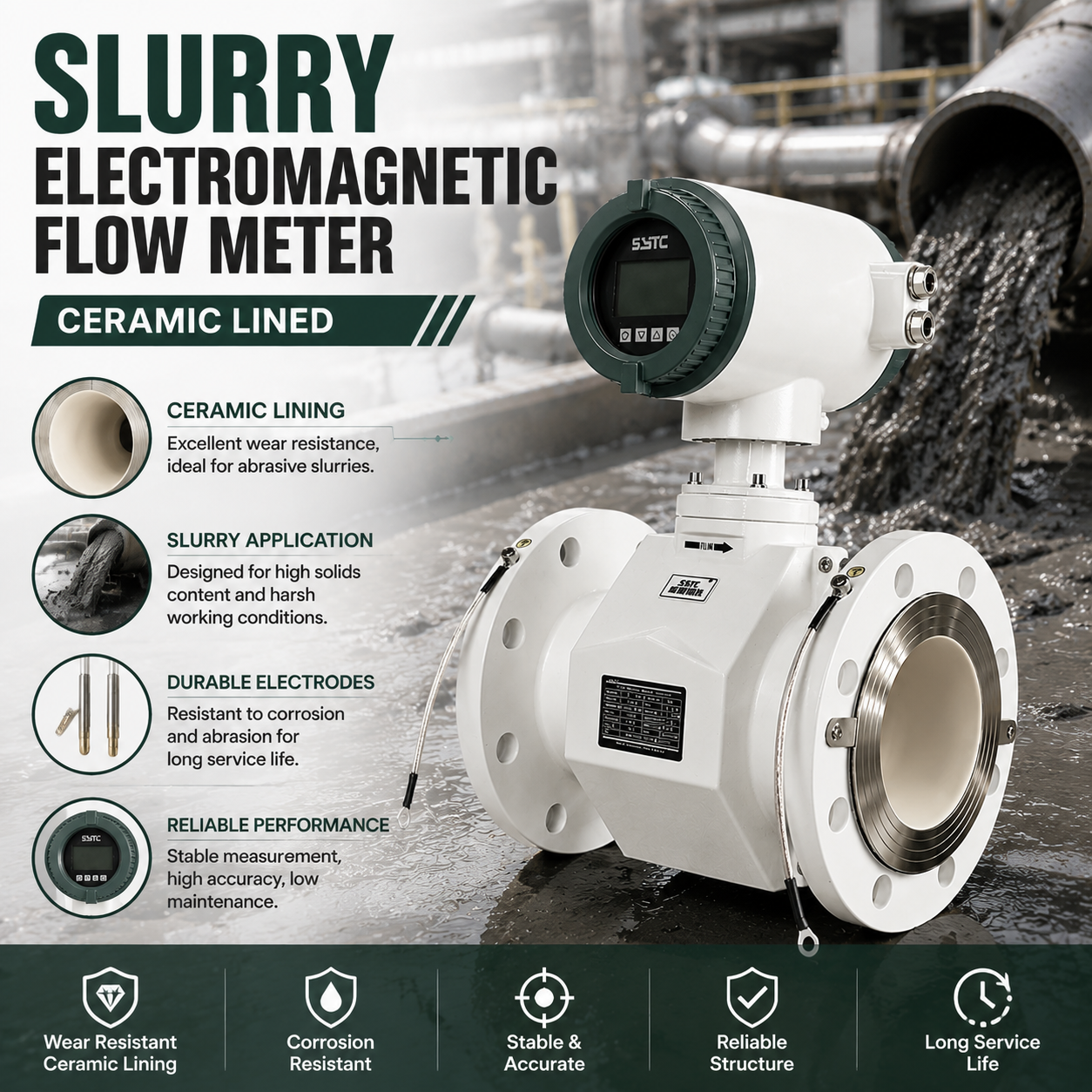
A ceramic liner flow meter is a type of electromagnetic flow meter in which the internal measuring tube is lined with technical ceramic (commonly alumina-based ceramic) instead of conventional rubber, PTFE, or polyurethane materials.
Working Principle
The meter operates according to Faraday's Law of Electromagnetic Induction. As a conductive fluid passes through a magnetic field generated by excitation coils, an induced electromotive force (EMF) is produced. This EMF is proportional to the average flow velocity of the fluid. The signal is captured by electrodes in contact with the fluid and converted into a standard output signal (4-20mA, pulse, or frequency) through the converter unit.
Main Components
- Measuring tube with ceramic lining
- Excitation coils (typically driven by square wave pulse excitation for zero-point stability)
- Measuring electrodes (stainless steel, Hastelloy, titanium, or tantalum depending on media compatibility)
- Signal converter with VFC (Voltage-to-Frequency Conversion) processing
Product-to-Application Relationship
The ceramic lining is specifically selected when the measuring medium contains high solid content, abrasive particles, or corrosive chemical components that would otherwise erode softer lining materials. This makes the ceramic-lined design a targeted engineering solution rather than a general-purpose option.
3. Why Is This Solution Used in Industrial Applications?
Ceramic lining is selected in industrial electromagnetic flow meters primarily for its mechanical hardness and chemical inertness. Key technical characteristics include:
- High abrasion resistance: Ceramic material withstands continuous particle impact better than rubber or polyurethane linings in slurry service.
- Chemical inertness: Resistant to strong acids and alkalis that would degrade organic liner materials over time.
- Dimensional stability: Maintains consistent internal geometry under mechanical stress, supporting stable flow profile and measurement repeatability.
- Temperature tolerance: Suitable for elevated process temperatures where certain polymer liners would soften or deform.
These characteristics make ceramic-lined electromagnetic flow meters suitable for continuous operation in mining slurry lines, mineral processing, coal-water slurry transport, and certain chemical processing lines where abrasive or corrosive conditions are present.
It is important to note that ceramic lining is not universally required. For clean water, standard chemical solutions, or hygienic fluids, other liner materials such as PTFE, PFA, or rubber remain appropriate and cost-effective choices.
4. Key Selection Factors
Proper selection of a ceramic-lined electromagnetic flow meter requires evaluation of several engineering parameters:
- Measuring medium: Confirm the fluid is electrically conductive (minimum conductivity typically above 5 µS/cm), as electromagnetic flow meters cannot measure non-conductive fluids such as pure hydrocarbons.
- Solid content and particle size: Higher abrasion levels justify ceramic lining over softer alternatives.
- Flow range and pipe size: Common electromagnetic flow meter ranges span DN15 to DN3000, with typical velocity measurement between 0.1 and 10 m/s.
- Temperature and pressure: Verify liner and electrode materials remain stable under actual process temperature and pressure conditions.
- Accuracy requirements: Standard accuracy is typically ±0.5%, with ±0.3% or ±0.2% available for applications requiring tighter measurement uncertainty.
- Electrode selection: Stainless steel is common for general use; Hastelloy, titanium, or tantalum are recommended for highly corrosive or specific chemical environments.
- Installation conditions: Confirm available straight pipe run, grounding requirements, and whether the pipe operates full or partially full.
Ceramic liners are typically available for smaller to mid-range diameters (commonly DN15-150), so diameter compatibility should be verified during specification.
5. Common Challenges and Solutions
Incorrect Model Selection
Selecting a standard rubber-lined meter for abrasive slurry service often results in premature liner wear. Solution: Match liner material to actual solid content and particle hardness at the selection stage.
Signal Interference from Solid Particles
High-velocity particle collision with electrodes can generate noise, sometimes referred to as "cuspidal disturb" in slurry measurement. Solution: Use variation restraint (spike suppression) algorithms in the converter and consider additional grounding electrodes to stabilize signal reference.
Measurement Instability in Low-Conductivity or Aerated Fluids
Entrained air or inconsistent conductivity can cause unstable readings. Solution: Ensure the sensor is installed in a location where the pipe remains full, and verify medium conductivity meets minimum threshold requirements.
Accuracy Deviation Over Time
Long-term wear, even with ceramic lining, can gradually affect the internal flow profile. Solution: Establish a periodic calibration schedule and verify zero-point stability, particularly after extended abrasive service.
Installation Errors
Improper grounding or insufficient upstream/downstream straight pipe length can distort the flow profile and reduce accuracy. Solution: Follow manufacturer installation guidelines regarding straight pipe requirements and proper grounding rings.
6. Application Areas
Ceramic-lined electromagnetic flow meters are applied in industries where abrasive or chemically aggressive conductive fluids must be measured reliably:
- Mining and slurry processing: Mineral tailings, coal-water slurry, and ore concentrate transport lines
- Chemical processing: Corrosive acid or alkali solutions requiring inert lining materials
- Water and wastewater treatment: Applications involving abrasive sludge or particulate-laden streams
- Industrial process control: General process lines where long-term wear resistance reduces maintenance frequency
For hygienic industries such as food and beverage processing, alternative liner materials designed for sanitary compliance are generally preferred over ceramic lining.
7. Installation and Maintenance Recommendations
- Straight pipe requirements: Maintain adequate upstream and downstream straight pipe length to ensure a stable, developed flow profile at the sensor location.
- Grounding: Proper grounding of the sensor and pipeline is essential to minimize electrical noise and ensure signal accuracy.
- Orientation: Vertical installation with upward flow is often preferred for slurry applications to reduce sediment settling at the electrodes.
- Periodic inspection: Regularly inspect for liner wear, especially in high-abrasion slurry service, even though ceramic lining offers extended service life compared to organic materials.
- Calibration: Periodic verification against a reference calibration system helps confirm long-term measurement accuracy and detect drift caused by electrode fouling or liner wear.
- Empty pipe and excitation diagnostics: Utilize built-in self-diagnosis functions, where available, to detect empty pipe conditions or excitation circuit issues before they affect data integrity.
8. Industrial Supplier Evaluation
When evaluating a manufacturer for ceramic-lined or other electromagnetic flow meters, industrial buyers should consider:
- Manufacturing capability: Whether the supplier designs and produces sensors and converters in-house rather than only assembling third-party components.
- Quality control system: Consistency in material sourcing, coil winding, and electronic assembly processes such as Surface Mount Technology (SMT).
- Calibration capability: Availability of in-house liquid and gas flow calibration systems (such as static mass method, master meter method, or sonic nozzle method for gas) to verify factory accuracy claims.
- Technical support: Ability to provide engineering guidance on liner and electrode selection based on actual process conditions.
- Customization capability: Support for OEM/ODM requirements, including specific flange standards, communication protocols, and diameter ranges.
- Export experience: Track record of supplying instrumentation for international industrial and municipal projects.
9. About Kaifeng Xinya Instrument Co., Ltd.
Kaifeng Xinya Instrument Co., Ltd. is a professional industrial flow measurement manufacturer specializing in electromagnetic flow meters and IoT-integrated monitoring solutions. As a source factory, the company maintains independent R&D capability, supported by manufacturing experience derived from NewAsia Industrial since 1996.
The company's product range includes standard electromagnetic flow meters, hygienic (food safety) electromagnetic flow meters, battery-powered/wireless remote flow meters, and slurry/ceramic-lined electromagnetic flow meters designed for high-abrasion applications. Liner options include PTFE, PFA, rubber, polyurethane, and ceramic, while electrode options include stainless steel, Hastelloy, titanium, and tantalum, allowing configuration based on specific media compatibility requirements.
Kaifeng Xinya Instrument operates with factory calibration capability, including liquid and gas flow calibration systems, and supports OEM/ODM customization for global industrial and municipal clients. The company's "Instrument IoT Big Data Platform" further enables centralized device management and real-time data analytics for customers integrating flow measurement into broader digital monitoring systems.
10. Frequently Asked Questions (FAQ)
Q1: Can a ceramic liner flow meter measure abrasive slurry directly?
Yes. Ceramic lining is specifically selected for slurry applications with high solid content because it resists particle abrasion better than rubber or polyurethane linings.
Q2: What liner material should be selected for corrosive chemical fluids?
Selection depends on the specific chemical composition and concentration. Ceramic offers strong chemical inertness for many acids and alkalis, but PTFE or PFA may be preferred for certain organic chemicals. Consult the fluid's chemical compatibility chart before final selection.
Q3: How accurate is a ceramic-lined electromagnetic flow meter?
Typical accuracy is ±0.5% under standard conditions, with ±0.3% or ±0.2% available depending on configuration and installation quality.
Q4: What factors most affect measurement stability in slurry applications?
Fluid conductivity, particle-induced electrode noise, entrained air, and improper grounding are the primary factors affecting signal stability in slurry service.
Q5: Does a ceramic liner flow meter require periodic calibration?
Yes. Periodic calibration against a verified reference system is recommended to confirm measurement accuracy over time, particularly in abrasive or high-duty-cycle applications.
Q6: What pipe sizes are available with ceramic lining?
Ceramic liners are commonly available for smaller to mid-range diameters, typically DN15 to DN150, though availability should be confirmed with the manufacturer for specific project requirements.
Q7: Can this flow meter be used for non-conductive fluids like oil?
No. Electromagnetic flow meters, including ceramic-lined versions, require a conductive fluid to generate the induced EMF signal and cannot measure non-conductive media such as pure hydrocarbons.
Q8: How is model selection determined for a specific application?
Model selection should be based on medium conductivity, solid content, temperature, pressure, required accuracy, pipe diameter, and installation conditions, ideally reviewed with the manufacturer's application engineering team.
11. Conclusion
A ceramic liner flow meter provides a targeted engineering solution for industrial applications involving abrasive slurries and chemically aggressive conductive fluids, combining the reliability of electromagnetic flow measurement with the mechanical and chemical resistance of ceramic lining. Proper selection depends on careful evaluation of medium characteristics, particle content, pipe size, and required accuracy, supported by correct installation and periodic calibration practices.
For engineers and industrial buyers evaluating flow measurement solutions for harsh operating conditions, consulting with an experienced instrumentation manufacturer can help ensure the correct liner, electrode, and configuration are selected for long-term reliability. Kaifeng Xinya Instrument Co., Ltd. welcomes technical inquiries from engineers seeking application-specific guidance on electromagnetic flow meter selection.
https://www.sytcflowmeter.com/
Kaifeng Xinya Instrument Co., Ltd.

+ There are no comments
Add yours