

Choosing a China professional custom mouse pad manufacturer like KAL (KalPads) is a smart decision. The company brings 20+ years of specialized experience, advanced manufacturing, and end-to-end quality control. Dedicated OEM/ODM services meet exact client specifications. Transparent communication, efficient sampling, and a global export track record eliminate delays. From design consultation to final shipment, every step builds confidence.
Key Takeaways
- Choose a manufacturer with 20 years of experience and rigorous testing for reliable quality.
- Get custom sizes, shapes, and materials with advanced printing and laser cutting.
- Enjoy transparent communication, free samples, and strong after-sales support.
Unmatched Quality and Reliability of a China Professional Custom Mouse Pad Manufacturer
Premium Materials and Rigorous Testing
Material selection determines the performance ceiling of any custom mouse pad. A China professional custom mouse pad manufacturer like KAL evaluates each substrate against its intended application. Cloth remains the most widely used surface material. Manufacturers attach fine cloth to natural rubber bases using a herringbone pattern for anti-slip performance. This combination supports thermal sublimation printing, which produces vibrant, long-lasting artwork.
Silicone offers distinct advantages for specialized applications. Its low surface tension and high compressibility make it ideal for wrist rests and promotional products. Silicone resists extreme temperatures, provides electrical insulation, and maintains oxidation stability. The material cleans easily and works effectively with optical mice. Plastic surfaces deliver a balanced compromise between speed and control. These pads offer excellent smoothness, stable operation, and high positioning precision. Users can wash them with water without damage. The primary drawback remains poor abrasion resistance over extended use.
Glass and metal represent the premium tier of mouse pad materials. These surfaces provide exceptional durability and resist scratches far better than soft pads. The flawless glide supports competitive gaming and detailed design work. Glass pads also offer a sleek, modern aesthetic that enhances any workspace. Manufacturers can customize glass pads in size, shape, and design just like cloth alternatives. KAL's material system includes natural rubber, memory foam, silicone, glass, aluminum, resin, PU leather, and felt. This range allows precise matching of material properties to product positioning.
Rigorous testing accompanies every material choice. Physical testing measures thickness, hardness, density, compression, and rebound. Durability testing evaluates tensile strength, abrasion resistance, surface wear, and edge durability. Functional testing confirms mouse tracking performance, surface consistency, anti-slip capability, and wrist support. Environmental testing checks color fastness and printing durability under various conditions. These tests ensure each pad meets its performance specification before production begins.
Certifications and Industry Standards (REACH, RoHS, Prop 65)
Compliance with international regulations protects both the manufacturer and the end customer. Three major standards govern mouse pad sales across global markets. REACH applies to all mouse pads sold in the European Union. This regulation screens products for Substances of Very High Concern above 0.1% weight by weight. Manufacturers must communicate information or submit SCIP notifications when applicable. REACH controls chemical risks by restricting hazardous substances and mandating supply chain transparency.
RoHS applies specifically to electronic mouse pads sold in the EU. Products with RGB lighting or wireless charging capabilities fall under this directive. RoHS restricts hazardous substances in electrical and electronic equipment. This limitation reduces exposure to toxic materials in powered components. Standard non-electronic mouse pads do not require RoHS compliance.
California Proposition 65 affects products sold in the United States, specifically California. This regulation requires clear warnings before knowingly exposing users to listed chemicals above safe-harbor levels. Prop 65 informs consumers about potential chemical exposures, allowing informed purchasing decisions. A professional manufacturer screens materials against the Prop 65 chemical list and provides appropriate documentation.
| Regulation | Applicability to Mouse Pads | Key Requirement | How It Ensures Safety |
|---|---|---|---|
| REACH | All mouse pads sold in the EU | Screen for SVHCs above 0.1% w/w; communicate information or submit SCIP notification | Controls chemical risks by restricting hazardous substances and mandating supply chain communication |
| RoHS | Electronic mouse pads (e.g., RGB, wireless charging) sold in the EU | Restrict hazardous substances in electrical and electronic equipment | Limits exposure to toxic materials in powered components |
| Prop 65 | Products sold in California, USA | Provide clear warnings before knowingly exposing users to listed chemicals above safe-harbor levels | Informs consumers about potential chemical exposures, allowing informed purchasing decisions |
KAL addresses compliance according to product category, materials, destination market, and customer requirements. This flexible approach ensures every shipment meets the regulatory standards of its target region.
Consistent Quality Control Processes (IQC, IPQC, FQC, OQC)
ISO 9001 standardizes the entire quality spectrum from Incoming Quality Control (IQC), In-Process Quality Control (IPQC), Finished Quality Control (FQC), to Outgoing Quality Control (OQC) in custom mouse pad manufacturing.
Quality control begins before production starts. Incoming Quality Control inspects all raw materials against required standards. Inspectors separate good and bad lots immediately. They track quality issues and communicate findings to relevant departments. This process proposes preventive measures to stop recurring problems. Analysis determines whether quality issues represent random errors or systematic failures. Persistent supplier problems may result in removal from the approved vendor list.
In-Process Quality Control monitors production from raw material processing through packaging. Inspectors check staff handling procedures, including proper work attire and protective equipment. Machinery and tool security checks prevent equipment-related defects. Verification confirms correct material placement and labeling throughout the workflow. Operators must use tools correctly according to documented procedures. Testing methodology validation ensures consistent pass/fail determinations. Workshop environment compliance with 5S standards maintains cleanliness and organization.
Final Quality Control performs comprehensive inspection after all processes complete but before packaging. Inspectors examine appearance characteristics including color, gloss, roughness, and scratches. Performance testing covers physical, chemical, electrical, and mechanical properties. This stage detects serious, major, and minor defects. Products must meet shipping specifications and customer requirements before proceeding.
Outgoing Quality Control inspects finished products before shipment. This checkpoint verifies packaging status, anti-collision materials, safety labels, and accessories. Inspectors confirm user manuals and outer box labels match order specifications. Product performance receives final verification. Sampling-based inspection typically applies, though full inspection suits high-value orders.
| Quality Standard | Typical Defect Rate Target | Application |
|---|---|---|
| AQL 1.0 | Critical defects: 0% tolerance | Safety/health-critical goods |
| AQL 2.5 | Major defects: ≤2.5% non-conforming units | Products where function/appearance is affected |
| AQL 4.0 | Minor defects: ≤4.0% non-conforming units | Products where use is not significantly affected |
| Six Sigma | 3.4 defects per million opportunities | Highly optimized processes |
These four checkpoints catch defects early in production. Early detection prevents costly rework, scrap, and downtime. Integrating quality checks into daily operations identifies issues before they impact finished goods. Proactive quality management surfaces problems sooner, reducing returns and boosting customer satisfaction. The result is a lower defect rate because fewer production errors reach the finished product stage. KAL maintains production traceability through material batch identification, production batch numbers, inspection records, and operator records. This documentation provides complete visibility into every pad's manufacturing history.
Comprehensive Customization and Manufacturing Excellence
Wide Range of Customization Options (Size, Shape, Material, Printing)
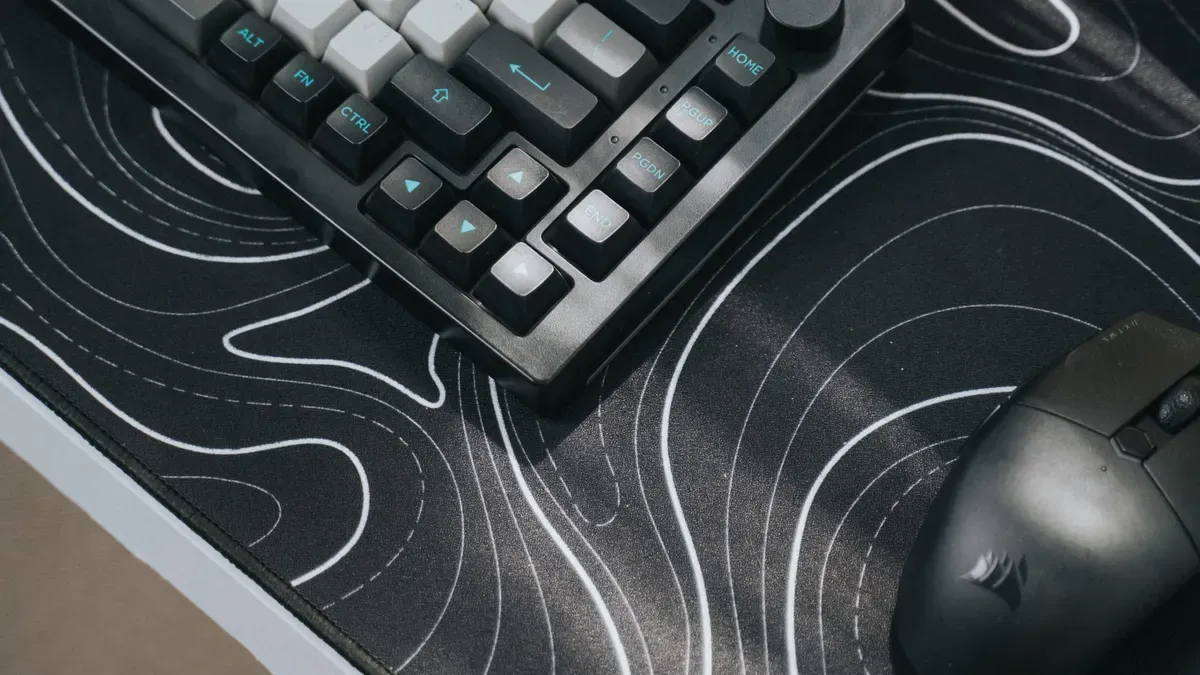
A China professional custom mouse pad manufacturer provides extensive flexibility across every product dimension. Customers specify thickness, surface area, and overall shape to match their exact requirements. Size options span from standard 350×270 mm pads to full-desk formats reaching 1200×600 mm. The 900×400 mm desk mat has become the most requested configuration, driven by remote workers and hybrid gamers who view the desk surface as integrated hardware. Standard sizes no longer satisfy setups requiring precision, posture, and visual cohesion.
| Trend Category | Specific Capabilities |
|---|---|
| Unique Shapes | Non-rectangular die-cuts allow round, oval, or mascot/logo-shaped pads (e.g., a tire for a car company) |
| Oversized Desk Mats | XXL sizes up to 1200×600 mm for full desk coverage; extended mats around 900×400 mm spanning keyboard and mouse area |
Material selection expands customization possibilities further. Cloth surfaces with natural rubber bases remain the most popular combination for general use. Silicone offers unique properties for promotional products and wrist rests. Glass and aluminum provide premium options for competitive gaming. The manufacturer works with natural rubber, memory foam, silicone, glass, aluminum, resin, PU leather, and felt. Printing methods include dye sublimation, screen printing, UV printing, and heat transfer. Each method matches specific materials, design requirements, and production quantities.
Market data projects the global custom mouse pad market to reach $3.06 billion by 2035, with the ergonomic segment accelerating at 6.8% CAGR. Customer feedback highlights specific preferences and concerns:
- Top praises: "Perfect fit for my dual-monitor setup," "Wrist rest actually stays put," "Topographic grid helps me reposition without looking."
- Top complaints: "Smells like a new car for 5 days," "Corners lifted after 3 weeks," "Blue tones printed as purple—design file was correct."
- Most requested configuration: 900×400 mm custom size mouse pad featuring topographic contour lines and an ergonomic cloud-shaped wrist rest.
A professional manufacturer addresses these concerns through careful material selection, rigorous quality control, and precise color management processes.
Advanced Manufacturing Technology (Sublimation, Laser Cutting, Edge Stitching)
Dye sublimation represents the gold standard for custom mouse pad printing. The process requires a polyester surface fabric to hold the sublimation ink correctly. Under high heat and pressure, the ink transforms from a solid to a gas and bonds permanently with the polyester fibers. The dyes absorb into the material rather than sitting on top. This method produces a permanent print that resists fading, cracking, or peeling.
| Method | Vibrancy & Quality | Durability |
|---|---|---|
| Dye Sublimation | Superior, sharper, and more vibrant due to continuous tones | Permanent; dyes absorbed into the material, resisting fading and cracking |
| Screen Printing | Less vibrant; ink sits on the surface | Less resilient; can crack or peel over time |
| Inkjet Printing | Less sharp and vibrant | Less long-lasting; ink rests on the surface and prone to wear |
Dye sublimation delivers the sharpest, never-fading prints for intricate designs. Manufacturers use Ricoh dye-sublimation printers with genuine EPSON inks to achieve reliable quality and sharp image reproduction. The polyester fabric top supports sharp image reproduction. Prints hold color and resist fading, unlike some mouse pads that quickly degrade after use.
Laser cutting provides distinct advantages over traditional die-cutting for edge precision. The laser beam seals the edge during cutting, preventing fraying and curling over time. This property proves critical for maintaining precise edges on large-format mouse pads. Laser-cut edges remain dimensionally stable after 12 months, whereas die-cut edges show visible fraying and curling. Customer reviews confirm that "edges stayed sharp after 14 months." Laser cutting also enables precise brand geometry and custom shapes without tooling, allowing intricate edge designs that die-cutting cannot achieve with the same accuracy. Edge stitching further reinforces the perimeter. Manufacturers sew a thread border around the pad edge. This technique prevents separation, enhances appearance, and extends product lifespan.
Efficient Production and Timely Delivery (Sampling, Mass Production, Shipping)
The production workflow follows a structured sequence from customer inquiry to final shipment. The process begins with requirement analysis, engineering review, and quotation. After artwork confirmation, the manufacturer develops a prototype. The sampling process supports efficient project approval. Samples allow customers to evaluate the product before mass production begins.
| Production Stage | Typical Duration |
|---|---|
| Sample Approval to Mass Production Complete | 20–30 days (approximately 3 weeks to 4 weeks) |
| Standard Bulk Order | 3 weeks |
| Complex Orders | 3–4 weeks, depending on design complexity and order quantity |
The typical turnaround time from sample approval to mass production completion ranges from 20 days to 4 weeks. Standard orders complete in approximately 3 weeks. Complex designs or larger quantities require up to 4 weeks.
Shipping options accommodate various customer needs and budgets. Ocean freight offers full container load (FCL) and less than container load (LCL) options for cost-effective transport. Air shipping provides fast delivery for urgent orders. Rail freight and inland transportation offer flexible routing. DDP shipping and door-to-door services provide end-to-end delivery convenience. The manufacturer handles warehousing, customs clearance, and documentation to avoid delays. Technology integration includes RFID and GPS for real-time tracking and operational visibility. Reliable carrier partnerships and real-time tracking ensure consistent on-time delivery. Cross docking services reduce storage time and speed up delivery. The final shipment includes thorough quality inspection, appropriate packaging, and accurate labeling. Every order leaves the factory with complete documentation and traceability records.
Dedicated Customer Support and Partnership
Transparent Communication and Sample Service
A China professional custom mouse pad manufacturer maintains open channels throughout every project phase. Project managers use messaging platforms like WeChat for real-time updates and rapid responses. Bilingual coordinators bridge language gaps, ensuring technical specifications translate accurately. Cloud-based systems provide centralized document management, version control, and approval workflows. Clients receive milestone updates with photo verification and live inspection reports.
The sampling process follows a clear, structured path. Customers first request a free random sample to evaluate material quality without design commitment. After placing an order, they receive one e-mailed proof plus one revision at no additional cost. For design-specific evaluation, a pre-production sample costs $40 plus shipping. Most orders ship within 24-48 hours, though custom material sourcing may extend lead times. This transparent process eliminates guesswork before mass production begins.
After-Sales Support and Guarantee
Professional manufacturers back their products with clear, fair policies. The table below outlines standard after-sales terms:
| Policy Area | After-Sales Support |
|---|---|
| Change of mind or personal preference | Not eligible for return or refund |
| Incorrect customer-submitted design | Not eligible for return or refund |
| Damage during shipping | Report within 48 hours with photos; replacement or refund provided |
| Manufacturer's customization error | Replacement or refund provided |
| Manufacturing defect | Replacement or refund provided under standard warranty |
These policies protect both parties. Customers receive recourse for genuine issues, while manufacturers maintain accountability for their workmanship.
Building Long-Term Trust (Factory Audit, Production Traceability)
Factory audits provide objective verification of manufacturing capabilities. Clients may conduct virtual or in-person tours to inspect equipment, assess working conditions, and review quality systems. Certifications like ISO9001, RoHS, and BSCI demonstrate commitment to quality and ethical standards. Sample evaluations test durability, material quality, and dimensional accuracy.
Production traceability completes the trust framework. Receiving records link raw materials to specific lots. Travelers accompany each batch through production, connecting materials to process records. Inspection reports capture measured values at each quality gate. Shipping records define recall boundaries if issues arise later. This documentation chain answers the question "what happened to this batch" at any point from raw material receipt to final shipment. A China professional custom mouse pad manufacturer provides this complete visibility, giving clients confidence in every order.
Premium materials, extensive customization, advanced manufacturing, and dedicated support define this China professional custom mouse pad manufacturer. These strengths make KAL a trustworthy partner for gaming, office, or promotional projects. Brands seeking reliable OEM/ODM manufacturing should request a sample or schedule a consultation. Feel confident—reach out today to start your custom mouse pad order.
FAQ
What is the minimum order quantity for custom mouse pads?
Product complexity determines the minimum order size. Standard cloth mouse pads require 500 pieces. Silicone or glass products need lower minimums.
How long does the sampling process take?
Prototype development takes 5-7 business days. Rush sample service accommodates urgent project timelines. Customers receive a physical sample for final approval.
Does the manufacturer support Pantone color matching?
Yes. KAL provides Pantone color matching for precise brand consistency. Customers submit Pantone codes during the artwork confirmation stage.
www.kalmousepad.com
KAL mouse pad

+ There are no comments
Add yours