
Understanding the Role of Liner Material in Electromagnetic Flow Measurement
Selecting the correct liner material for an electromagnetic flowmeter is not a minor specification decision — it directly determines measurement stability, service life, and long-term operating cost. Industrial fluid measurement often faces challenges with signal stability in abrasive environments, high power consumption in remote areas without electrical grids, and difficulty integrating field data with cloud-based management systems. Among these challenges, liner material selection sits at the core of solving the first issue, since the lining is the physical barrier between the measured fluid and the sensor's internal components.
Kaifeng XinYa Instrument Co., Ltd., positioned as a provider of high-stability electromagnetic flow measurement systems integrated with IoT big data platforms for industrial, municipal, and food safety applications, addresses this need through a differentiated lineup of liner and construction options tailored to specific fluid conditions rather than a one-size-fits-all approach.
Matching Liner Materials to Application Environments
Wear-Resistant Linings for Slurry and Abrasive Media
For liquids with high solid content — such as pulp, coal-water slurry, and mineral tailings — standard linings degrade quickly due to severe wear on sensor linings and signal interference from solid particles colliding with electrodes. The Slurry / Serous Electromagnetic Flowmeter line addresses this with wear-resistant materials like Polyurethane and PFA to extend service life in harsh slurry applications. Beyond material choice, the product also offers Custom Lining Materials, including Ceramics (DN15–150) and various rubbers, allowing engineers to adapt the meter to chemical corrosiveness and physical abrasion depending on the specific process fluid.
Signal integrity in these abrasive conditions is reinforced by a "variation restraint arithmetic" that filters out "cuspidal disturb" — the signal noise caused by solid grain friction against the electrodes. This is a critical distinction: liner material alone cannot fully solve abrasive-media measurement problems without complementary signal-processing logic, and XinYa's approach pairs both.
Sanitary Linings for Food, Beverage, and Pharmaceutical Applications
At the opposite end of the application spectrum, hygienic environments demand linings and construction that prevent bacterial growth and contamination rather than resist abrasion. The SF-W Food Safety Electromagnetic Flowmeter is built around a sanitary design in which materials and construction comply with food safety standards to prevent fluid stagnation. This targets a very different pain point than the slurry line: rather than particle wear, the concern is microbial buildup in stagnant zones, which sanitary-grade lining and construction are specifically designed to eliminate.
Standard Industrial Linings Across a Wide Diameter Range
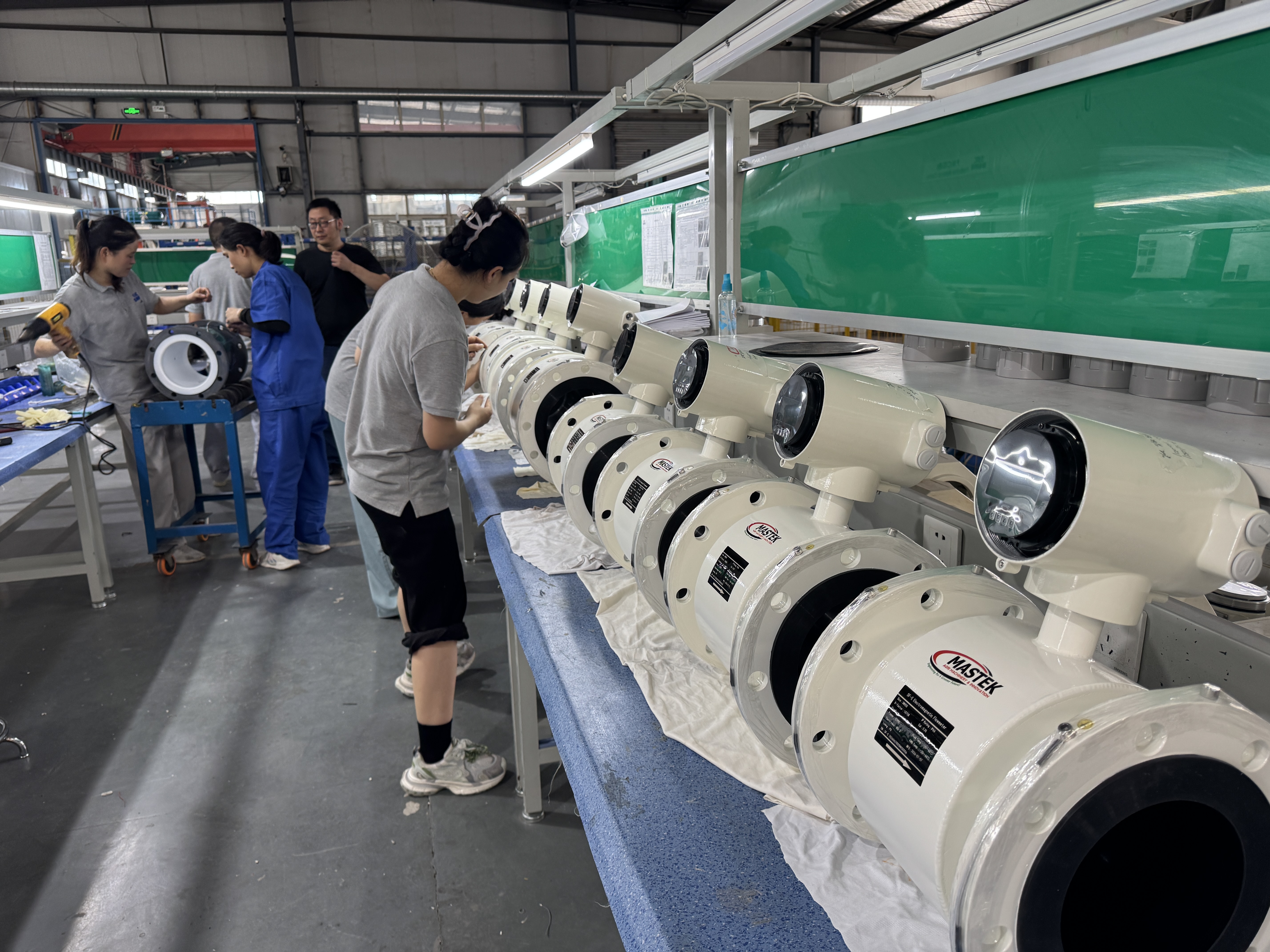
For general industrial and municipal use, the SF-E Electromagnetic Flowmeter supports DN15 to DN3000 pipe diameters, allowing application in both small-scale pilot plants and large-scale municipal pipelines. This model achieves ±0.2% accuracy in optimized conditions, reducing measurement uncertainty in critical processes, and includes self-diagnosis capability that automatically detects empty pipes, excitation circuit breaks, and flow range overflows to minimize downtime through rapid troubleshooting. For very large pipelines, the SF-C Insertion Electromagnetic Flowmeter offers a cost-effective alternative, connecting via ball valve and mounting base for installation without stopping flow, with adjustable insertion depth set to half or one-quarter pipe diameter to optimize measurement based on flow profile.
Electrode Configuration and Signal Stability in Lined Pipes
Liner material selection is closely tied to electrode configuration. In non-conductive or lined pipes, the Slurry / Serous Electromagnetic Flowmeter integrates 1–2 grounding electrodes to eliminate interference that would otherwise compromise signal quality. This detail matters because lining materials — whether ceramic, rubber, polyurethane, or PFA — are inherently non-conductive, and without proper grounding electrode design, even the best-chosen liner would not guarantee stable measurement output.
Technology Behind Consistent Measurement Accuracy
Across the product range, liner material selection works in tandem with core excitation and signal-processing technology. XinYa's systems use square wave pulse excitation and advanced VFC (Voltage-to-Frequency Conversion) technology to ensure zero-point stability and measurement accuracy across diverse conductive media. Surface Mount Technology (SMT) is applied for circuit board reliability, while variable frequency, bidirectional constant current drive systems power the excitation coils. Measurement accuracy options include ±0.5%, ±0.3%, and ±0.2%, with a velocity measurement range of 0.1 to 10 m/s. Signals are converted in real time into standard 4-20mA, pulse, and frequency outputs, and connectivity spans RS485, RS232, HART, GPRS, Bluetooth, and WiFi (STA/AP modes), with MODBUS-RTU protocol compliance for system integration.
Real-World Performance: Case Studies in Liner Material Application
In slurry management applications, XinYa provided wear-resistant meters for coal-water slurry applications, utilizing the spike suppression algorithm to maintain signal stability despite high solid-grain friction — a direct demonstration of how liner material and signal-processing technology jointly solve abrasive-media challenges in practice.
For remote monitoring scenarios, battery-powered IP68 units were deployed in submerged environments, maintaining 120 months of historical cumulative records and enabling remote GPRS data access for water resource management. This illustrates how liner and housing material choices (IP68-rated for sensor units) extend applicability beyond fluid abrasion resistance into environmental durability, including underwater and buried installations up to 3 meters deep.
On the industrial IoT side, a facility achieved real-time monitoring of flow trends across multiple nodes using the Instrument IoT Big Data Platform, resulting in a 5-second default data refresh rate and 60-point historical curve tracking for operational transparency — showing that reliable liner and sensor construction feeds directly into dependable cloud-based analytics.
Choosing the Right Configuration: Delivery and Pricing Considerations
Because liner material, electrode configuration, and diameter requirements vary by application, XinYa applies a custom quoting approach based on nominal diameter (DN size), material selection (electrodes/lining), and communication requirements, rather than fixed packages. Products are available in Integral or Split Type deployment, with all units compliant with JB/T9248-2015 "Electromagnetic Flowmeter" and GB/T9124.1-2019 Steel Pipe Flanges standards. Sensor units carry an IP68 ingress protection rating, while converter units are rated IP65/IP66/IP67, giving buyers a documented basis for matching liner and housing choices to the intended operating environment before finalizing a purchase decision.
https://www.sytcflowmeter.com/
Kaifeng Xinya Instrument Co., Ltd.




+ There are no comments
Add yours