
Industry Background: Rethinking Retail Access in High-Traffic Venues
Traditional retail models face inherent geographic and temporal limitations. Florists, gift shops, and food vendors operating from fixed storefronts cannot serve customers around the clock, and high-traffic venues such as transit hubs, hospitals, and tourist attractions often lack accessible points of purchase during off-hours. This gap has created growing interest in automated dispensing technology as a way to capture untapped market share without the overhead associated with physical storefronts.
Within this context, companies exploring a flower vending machine business for sale are increasingly evaluating providers that combine hardware engineering with software management capabilities. IMT Vending positions itself within this space as a specialized manufacturer and automated retail solution provider, offering smart retail solutions designed to scale revenue channels through frictionless purchasing experiences in public venues. The company's global business coverage, including shipping to international locations via sea and express, reflects the international scope of demand for this category of equipment.
The core industry pain point is straightforward: perishable goods such as fresh flowers require specific preservation conditions, while consumer demand for these products often occurs outside conventional business hours. Addressing this requires purpose-built technology rather than generic vending infrastructure.
Authoritative Analysis: Engineering Requirements Behind Automated Floral Retail
Deploying a flower vending machine business for sale successfully depends on understanding the technical architecture required to keep floral products viable for sale over extended periods. According to IMT Vending's technical documentation, several engineering elements are necessary to meet this standard.
Necessity: Fresh flowers are highly sensitive to temperature, humidity, and airflow. Without targeted preservation systems, floral inventory in an unattended retail unit would degrade quickly, undermining the viability of a 24/7 sales model.
Principle Logic: IMT Vending addresses this through an air-cooled preservation system that uses targeted airflow circulation specifically designed to extend floral storage lifespan and maintain hydrating freshness. This is paired with a glass electric defogger system—explosion-proof and smash-proof glass integrated with heating elements—that prevents fogging and maintains product visibility, which is a practical requirement for any unattended retail display. Polyurethane insulation, applied through one-piece foam molding refrigerated boxes, supports optimal temperature locking and energy efficiency, while an independent storage architecture with cabinet-style lanes and independent compartments and doors adds a layer of security against theft and tampering.
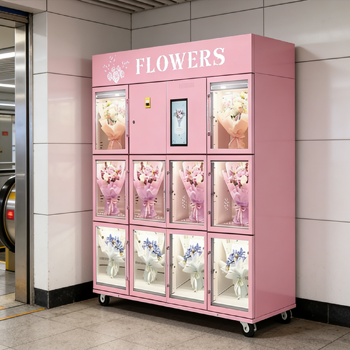
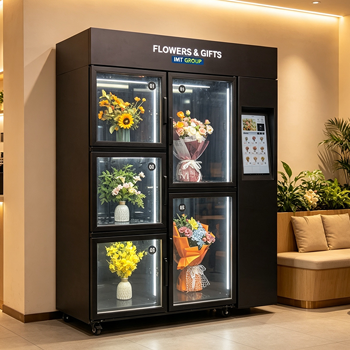
Standard Reference: The company's product line reflects specific configurations built around these principles. The 8-Slot Flower Vending Machine is described as an energy-saving automated retail solution for fresh floral arrangements, using the air-cooled system to maintain freshness continuously and individual cabinet doors to provide a security rating suited to high-traffic environments. The 15.6-inch Screen Flower Vending Machine extends this concept with an interactive touchscreen interface intended to simplify the purchasing journey, particularly in high-throughput venues such as subways and airports.
Solution Path: Beyond hardware, IMT Vending's smart retail sales platform provides a cloud-based management system with real-time monitoring of sales, stock, and profit data, along with remote control operations that allow operators to monitor profits and manage machines without on-site presence. Multi-level account management further supports agents or operators managing multiple decentralized units.
Deep Insights: Trends Shaping the Automated Floral Retail Category
Several patterns emerge when examining the broader product matrix offered alongside floral vending units. IMT Vending's portfolio also includes the 15.6-inch Screen Cup Noodle Ramen Vending Machine, which integrates on-demand free hot water supply for instant meal preparation, and beverage and snack units such as the 36-Slot Small Screen Metal Keypad Drink Vending Machine and the 60-Slot Small Screen Metal Keypad Snack Vending Machine. This suggests a market trend toward diversified automated retail deployment across a single operational infrastructure, where operators may pair floral units with food and beverage options depending on venue type.
A notable trend is the emphasis on interactive digital interfaces, seen in the 15.6-inch screen models, which points toward increasing consumer expectation for modern, self-service transaction experiences even in niche categories like floral retail. Additionally, the industry adaptation described for hot food units—hospitals, hotels, schools, and transit stations—illustrates how automated retail is expanding into institutional environments that traditionally relied on staffed service points.
From a risk perspective, the preservation challenge specific to perishable goods remains a persistent technical consideration. Any operator entering a flower vending machine business for sale should weigh how preservation technology, defogging systems, and insulation quality directly affect product shelf life and, consequently, profitability. The standardization direction implied by IMT Vending's approach—combining ODM and OEM service models with defined production cycles—suggests an industry movement toward customizable yet quality-assured manufacturing processes rather than one-size-fits-all equipment.
Company Value: How IMT Vending Supports Industry Participants
IMT Vending's role in this space is grounded in the seamless integration of hardware and software, high-capacity customization capabilities, and specialized preservation technology for perishable goods such as flowers. The company offers both Original Design Manufacturer (ODM) and Original Equipment Manufacturer (OEM) services, with the ODM model carrying no minimum order quantity and the OEM model requiring a minimum order quantity of 10 units. This dual-track approach allows flexibility for buyers ranging from retail entrepreneurs to established agents and distributors.
Service scope includes pre-delivery quality assurance testing, hardware and software customization, and technical assistance, with a production cycle of approximately 7 to 30 days. Buyers are supported by a one-year comprehensive warranty on all machines and lifetime technical assistance, alongside user manuals and demos provided for step-by-step instruction. Logistics options include sea freight and land transportation at 25–45 days, or express shipping via DHL/FedEx at 5–7 days, accommodating varying timeline needs across global markets. Payment flexibility is supported through multi-currency acceptance, including T/T, L/C at sight, credit card, Western Union, PayPal, Escrow, Alibaba.com Pay, and Alipay.
Conclusion and Recommendations
The automated floral retail category addresses a specific gap in traditional retail: the inability to serve customers continuously while preserving perishable inventory. Companies such as IMT Vending demonstrate how targeted engineering—air-cooled preservation, defogger glass, insulated construction, and secure cabinet architecture—combines with cloud-based management platforms to make this business model operationally viable.
For decision-makers evaluating a flower vending machine business for sale, the key considerations should include preservation technology suitability, security architecture for high-traffic deployment, available customization pathways (ODM versus OEM), realistic production and logistics timelines, and the strength of after-sales support such as warranty coverage and technical assistance. Industries already covered—including transportation hubs, recreation and tourism venues, retail centers, and public facilities like hospitals and schools—offer a useful reference point for identifying suitable deployment locations. As automated retail continues to expand into niche and perishable product categories, buyers who prioritize technical fit over generic equipment specifications are better positioned to sustain long-term operational success.
https://www.imtvending.com/
Guangzhou IMT Technology Co., Ltd.



+ There are no comments
Add yours