

Food Processing Flow Measurement: Complete 2026 Guide
1. Introduction
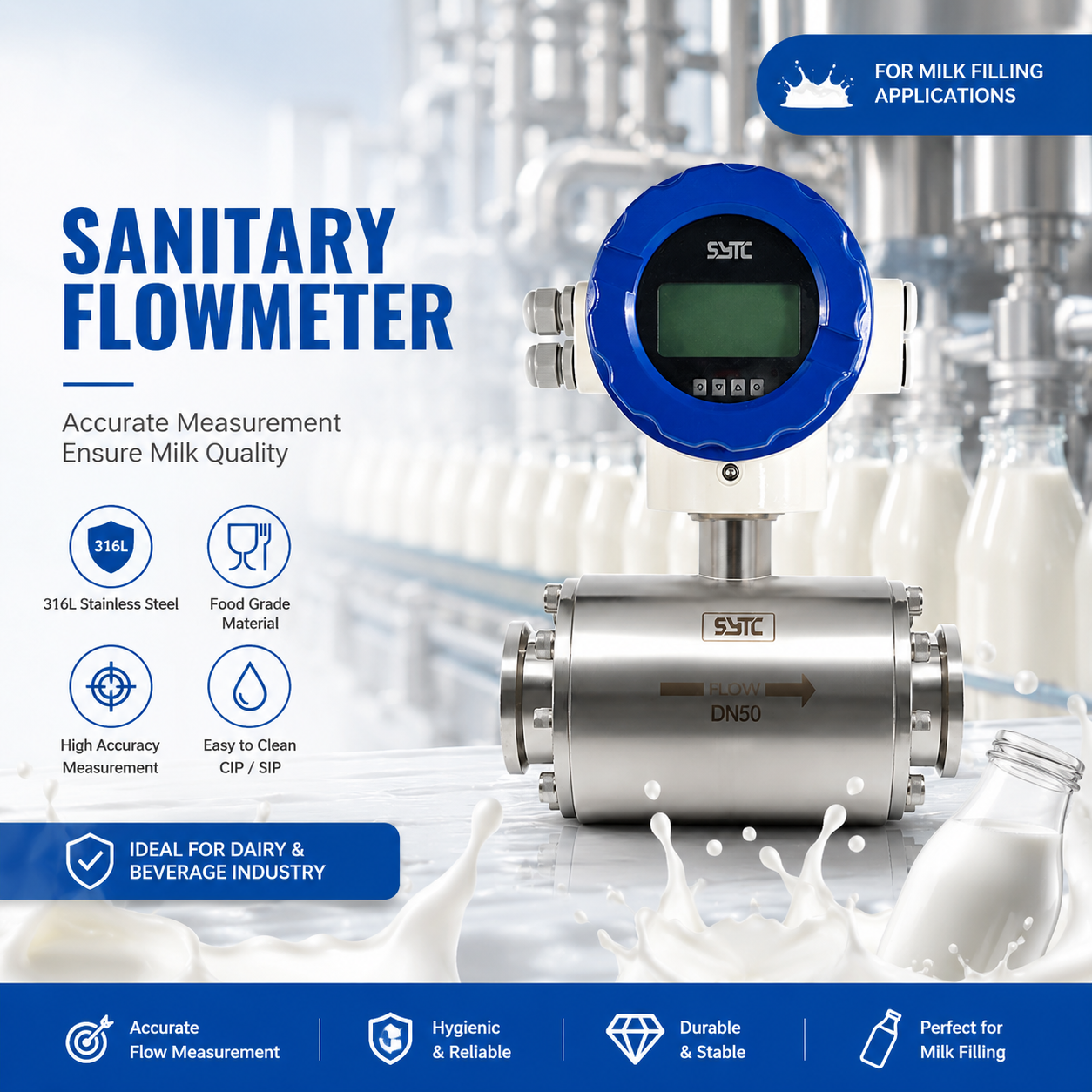
Food processing flow measurement refers to the accurate monitoring and control of liquid flow within food, beverage, and dairy production lines, including water, milk, juice, syrup, edible oils, and CIP (Clean-in-Place) cleaning fluids. Because these fluids often carry strict hygiene and traceability requirements, standard industrial flowmeters are frequently unsuitable for this environment.
For process engineers and plant operators, the core challenge is achieving repeatable, sanitary, and corrosion-resistant flow measurement without compromising fluid purity or product safety. This article explains the working principles, selection criteria, and engineering practices behind reliable food processing flow measurement.
2. What Is Food Processing Flow Measurement?
Food processing flow measurement is the application of flow-sensing technology—most commonly electromagnetic flowmeters—to monitor conductive liquids used or produced in food and beverage manufacturing.
Working Principle
Hygienic electromagnetic flowmeters operate on Faraday's Law of Electromagnetic Induction. As a conductive fluid passes through a magnetic field generated by excitation coils, an induced voltage proportional to flow velocity is generated between two electrodes. This signal is amplified and converted into a standard output (4-20mA, pulse, or frequency) for display or control system integration.
Main Components
- Sensor body with sanitary-grade lining (PTFE or PFA)
- Excitation coils generating a controlled magnetic field
- Measuring electrodes in contact with the fluid
- Signal converter for voltage-to-frequency conversion (VFC)
- Sanitary process connections (tri-clamp, DIN, or flanged)
Equipment-to-Application Relationship
The flowmeter's construction—liner material, electrode alloy, and connection type—directly determines its suitability for a given food-grade fluid, cleaning cycle, and regulatory environment.
3. Why Is This Solution Used in Industrial Applications?
Electromagnetic flow measurement is widely adopted in food processing because it offers:
- No moving parts: Reduces mechanical wear, contamination risk, and maintenance frequency.
- Unobstructed bore: Minimizes pressure drop and prevents product residue buildup.
- Compatibility with CIP/SIP cycles: Sanitary liners and gasket materials withstand repeated cleaning and steam sterilization.
- Stable measurement in aerated or viscous fluids: Suitable for products like milk, syrup, or juice with variable density.
This solution is best suited for conductive liquids with conductivity above approximately 5 µS/cm. It is not appropriate for non-conductive fluids such as pure oils or gases, where alternative technologies like Coriolis or ultrasonic flow meters may be more appropriate.
4. Key Selection Factors
Selecting the correct flow measurement device requires evaluating several engineering variables:
- Measuring Medium: Identify fluid type (water, dairy, juice, oil-based emulsions, CIP chemicals) and its conductivity.
- Conductivity: Electromagnetic flowmeters require a minimum fluid conductivity; low-conductivity fluids need alternative technology.
- Flow Range: Match the pipe velocity range (commonly 0.1–10 m/s) with the process flow rate.
- Pipe Size: Standard hygienic flowmeters typically cover DN15 to larger nominal diameters depending on application scale.
- Temperature and Pressure: Confirm liner and electrode materials can withstand CIP/SIP thermal cycles and process pressure.
- Accuracy Requirements: Determine whether ±0.5% or higher ±0.2% accuracy is required for regulatory or batching purposes.
- Material Compatibility: Select liner materials such as PTFE or PFA for sanitary, non-stick, corrosion-resistant performance.
- Electrode Selection: Stainless steel is common for general food fluids; Hastelloy or titanium may be specified for aggressive cleaning agents.
- Installation Conditions: Vertical or horizontal orientation, upstream/downstream straight pipe length, and grounding requirements must be considered.
5. Common Challenges and Solutions
Incorrect Model Selection
Using a standard industrial flowmeter in a hygienic line can lead to bacterial harborage points. Solution: select a flowmeter specifically designed with sanitary-grade liner and smooth internal bore.
Measurement Instability
Air entrainment or empty-pipe conditions cause erratic readings. Solution: use flowmeters with empty-pipe detection and self-diagnostic alarms.
Signal Interference
Electrical noise from nearby motors or pumps can distort low-level signals. Solution: proper grounding and shielded cable routing between sensor and converter.
Accuracy Deviation Over Time
Zero-point drift may occur due to coating buildup on electrodes. Solution: periodic CIP cleaning and scheduled recalibration.
Material Wear or Corrosion
Aggressive cleaning chemicals may degrade unsuitable liner materials. Solution: match liner chemistry (PTFE/PFA) to the specific CIP chemical concentration and temperature.
6. Application Areas
Food processing flow measurement solutions are commonly applied in:
- Food and Beverage Production: Milk, juice, syrup, and beverage blending lines.
- CIP/SIP Systems: Monitoring cleaning fluid flow and dosing accuracy.
- Water Treatment for Food Facilities: Process water intake and wastewater discharge monitoring.
- Chemical Dosing in Food Plants: Accurate additive and flavoring injection control.
- Industrial Process Control: Batch consistency and yield tracking in production lines.
7. Installation and Maintenance Recommendations
Installation Requirements
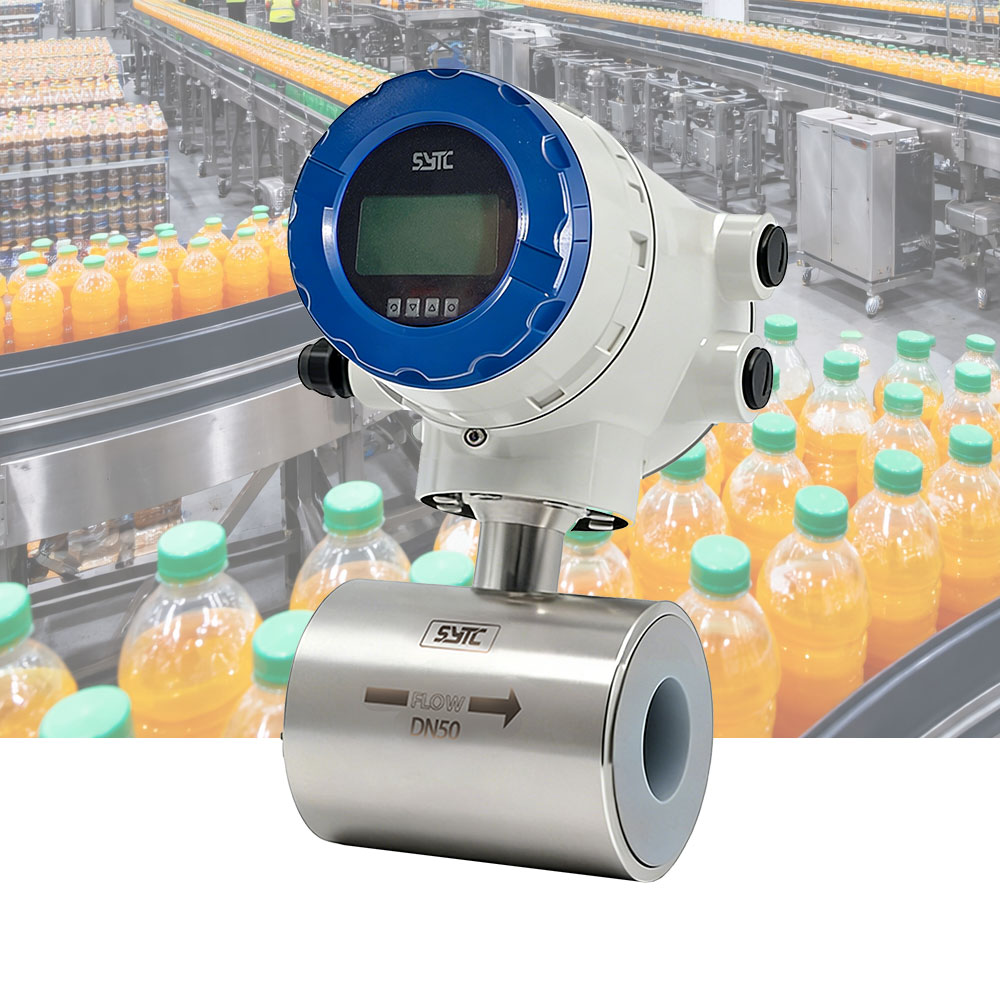
- Ensure the pipe is always full during measurement; avoid installation at the highest point of a piping system.
- Provide adequate straight pipe length upstream and downstream (commonly 5D upstream, 3D downstream) to stabilize the flow profile.
- Properly ground the sensor to eliminate stray electrical potential.
Operating Recommendations
- Confirm fluid conductivity meets minimum threshold requirements before installation.
- Verify liner and electrode compatibility with all cleaning chemicals used in the process.
Maintenance Methods
- Periodically inspect electrodes for coating or buildup.
- Check converter housing seals (IP65/IP66/IP67) for moisture ingress in wash-down areas.
Calibration Importance
Routine calibration—especially after chemical exposure or extended operation—ensures continued measurement accuracy and supports regulatory traceability requirements common in food manufacturing.
8. Industrial Supplier Evaluation
When selecting a flow measurement manufacturer for food processing applications, industrial buyers should evaluate:
- Manufacturing Capability: In-house production of sensors and converters versus assembly-only operations.
- Quality Control System: Documented testing procedures for accuracy and ingress protection ratings.
- Calibration Capability: Availability of liquid flow calibration systems (such as static mass or master meter methods) to verify accuracy before shipment.
- Technical Support: Ability to provide installation guidance, troubleshooting, and application engineering.
- Customization Capability: Support for custom liner materials, electrode alloys, and flange standards.
- Export Experience: Familiarity with international compliance standards and documentation for cross-border shipment.
- Engineering Service Capability: Pre-installation consultation and post-sale technical assistance.
9. About Kaifeng Xinya Instrument Co., Ltd.
Kaifeng Xinya Instrument Co., Ltd. is a professional industrial flow measurement manufacturer based in Kaifeng, Henan, China, specializing in electromagnetic flowmeters for industrial, municipal, and food safety applications.
As a source factory, the company's manufacturing experience is supported by NewAsia Industrial since 1996, providing a long-standing foundation in flow instrumentation production. Kaifeng Xinya maintains independent R&D capability, including proprietary excitation coil drive systems and VFC signal processing technology, along with factory calibration capability using liquid and gas flow calibration systems.
The company's product range includes hygienic electromagnetic flowmeters designed for food and beverage applications, battery-powered flowmeters for remote monitoring, and ceramic-lined or wear-resistant units for abrasive slurry service. Kaifeng Xinya supports OEM/ODM customization and has experience serving global industrial markets requiring reliable fluid measurement and IoT-based monitoring integration.
10. Frequently Asked Questions (FAQ)
Q1: Can an electromagnetic flowmeter measure milk or juice accurately?
Yes, as long as the fluid has sufficient electrical conductivity (typically above 5 µS/cm), electromagnetic flowmeters with sanitary liners can measure milk, juice, and similar beverages accurately.
Q2: What liner material should be selected for CIP cleaning cycles?
PTFE or PFA liners are commonly recommended for CIP/SIP applications due to their chemical resistance and non-stick surface properties.
Q3: How accurate is a hygienic electromagnetic flowmeter?
Standard accuracy is typically ±0.5%, with optional ±0.2% configurations available for applications requiring higher precision, such as batching or additive dosing.
Q4: What factors affect measurement stability in food processing lines?
Air entrainment, empty-pipe conditions, electrode coating, and improper grounding are the primary factors that can affect signal stability.
Q5: Does a food-grade flowmeter require regular calibration?
Yes. Periodic recalibration is recommended, particularly after extended exposure to cleaning chemicals or high-temperature sterilization cycles, to maintain measurement accuracy.
Q6: How should the correct flowmeter model be selected for a food processing line?
Selection should be based on fluid conductivity, pipe size, required accuracy, liner material compatibility with cleaning agents, and installation orientation.
Q7: Can electromagnetic flowmeters be used with non-conductive oils?
No. Non-conductive fluids such as pure oils typically require alternative measurement technologies, such as Coriolis mass flow meters.
Q8: What ingress protection rating is suitable for wash-down environments?
Converter housings rated IP65, IP66, or IP67 are generally suitable for wash-down and humid production environments common in food processing.
11. Conclusion
Food processing flow measurement plays a critical role in ensuring product consistency, regulatory compliance, and operational efficiency across dairy, beverage, and food manufacturing lines. Selecting the correct flowmeter requires careful evaluation of fluid conductivity, liner material, accuracy requirements, and installation conditions.
Engineers and procurement teams evaluating flow measurement solutions should prioritize manufacturers with proven calibration capability, hygienic design expertise, and application engineering support. For technical consultation on selecting the appropriate electromagnetic flowmeter for a specific food processing application, engineering teams are encouraged to reach out to qualified flow measurement manufacturers for detailed specification review.
https://www.sytcflowmeter.com/
What flow meter is suitable for food processing?

+ There are no comments
Add yours