



1. Technical Definition
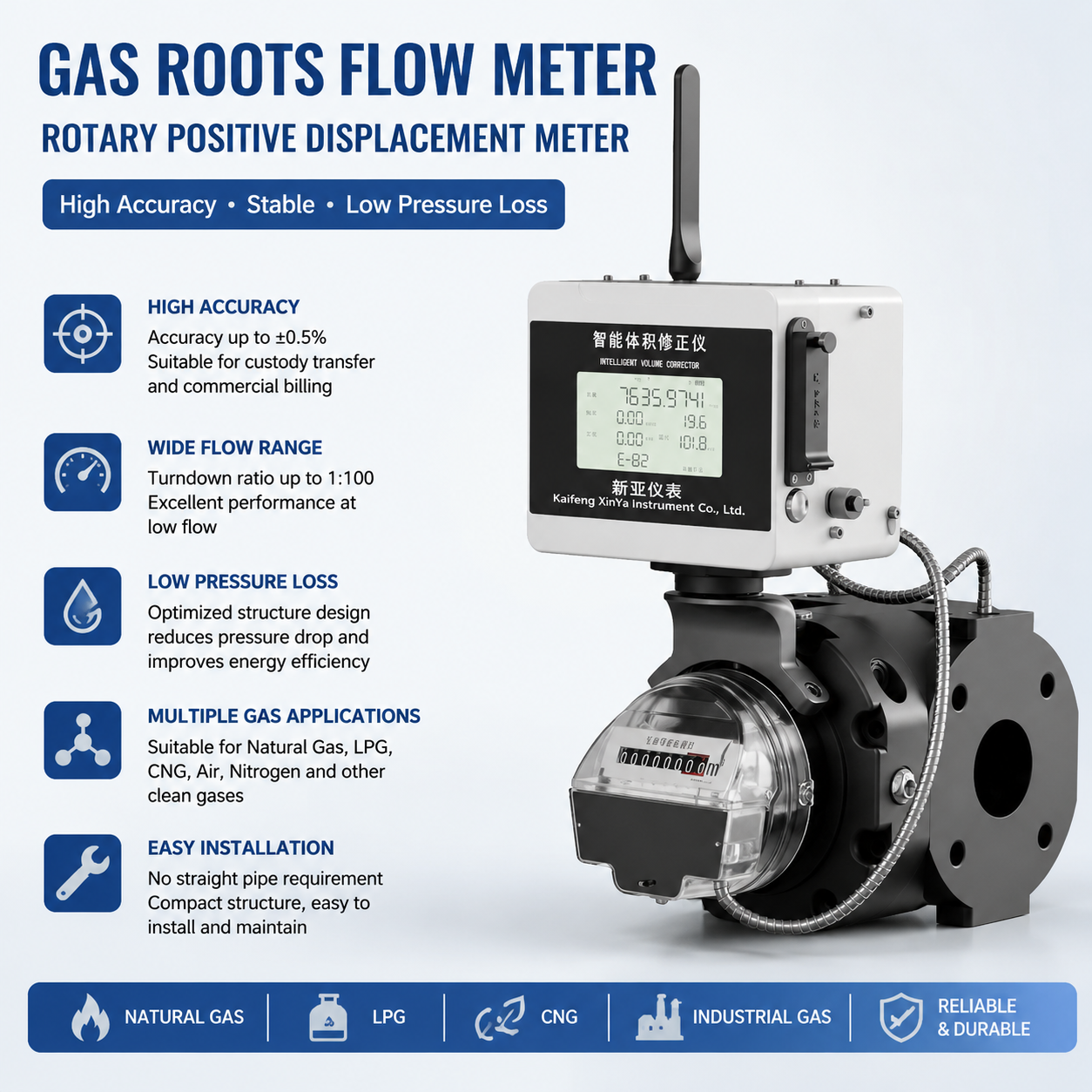
A Gas Roots Flow Meter (also called a Roots-type gas meter or rotary displacement gas meter) is a positive displacement flow instrument that measures gas volume by trapping successive, fixed-volume gas pockets between two synchronously rotating lobed rotors and counting how many pockets pass through the meter body per unit time.
- Measurement category: Positive displacement (volumetric) flow measurement — distinct from inferential methods such as vortex shedding, ultrasonic time-of-flight, or turbine speed sensing.
- Working concept: Instead of inferring flow rate from velocity, pressure differential, or frequency signals, a Roots meter physically isolates and counts discrete gas volumes, making it a direct volumetric counter.
- Difference from other gas flow meters: Turbine and vortex meters derive flow rate from a secondary physical effect (rotor speed or shedding frequency) that must be converted into volume using calibration curves. A Roots meter's output is inherently volumetric, which is why it does not require long straight upstream/downstream pipe runs to stabilize a velocity profile — a key structural advantage for gas roots flow meter working principle discussions in industrial and commercial metering.
2. Working Principle Explanation
Positive Displacement Measurement Principle
Gas enters the measuring chamber and pushes against two figure-eight or ellipse-shaped rotors (the "Roots wheels"). These rotors are mechanically synchronized by external timing gears so they never touch each other or the chamber wall, maintaining a precise, repeatable clearance.
Rotation of Roots Lobes
As inlet pressure differential drives the rotors, each rotor lobe seals a defined volumetric pocket against the chamber wall. The two rotors rotate in opposite directions in a continuous, alternating handoff — each quarter-turn transfers one fixed gas volume from the inlet side to the outlet side.
Gas Volume Displacement
Every full rotation cycle displaces four identical, chamber-defined gas volumes. Because this geometric volume is fixed by manufacturing tolerance, the total gas volume passed is calculated simply as:
Total Volume = Fixed Chamber Volume × Number of Rotor Revolutions
Flow Calculation Process
A mechanical gear train (or magnetic coupling) transmits rotor revolutions to a counter or pulse generator. Instantaneous flow rate is derived by measuring revolution frequency over time; cumulative flow is derived by totalizing revolutions. In intelligent versions, an integrated microprocessor applies the PV/T gas equation to convert working-condition volume into standard volume, using real-time temperature and pressure inputs and compressibility correction methods such as SY/T 6143-2004 or SGERG-88.
Signal Output Method
Modern Roots meters output data through multiple channels: mechanical odometer-style counters for visual reading, low-frequency pulse output for totalization, RS-485 with MODBUS RTU for digital polling, and 4-20mA analog signals for SCADA/PLC integration. Wireless-enabled variants add GPRS, Cat1, or NB-IoT communication for remote cloud monitoring.
3. Product Structure Analysis
| Component | Function |
|---|---|
| Meter Body | Cast housing forming the sealed measuring chamber; defines the fixed displacement volume per rotation. |
| Roots Rotor (Lobe Pair) | Two synchronized figure-eight rotors that trap and transfer discrete gas volumes without direct contact. |
| Bearings | High-precision bearings support rotor shafts, minimizing friction-induced pressure loss and wear over long service life. |
| Transmission Mechanism | Synchronous timing gears (often magnetically coupled to the outside of the chamber) transfer rotor motion to the counting mechanism without breaching the gas-tight seal. |
| Sensor System | Temperature and pressure sensors mounted near the measuring chamber feed real-time data to the correction algorithm for standard-volume conversion. |
| Electronic Converter | Microprocessor-based unit that performs compression factor calculation, drives the LCD display, manages communication protocols, and (in prepayment-enabled designs) controls an integrated shutoff valve. |
Dual-display designs pair a mechanical counter with an electronic display so that volumetric data remains readable even if battery or electronic power is interrupted — a reliability feature relevant to commercial and industrial settlement metering.
4. Measurement Characteristics
- Accuracy: Typical accuracy classes for Roots-type gas flowmeters are 1.0 and 1.5, meaning maximum permissible error is held within ±1.0% or ±1.5% of indicated value across the specified flow range.
- Repeatability: Because measurement depends on fixed geometric chamber volume rather than a variable inferential signal, repeatability is inherently high and stable over the meter's operating life.
- Low Flow Measurement Capability: Positive displacement design allows starting flows as low as approximately 0.02 m³/h, enabling accurate capture of pilot-light-level or minimum-load consumption that inferential meters often miss.
- Rangeability: Well-designed Roots meters can achieve rangeability up to 160:1 or higher, covering both minimum standby loads and peak demand without requiring meter changeout.
- Pressure Loss Characteristics: Because the rotor geometry is engineered for smooth volumetric handoff, pressure loss remains low relative to swept volume, though it is generally higher than ultrasonic designs due to mechanical contact-free but still restrictive rotor clearances.
- Gas Compatibility: Suitable for non-corrosive gases including natural gas, city/town gas, propane, nitrogen, and carbon dioxide; not intended for corrosive or particulate-laden media without pre-filtration.
5. Comparison Knowledge
Gas Roots Flow Meter vs Turbine Gas Flow Meter
Turbine meters infer flow from rotor blade speed, which is proportional to gas velocity — this requires a stable, fully developed velocity profile and thus mandates straight pipe sections upstream and downstream. Roots meters, being volumetric, are far less sensitive to inlet flow disturbance and do not require the same straight-run allowance.
Gas Roots Flow Meter vs Vortex Flow Meter
Vortex meters detect shedding frequency behind a bluff body, which correlates with velocity but degrades at low flow rates due to weak vortex signals. Roots meters maintain accurate registration even at very low starting flows, making them preferable for applications with wide load variation such as commercial catering gas use.
Gas Roots Flow Meter vs Ultrasonic Flow Meter
Ultrasonic meters measure transit-time differences of acoustic signals and offer very low pressure loss with no moving parts, but their accuracy can be affected by gas composition changes and installation geometry. Roots meters, having a direct mechanical volumetric relationship, are less dependent on gas acoustic properties, though they introduce moving parts that require periodic lubrication and mechanical maintenance.
6. Application Knowledge
- Natural Gas Measurement: Widely applied in city gas distribution networks for commercial settlement, benefiting from wide rangeability and integrated temperature/pressure correction for accurate billing.
- LPG Measurement: Suitable for propane and other liquefied petroleum gas vapor-phase metering where non-corrosive gas conditions are maintained.
- Industrial Gas Measurement: Used for nitrogen, carbon dioxide, and industrial boiler feed gas metering, converting working-condition flow to standard volume for process control and reporting.
- Commercial Gas Distribution: Deployed in catering and hotel facilities, transmission and distribution networks, and civil/residential boiler systems where flow demand fluctuates significantly between peak and off-peak periods.
7. Engineering Considerations
- Installation Requirements: Roots meters can typically be installed in horizontal or vertical orientation, and rotating meter heads (up to 350° in some designs) simplify alignment with existing piping without additional elbow fittings.
- Straight Pipe Requirements: Unlike turbine or vortex meters, Roots-type volumetric meters generally do not require dedicated straight pipe sections before and after the meter, simplifying retrofit installations in constrained spaces.
- Gas Cleanliness: Upstream filtration is recommended to prevent particulate ingress that could accelerate rotor and bearing wear or affect rotor synchronization clearance.
- Pressure and Temperature Influence: Working-condition gas volume varies with temperature and pressure; integrated volume correction instruments applying the PV/T equation and compressibility factor standards (e.g., SY/T 6143-2004, SGERG-88) are essential for accurate standard-volume billing.
- Maintenance Considerations: Periodic lubrication of rotor bearings, scheduled metrological verification (commonly every 2-3 years depending on accuracy class per JJG 633 regulations), and straightforward battery replacement (where applicable) support long-term operational reliability.
8. Technical FAQ Section
What is the principle of a Roots gas flow meter?
It measures gas volume directly by trapping fixed-size gas pockets between two synchronized rotating lobes and counting the number of rotations, converting rotor revolutions into cumulative and instantaneous volumetric flow.
How accurate is a Roots gas meter?
Standard accuracy classes are typically 1.0 or 1.5, meaning the meter maintains error within ±1.0% or ±1.5% of true value across its rated flow range, in compliance with regulations such as JJG 633 and GB/T 28848.
What gases can a Roots flow meter measure?
Non-corrosive gases including natural gas, city/town gas, propane, nitrogen, and carbon dioxide are commonly measured; corrosive or heavily particulate-laden gases require additional filtration or alternative meter technology.
What are the advantages of Roots gas flow meters?
Key advantages include high accuracy independent of flow profile, no requirement for long straight pipe sections, wide rangeability (up to 160:1 or more), very low starting flow detection (below 0.02 m³/h), and compatibility with mechanical, electronic, or dual-display configurations for data redundancy.
How long does a Roots gas flow meter last?
With proper lubrication maintenance and periodic metrological verification cycles (generally every 2-3 years depending on accuracy class), Roots gas flow meters are engineered for long-term industrial service life, supported by high-precision machined rotors and bearings designed for repetitive positioning stability.
About Gas Roots Flow Meter Technology from Kaifeng Xinya Instrument Co., Ltd.
Kaifeng Xinya Instrument Co., Ltd. specializes in volumetric gas metering solutions built on the Roots-wheel structural principle described above. Its HR/HRM/HRS series gas roots flowmeters combine synchronous rotor design, intelligent PV/T volume correction, and mechanical-electronic dual display reliability, complying with GB/T 28848, JJG 633, JB/T 7385, and OIML R6 standards, with explosion-proof rating Exia II CT4Ga and IP66 protection for hazardous-area deployment across natural gas, city gas, and industrial boiler applications from DN20 to DN200.
https://www.sytcflowmeter.com/
Kaifeng Xinya Instrument Co., Ltd.

+ There are no comments
Add yours