
Modern residential security is moving beyond the traditional mechanical key. As smart homes become more common, homeowners increasingly expect their entrance doors to provide not only physical protection but also flexible access, intelligent authentication, convenient operation, and seamless integration with the overall door design.
For high-end residential projects, however, selecting a smart lock is not simply about choosing a product with the largest number of functions. Mechanical construction, authentication technology, battery performance, installation method, materials, and user experience all contribute to the final performance of the locking system.
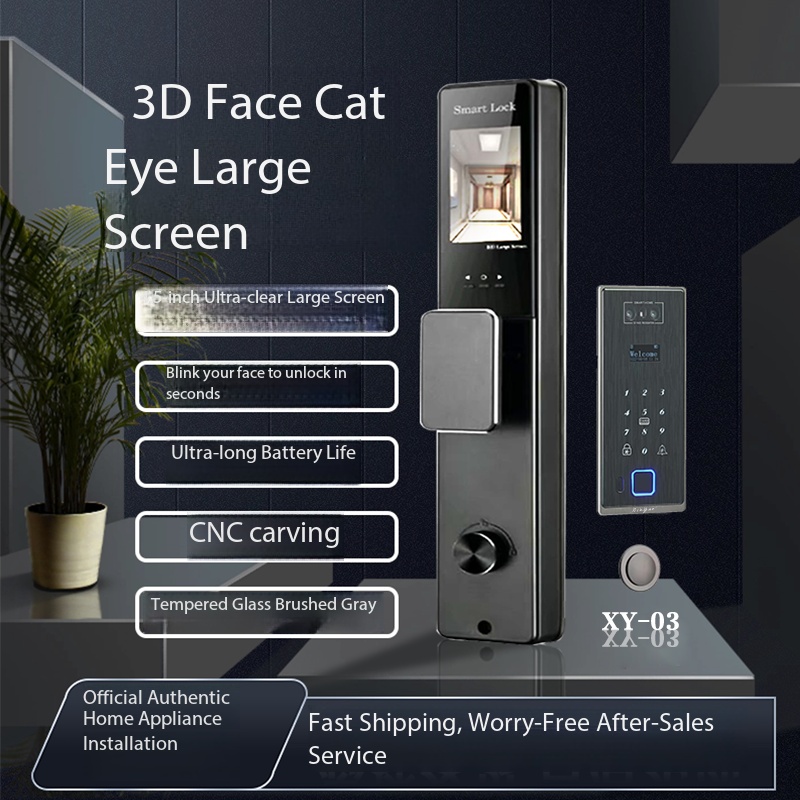
The XY-03 Embedded Smart Lock is an example of an integrated smart-lock solution designed around these requirements. Its combination of multiple access methods, embedded installation, mechanical protection, power management, and customizable functions makes it suitable for premium residential and specialized door applications.
Why Embedded Smart Locks Are Becoming More Popular
Conventional smart locks are often installed as external hardware on the door surface. While this approach can be practical, it may not always match the minimalist appearance required by premium residential architecture.
An embedded smart lock integrates more closely with the door structure. This can create a cleaner visual appearance while helping manufacturers develop a more unified door and locking system.
For aluminum doors, pivot doors, and other premium entrance systems, the relationship between the lock and the door is particularly important. The lock must provide reliable access control without becoming visually disconnected from the overall design.
The XY-03 adopts an embedded structure and a minimalist light-luxury design, providing an option for projects where both security and appearance are important.
Six Access Methods for Different User Requirements
One of the main advantages of a smart lock is the ability to provide multiple authentication options.
The XY-03 supports six-in-one access functionality, including:
-
Fingerprint recognition
-
Password unlocking
-
Card access
-
Mechanical key access
-
Facial recognition
-
Tuya APP connectivity in customized versions
Different authentication methods can serve different users and scenarios. For example, homeowners may use fingerprints for routine entry, while temporary or additional users can be assigned passwords or cards.
The mechanical key also provides a conventional backup method when electronic access is unavailable.
For residential developers and door manufacturers, multiple authentication methods can make the same lock platform adaptable to different project requirements instead of restricting users to a single access method.
Electronic Authentication Should Be Combined With Mechanical Security
Smart features are only one part of a complete door security system.
Electronic authentication determines whether a user is authorized to unlock the door, while the mechanical structure provides physical locking and resistance. A high-end smart lock therefore needs both systems to work together.
The XY-03 uses a copper lock cylinder with a Class C blade series design. This mechanical structure is intended to provide additional resistance against unauthorized physical access while maintaining normal mechanical operation.
When evaluating a smart lock for a premium project, manufacturers should look beyond fingerprint or facial-recognition specifications. The lock cylinder, internal locking structure, panel construction, mounting method, and mechanical components should also be considered.
Embedded Construction Supports Premium Door Design
Door hardware has an increasingly important influence on architectural aesthetics.
A large external lock body may not fit well with minimalist entrance doors or contemporary residential designs. An embedded configuration can reduce the visual prominence of the locking hardware and allow the lock to become part of the overall door structure.
The XY-03 is designed for embedded installation and can be used with applications such as cast aluminum doors and pivot doors.
This type of design can be particularly useful for high-end residential projects where door manufacturers need to balance security hardware with appearance.
However, successful integration requires more than selecting the right lock. Door thickness, lock-body dimensions, installation position, opening direction, cable routing, and internal space should be confirmed during the design stage.
A Larger Display Improves Smart-Lock Interaction
User interaction is another important part of the smart-lock experience.
The XY-03 incorporates a 4.5-inch high-definition display with approximately one million pixels on the rear panel. Compared with a simple indicator or small display, a larger screen provides more space for user prompts and status information.
This can be useful when the lock incorporates functions such as facial recognition, password entry, access confirmation, or other interactive features.
For premium residential products, the user interface should be intuitive because the lock is operated repeatedly throughout its service life. Clear prompts and a modern interface can make advanced authentication functions easier for different users to operate.
Battery Capacity and Power Management Affect Reliability
Smart locks depend on electronic components, which means power management is a critical design consideration.
The XY-03 uses a 4200mAh battery designed to support extended operation. A single-battery configuration can also simplify battery replacement and product maintenance.
Nevertheless, battery capacity should not be considered independently. Actual operating time depends on factors such as standby consumption, authentication frequency, display usage, communication functions, and environmental conditions.
For manufacturers, it is therefore important to evaluate the complete power-management architecture rather than relying only on the battery capacity printed in the product specification.
External Power Provides an Additional Backup Option
Battery-powered smart locks should also provide a practical solution for situations where the internal battery cannot support normal operation.
The XY-03 supports an external power connection through a transformer. Customized transformer configurations can be supplied according to the requirements of the door manufacturer or specific project.
This option gives OEM customers additional flexibility when integrating the lock into a complete electrical and door system.
During product development, engineers should determine the transformer specification, installation position, cable routing, and connection method before finalizing the door structure. Early planning can reduce installation difficulties during production and on-site assembly.
Optional Lighting Integration Adds Design Flexibility
For premium entrance doors, lighting can become part of the overall product design.
The XY-03 provides an external lighting cable interface that can be connected to suitable lighting components. Customized lighting cable configurations can also be discussed according to factory requirements.
This type of integration can help improve visibility around the lock while adding a more refined appearance to modern entrance doors.
For manufacturers, cable routing and connection reliability should be considered together with the lock structure. Lighting integration should not interfere with the locking mechanism, authentication components, or maintenance access.
CNC Aluminum Construction Supports Both Appearance and Precision
Material selection has a direct impact on the appearance, durability, and manufacturing consistency of smart-lock panels.
The XY-03 uses an aerospace-grade, high-temperature-resistant aluminum CNC panel. CNC machining enables manufacturers to produce accurately processed components with consistent dimensions and detailed surface features.
For high-end door hardware, the panel needs to provide more than an attractive appearance. It must also maintain dimensional accuracy and structural stability through repeated operation.
This becomes particularly important for large aluminum doors, pivot doors, and other customized entrance systems where the lock must remain accurately aligned with the surrounding hardware.
What Should OEM Buyers Consider?
For distributors, door manufacturers, and residential project developers, smart-lock selection should be based on the complete application rather than a simple list of functions.
Door Compatibility
Check door thickness, lock-body dimensions, opening direction, mounting position, and available installation space.
Authentication
Determine whether the project requires fingerprint, password, card, facial recognition, mobile APP connectivity, or mechanical-key access.
Mechanical Protection
Evaluate the lock cylinder, internal mechanism, panel strength, and resistance to physical attack.
Power System
Review battery capacity, standby consumption, external power options, transformer requirements, and maintenance procedures.
Installation
Embedded smart locks require closer coordination between the lock supplier and door manufacturer. Cable routing and mechanical interfaces should be confirmed before mass production.
Customization
Large projects may require customized APP functions, transformer specifications, lighting connections, appearance, or other product parameters.
Why Manufacturer Experience Matters
A sophisticated smart lock combines mechanical hardware, electronic control, authentication technology, structural design, and manufacturing processes. The supplier therefore plays an important role in determining the consistency of the final product.
Foshan Huixinsheng Lock Industry Co., Ltd. has been involved in the hardware lock industry since 2010. The company established a mechanical handle processing factory in Foshan in 2013 and expanded into smart-lock production and sales in 2015.
Foshan Huixinsheng Lock Industry Co., Ltd. was established in 2019, while the German Xinkey smart lock brand was established in 2024.
This development reflects an approach that combines traditional hardware manufacturing experience with modern intelligent locking technology. For OEM and project customers, this type of manufacturing background can be valuable when customized mechanical and electronic requirements need to be coordinated.
Conclusion
A high-end smart lock should be evaluated as a complete access-control system rather than simply as an electronic door lock.
Multiple authentication methods can improve convenience, while a reliable mechanical cylinder provides physical locking protection. Embedded installation can support modern door aesthetics, and appropriate battery and external power solutions can improve operational reliability. Materials, CNC manufacturing, display design, lighting integration, and customization capabilities also influence the final user experience.
The XY-03 Embedded Smart Lock combines six-in-one access functionality, a 4200mAh battery, external power support, optional lighting integration, a 4.5-inch high-definition display, CNC aluminum construction, and a Class C copper lock cylinder into one integrated platform.
For manufacturers and distributors serving high-end residential markets, the key is to evaluate how well the smart lock integrates with the complete door system. Security, electronics, mechanical structure, power management, installation, appearance, and customization should all be considered before moving from product selection to large-scale deployment.
www.dexinyao.com
Foshan Huixinsheng Lock Industry Co., Ltd.


+ There are no comments
Add yours