
Understanding How Distance and Level Sensing Works
Industrial automation depends heavily on the ability to measure distance, detect presence, and monitor liquid or material level without physically touching the target. Two non-contact sensing approaches are commonly discussed in this context: ultrasonic sensing, which relies on sound waves, and radar sensing, which relies on microwave signals. Both methods generally work on a similar principle of emitting a signal and measuring the reflected wave to determine how far away a target is or where a liquid surface sits inside a tank or channel. However, the medium each method uses—sound versus microwave—affects how each performs when environmental conditions such as dust, fog, vapor, lighting changes, or complex target colors come into play.
This distinction matters because many industrial environments are far from ideal. Factories, ports, storage yards, and outdoor equipment sites frequently expose sensors to airborne particles, temperature swings, uneven lighting, and targets with inconsistent surface colors or textures. Understanding how each sensing method behaves under these conditions helps engineers and procurement teams choose equipment that will deliver stable readings over time, rather than equipment that performs well only under controlled laboratory conditions.
How Radar Sensors Determine Distance, Speed, and Level
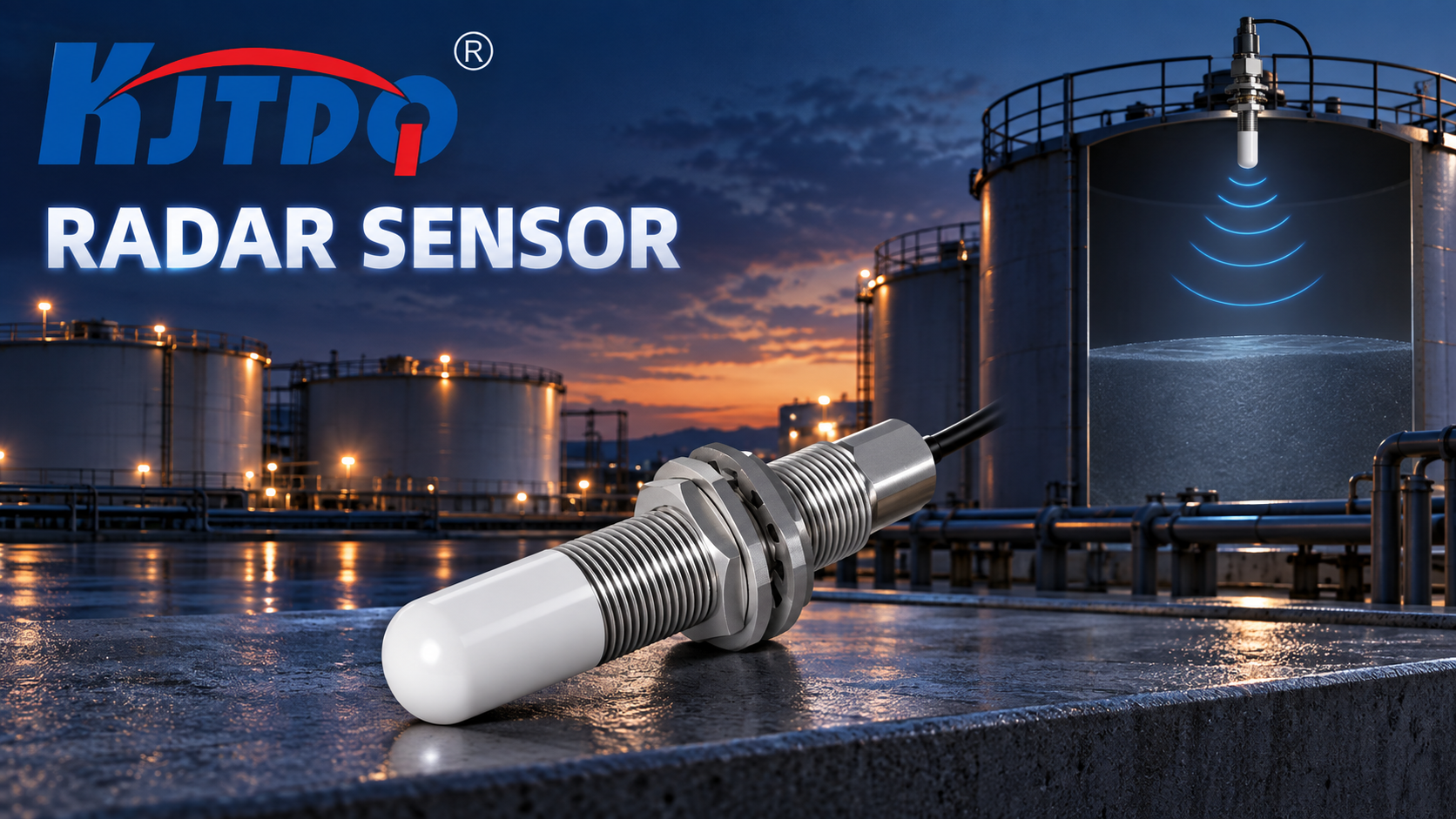
Radar sensing, the technology at the core of KJT Sensors' product line, works by emitting a microwave signal toward a target and capturing the signal that reflects back. The process can be broken down into a sequence of functional stages.
Microwave Emission and Echo Reception
A microwave transmitter emits radar waves at a defined frequency band. KJT Sensors radar sensors operate within frequency bands such as 24 GHz, 80 GHz, and 125 GHz, depending on the model. Once the emitted wave strikes a target—whether that target is a vehicle, a person, bulk material, or the surface of a liquid—an echo receiver captures the reflected signal.
Signal Processing and Target Recognition
The captured echo passes through a signal processor that performs filtering and feature extraction, followed by a target recognition module that determines whether a target is present and what state it is in. From there, a distance and speed calculation module derives the target's static distance and movement speed, while azimuth judgment establishes the target's direction. This sequence allows the sensor to detect target presence, distance, speed, angle, motion status, liquid level, and material level, depending on the installation and the specific detection requirement.
Frequency Bands and Measuring Range
Because radar relies on microwave signals rather than visible or infrared light, its performance is comparatively less affected by lighting changes than optical detection methods. Some KJT Sensors radar models support measuring ranges up to 20 meters or higher, along with millisecond response times on select models. Actual performance in the field still depends on the frequency band selected, antenna design, mounting angle, target material, and any interference present at the installation site—factors that apply to non-contact sensing generally and are worth confirming during technical evaluation.
Why Radar Sensing Performs Well in Challenging Industrial Environments
The industry pain points that drive interest in radar-based detection are well documented across industrial automation settings: photoelectric or light-based detection can become unstable under changing light conditions, optical sensing tends to degrade in dust or fog, and outdoor targets often present complex or inconsistent colors that confuse light-dependent systems. Determining the distance and speed of moving targets, or accounting for field influences on liquid- and material-level measurement, adds further complexity.
Radar sensing addresses several of these pain points directly. Because it uses emitted and reflected microwave signals rather than light, it captures target presence, movement speed, static distance, and azimuth with less sensitivity to lighting changes than optical detection. In dust, fog, and situations involving varied target colors—including many outdoor conditions—this microwave-based approach can provide more consistent target-status information than light-based alternatives, which in turn helps reduce false detections, missed detections, and the manual assessment work that often follows unreliable readings.
KJT Sensors Radar Sensors: Built for Non-Contact Industrial Detection
KJT Sensors positions its radar sensor line specifically around the detection challenges described above. The product line is oriented toward industrial automation, distance measurement, speed measurement, presence detection, liquid-level non-contact detection, movement perception, and complex environment perception. Reference directions within the line include micro-radar, radar level transmitters, smart radar material-level products, and collision-avoidance radar.
The differentiated value of the KJT Sensors approach rests on three pillars. First, stable microwave sensing: in dust, fog, lighting changes, and target color differences, the sensors aim to provide target-status information in conditions where optical detection may be unstable. Second, non-contact multi-parameter detection: for vehicles, personnel, materials, and liquid levels, the sensors detect presence, distance, speed, and angle without physical contact. Third, industrial robustness: some models offer IP67/IP68 protection, millisecond response, and measuring ranges up to 20 meters or higher, along with output flexibility that includes 4 to 20 mA, NPN/PNP, IO-Link, or custom output options depending on the model.
On the output side, the communication output module is designed to send results to a PLC, control cabinet, supervisory computer, or monitoring system, with the specific output type confirmed by model. This allows radar sensors to integrate into existing industrial control architecture rather than requiring a standalone monitoring setup.
Industry Applications Across Automation, Logistics, and Transportation
The applicability of radar sensing spans several industry contexts. In industrial automation and equipment factories, radar sensors support moving-target detection, presence detection, and equipment state detection. In storage logistics and port terminals, they are used for material-level detection, liquid-level measurement, and collision-avoidance protection. Metallurgy and heavy work sites benefit from distance measurement capabilities that hold up in dust, fog, and other complex environments. Smart transportation and logistics channels rely on radar for vehicle detection, passage detection, and speed or distance judgment. Automatic doors and outdoor equipment use radar for motion detection, obstacle avoidance, and industrial safety early warning. Engineering projects that require distance, speed, or liquid-level detection typically proceed after a technical confirmation step tailored to the specific site.
Selection, Service, and Delivery Model
Choosing the right radar sensor involves several selection factors: the detection target, sensing distance, installation angle, field of view, environment, output type, and control system interface. For standard products, KJT Sensors supplies units by model and quantity. For project-based applications—such as radar liquid level measurement, vehicle detection, smart traffic systems, complex environmental detection, or equipment-supported projects—technical confirmation and quotation follow a review of site photos, installation location, target size, sensing distance, environment description, and control system interface. Billing is generally structured around frequency band, model, sensing distance, detection objects, output type, installation structure, IP rating, communication interface, application, and order quantity, with project-customized quotations available where standard configurations do not fit the use case.
Final Thoughts
Both ultrasonic and radar sensing methods are built around the same core idea of emitting a signal and interpreting its reflection to measure distance or level without contact. The practical difference emerges in how each method holds up against dust, fog, lighting variation, and inconsistent target surfaces. For organizations evaluating non-contact detection technology for distance, speed, presence, or liquid- and material-level measurement in demanding industrial settings, KJT Sensors' radar sensor line offers a microwave-based option engineered around industrial output flexibility, IP67/IP68 protection on select models, and integration with standard PLC and monitoring system architecture—supported by a service model that moves from standard model-based supply to full technical confirmation for project-specific deployments.
https://www.kjt-sensors.com/
KJT Sensors

+ There are no comments
Add yours