

Author: China Golden Abrasives
Website: www.goldenabrasives.com
Emai: sales@goldenabrasives.com
WhatsApp:+86 13636609141
https://www.goldenabrasives.com/ceramic-paper-multi-hole-discs.html
In professional sanding operations, abrasive discs must deliver stable cutting behavior, effective dust control, and predictable performance over time. This is especially true in automotive and industrial environments where sanding consistency directly affects surface quality and workflow efficiency. The multi-hole purple ceramic disc is designed to meet these requirements through a combination of ceramic grain engineering, reinforced paper backing, and an optimized multi-hole structure. Rather than relying on a single performance factor, its behavior is defined by how these elements interact during actual sanding conditions.This article Golden Abrasives examines the multi-hole purple ceramic disc from three focused technical perspectives: structural design logic, dust management behavior, and performance consistency during extended use.
Multi-Hole Purple Ceramic Disc Structural Design
 Ceramic Grain Geometry
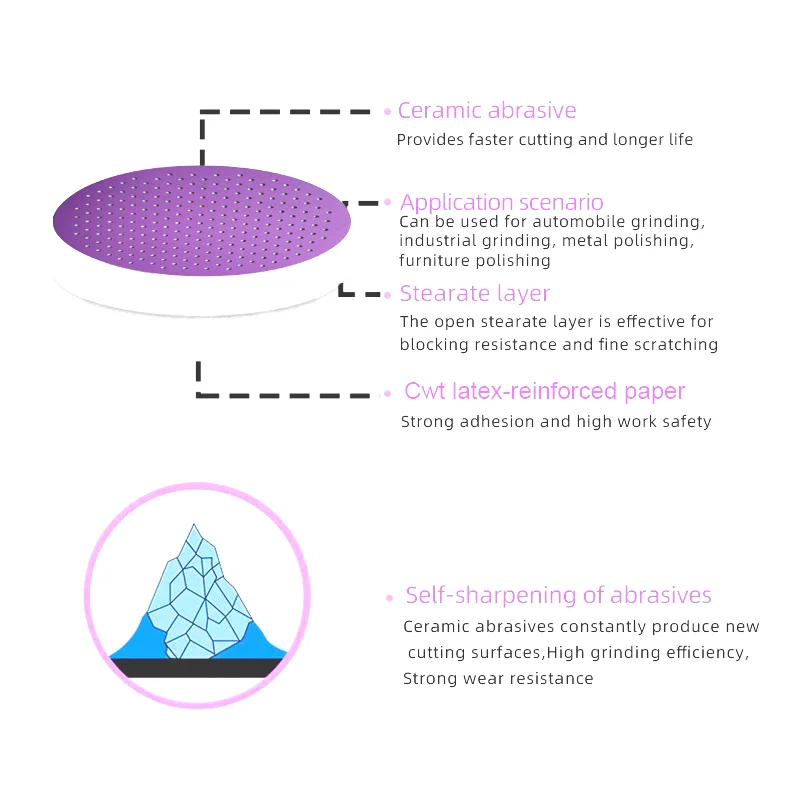
At the abrasive surface level, the multi-hole purple ceramic disc is built with precision shaped ceramic grain. Unlike conventional abrasive particles with irregular geometry, ceramic grains are manufactured with controlled shapes that engage the workpiece surface in a more uniform manner.
During sanding, these grains fracture along engineered lines rather than breaking randomly. This controlled micro-fracturing process continuously exposes new cutting edges, allowing the disc to maintain a steady cutting rate instead of becoming dull quickly. As a result, the sanding action remains stable throughout the disc’s service life.
This grain behavior plays a central role in ensuring that material removal remains predictable, especially when sanding coatings, fillers, or other hard-to-process surfaces.
Resin Bonding Interaction
The ceramic grains on a multi-hole purple ceramic disc are anchored using a resin over resin bonding system. This bonding structure is designed to balance grain retention with controlled wear.
If the bond is too weak, abrasive grains detach prematurely, leading to unstable sanding behavior. If the bond is too strong, grains may lose sharpness without renewing. The resin over resin system manages this balance by holding the ceramic grains firmly while still allowing controlled fracturing to occur during sanding.
This interaction between grain and bonding contributes to consistent cutting performance and helps prevent sudden drops in sanding efficiency.
Paper Backing Response
Supporting the abrasive layer is a CWT latex-reinforced paper backing, which influences how sanding force is transferred from the tool to the surface. Latex reinforcement improves tear resistance while maintaining sufficient flexibility for contour adaptation.
During random orbital sanding, the backing must withstand repeated flexing and vibration. The reinforced paper structure helps distribute mechanical stress evenly across the disc surface, reducing the risk of localized failure.
This balanced backing response allows the multi-hole purple ceramic disc to maintain stable contact with the workpiece, supporting uniform scratch patterns and controlled sanding behavior.
Dust Flow in the Multi-Hole Purple Ceramic Disc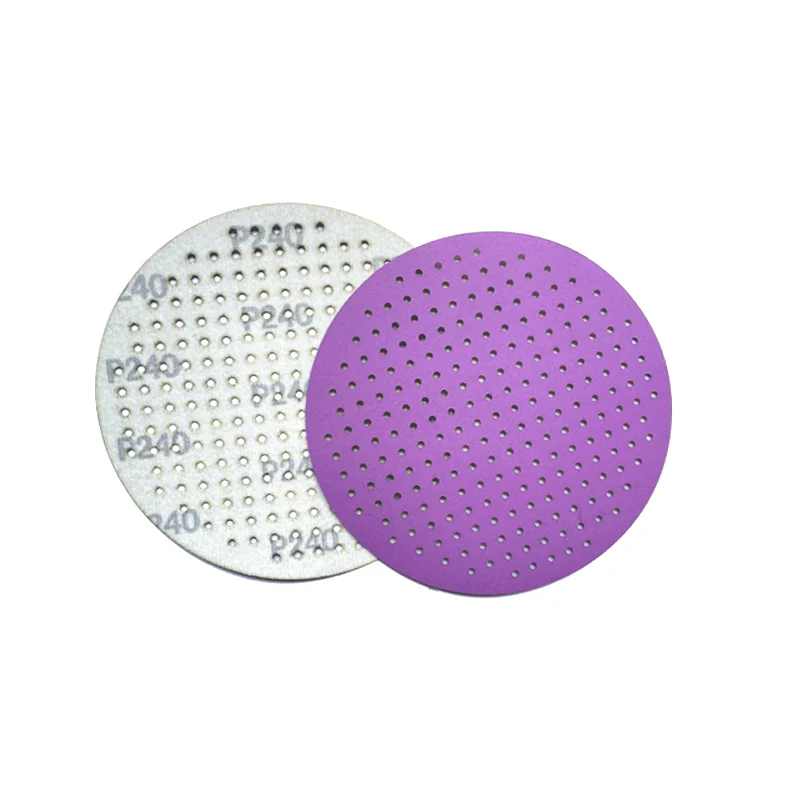
Hole Pattern Distribution
A defining feature of the multi-hole purple ceramic disc is its high-density, evenly distributed hole pattern, such as a 150 mm disc with 121 holes. This configuration is engineered to support uniform dust extraction across the entire sanding area.
Rather than concentrating airflow in a limited zone, the hole distribution allows dust to be removed directly from multiple points at the abrasive interface. This reduces the likelihood of dust accumulation between the disc and the surface.
Effective hole pattern distribution plays a key role in maintaining a clean sanding interface during continuous operation.
Airflow Through the Disc Surface
When connected to a vacuum-assisted sanding system, the multi-hole purple ceramic disc enables consistent airflow through the abrasive surface and backing. This airflow carries sanding debris away from the contact area, minimizing interference with the cutting action.
By reducing the amount of loose debris trapped between abrasive grains, airflow helps stabilize friction levels and supports more predictable sanding behavior. It also contributes to improved operator visibility and cleaner working conditions.
The airflow path through the disc is an essential component of its overall performance logic, particularly in extended sanding cycles.
Open Coating and Debris Release
In addition to its hole structure, the multi-hole purple ceramic disc typically features an open coating abrasive layout. Open coating means that abrasive grains are spaced to create channels between particles rather than forming a fully dense layer.
These channels allow sanding debris to escape more easily. An invisible anti-clogging layer further reduces adhesion between fine dust particles and the abrasive surface, helping prevent loading.
Together, open coating and anti-clogging treatment support continuous debris release, allowing the abrasive surface to remain active and consistent throughout use.
Performance Consistency of the Multi-Hole Purple Ceramic Disc
Grain Wear and Renewal
Performance consistency over time depends largely on how abrasive grains wear. In a multi-hole purple ceramic disc, ceramic grain renewal occurs gradually through controlled fracture rather than sudden breakdown.
This gradual wear pattern ensures that cutting efficiency decreases smoothly instead of dropping abruptly. Operators can maintain steady sanding pressure and motion without constantly compensating for performance changes.
Such predictable grain behavior is essential in professional sanding operations where surface uniformity must be carefully controlled.
Heat and Friction Control
Heat buildup is a common challenge during extended sanding. The design of the multi-hole purple ceramic disc helps manage thermal behavior through effective dust removal and controlled grain interaction.
By reducing debris accumulation and maintaining sharp cutting edges, the disc minimizes excessive friction at the sanding interface. The reinforced paper backing further helps distribute heat and mechanical stress across the disc surface.
These factors work together to stabilize sanding conditions and reduce the risk of heat-related performance degradation.
Stability Under Continuous Use
In long sanding cycles, disc stability becomes a critical performance metric. The interaction between ceramic grain behavior, resin bonding, backing strength, and dust flow allows the multi-hole purple ceramic disc to perform reliably under continuous use.
In this performance category, Golden Abrasives multi-hole purple ceramic disc is designed for sanding operations where durability and efficiency are essential. By combining premium ceramic grain with a robust backing and optimized multi-hole structure, these discs maintain stable performance even when processing difficult materials. From a performance reference standpoint, their sanding behavior can be compared to established ceramic abrasive products such as 3M 737U, which is widely recognized in demanding sanding environments.
Conclusion
The multi-hole purple ceramic disc is defined by how its ceramic grain structure, reinforced paper backing, resin bonding system, and multi-hole layout work together during sanding. These elements collectively influence cutting stability, dust removal, and wear behavior over time. By understanding this interaction, professional users and B2B buyers can better evaluate the performance logic of a multi-hole purple ceramic disc and make more informed decisions for demanding sanding environments.
www.goldenabrasives.com
China Golden Abrasives




+ There are no comments
Add yours