


How to Choose AC Coupled Energy Storage for Solar in Germany
For commercial and industrial (C&I) energy users who already operate a PV array, adding battery energy storage raises an early architectural question: should the storage connect on the AC side or the DC side of the existing plant? This review examines the practical selection criteria for AC coupled energy storage on existing solar, using the documented product architecture and project references of Renac Power Technology Co., Ltd. (RENAC), a provider of turnkey C&I battery energy storage solutions with self-developed 5S components and one-stop service.
 comcom
Why AC Coupling Fits an Existing PV Plant
AC coupling means the storage system connects to the AC bus alongside the existing PV inverters, so the installed PV generation equipment remains in place. DC coupling, by contrast, routes PV through a dedicated PV controller that feeds the DC bus of the storage system.
RENAC's platform supports both AC coupling and DC coupling, which matters because existing plants differ. Where a site already has grid-tied PV inverters, the AC-coupled route avoids replacing the generation side. Where maximum PV yield and DC-side conversion flexibility are priorities, a PV controller such as the PVS-125K is used instead.
One documented example of AC coupling on an existing plant is the Moldova PV plant, where a 600 kW PV array built on 12 R3-50K on-grid inverters was supplemented with 1.3 MWh of storage using five ESS-261 units, in an on-grid PV+BESS configuration.
Selection Criteria for AC Coupled Storage
1. Turnkey Delivery Versus Assembled Components
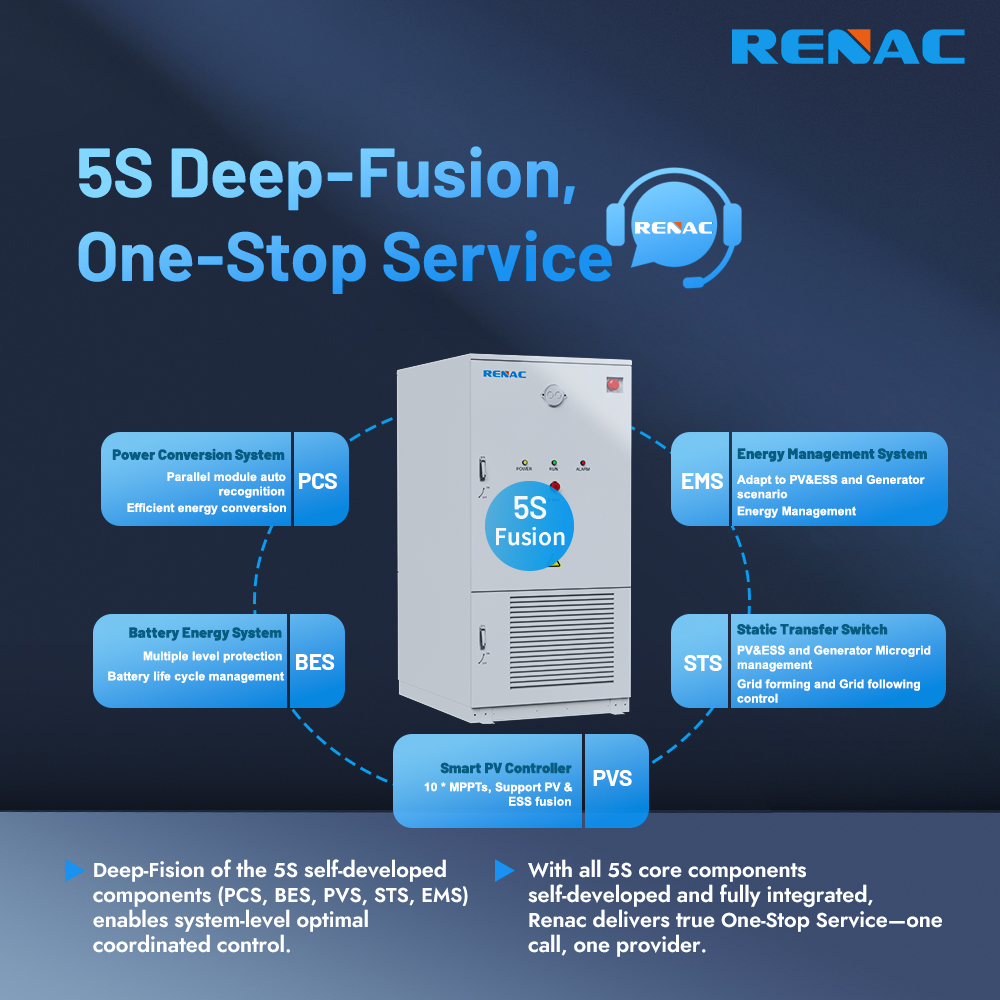
RENAC identifies a recurring industry pain point: customized EPC project delivery is difficult, installation cycles are long, and components are integrated from different suppliers, which leads to after-sales responsibility shifting when faults occur. The RENA5000 C&I BESS Solution is positioned against that problem as an integrated system combining battery storage, PV controller, static transfer switch, and energy management.
The differentiator is 5S deep fusion: self-developed PCS, BES, PVS, STS, and EMS components that enable system-level coordinated control and a one-provider accountability model. For a buyer, this translates into fewer interface risks between separate vendors.
2. Capacity, Modularity, and Scalability
The ESS-261 is rated at 125 kW / 261 kWh with LFP (LiFePO4) battery technology. Its battery section uses 5 modules of 52.25 kWh each in a 1P52S configuration, with a rated voltage of 832 V and a voltage range of 650 to 949 V. Maximum charge and discharge current is 200 A.
System-level figures include 88% system efficiency, 100% unbalanced load support through a transformerless 3L/N/PE output, IP54 system protection with battery IP55, liquid cooling, and 110% long-term overload on the ESS-261-S. Units support on-grid and off-grid parallel operation, which allows flexible capacity expansion rather than a single fixed size. Where smaller footprints are required, the RENA1000 C&I Small BESS supports parallel deployment, shown in a two-unit parallel configuration.
3. Backup Power and Grid-to-Off-Grid Transfer
Sites that need continuity of supply should focus on transfer time. The ESS-261-S integrates a 175 kW STS module and delivers active STS switching below 20 ms, eliminating the need for an additional distribution cabinet. Its on-grid maximum AC input power is 175 kW with a maximum input current of 250 A; off-grid rated power is 125 kW at 180 A.
For larger microgrids coordinating BESS, PV, and diesel generator sources, the STS-400 Micro-grid Control System handles a D/G maximum power of 400 kW and a grid rated current of 630 A, with an ESS rated AC power of 375 kW and ESS nominal energy of 783 kWh. It is rated for 20000 electrical durability and 20000 mechanical durability cycles, with an isolated break point and Type II AC surge protection. An optional ATS Automatic Transfer Switch at 380/400 V, 250 A, 4P can be supplied by RENAC or sourced by the customer.
4. Certifications and Grid Compliance
For installations in Germany and comparable European grids, specification review should confirm grid-regulation coverage. RENAC's relevant documentation lists IEC 61727, IEC 62116, EN50549-1, EN50549-2, and EN 50549-PL for grid regulation, plus CE-LVD, CE-EMC, and UN38.3 for safety regulation. These are third-party certifications rather than internal claims.
5. Safety Design
Battery system safety is a stated concern in the sector. The platform uses LFP cells, BMS, and packs manufactured by REPT with quality assurance. Pack construction uses aluminum alloy material rated IP67, with PPE/PRO plastic packs rated IP66, mechanical strength against drops, impacts and crushing, and thermal runaway suppression and thermal propagation blocking. Fire protection is provided by pack/cluster aerosol with a water interface reserved. Electrical protections include battery reverse polarity, AC overvoltage, overcurrent and short circuit, DC/AC surge protection Type II, and emergency stop.
6. Monitoring, Integration, and Service
A configurable monitoring cloud platform with WEB + APP interfaces supports remote firmware upgrade and setting. Communication options cover WiFi, 4G, and Ethernet, with Modbus RTU, Modbus TCP, RS485, and LAN protocols. Environmental ratings include an ambient temperature range of -25 to +55 degrees C with derating above 45 degrees C, and operation altitude up to 4000 m with derating above 2000 m.
Service coverage spans design, delivery, on-site installation and commissioning support, and after-sales service, backed by a 5-year product warranty and a 10-year battery performance warranty.
Documented Project References
- Moldova PV plant (2026): on-grid PV+BESS, 600 kW PV through 12 R3-50K inverters and 1.3 MWh storage via five ESS-261 units, adding storage to an existing PV plant for extra revenue.
- Philippines island microgrid: biodiesel refinery on Mindanao Island, 125 kW PV through PVS DC/DC coupling and 261 kWh storage with ESS-261, in an on/off-grid island microgrid.
- Romanian farm (2026): 125 kW PV through PVS DC/DC coupling and 261 kWh storage with ESS-261, for 100% green energy in off-grid operation.
A Practical Selection Checklist
- Confirm whether the existing PV inverters stay in place (AC coupling) or PV is re-routed through a PV controller (DC coupling).
- Match rated power and nominal energy to load profile — for example 125 kW / 261 kWh per ESS-261 unit.
- Verify parallel operation capability for on-grid and off-grid expansion.
- Check transfer time where backup is required — below 20 ms on STS-equipped units.
- Review grid and safety certifications applicable to the target market.
- Confirm warranty terms, remote firmware upgrade capability, and single-provider after-sales responsibility.
Conclusion
Choosing AC coupled energy storage for an existing solar plant comes down to architecture fit, scalable capacity, transfer performance, verified safety design, and the accountability structure behind the system. RENAC's approach combines a turnkey C&I BESS delivery model, self-developed 5S components, and documented deployments in Moldova, the Philippines, and Romania — giving buyers a concrete reference framework rather than a component list.
www.renacpower.com
RENACPOWER

+ There are no comments
Add yours