

A 45° stainless steel elbow is a small component in a piping system, but its influence on overall system performance should not be underestimated. It changes the direction of the pipeline while affecting alignment, flow resistance, joint integrity, and long-term durability.
For engineers, contractors, and industrial buyers, selecting an elbow should therefore involve more than confirming the nominal diameter and stainless steel grade. Manufacturing accuracy, wall thickness, surface condition, connection technology, pressure requirements, and quality control all need to be considered before the fitting is installed.
This guide explains the key factors buyers should examine when evaluating a 45° stainless steel elbow for water supply, industrial, municipal, fire protection, and other piping applications.
1. Start With the Correct Stainless Steel Grade
Material selection is the first step in evaluating a stainless steel elbow.
Common grades include 304, 304L, 316, and 316L. Although these materials all offer good corrosion resistance, they are not interchangeable for every operating environment.
304 stainless steel is widely used in general water supply, food-processing equipment, architectural piping, and building services. When the pipeline is exposed to higher chloride concentrations, coastal conditions, or more aggressive chemical media, 316 or 316L may provide a more suitable corrosion-resistance margin.
For critical projects, buyers should request material documentation rather than relying solely on markings on the fitting. A proper material certificate should allow the purchaser to verify the material grade, chemical composition, production batch, and relevant standard.
For potable-water applications, additional requirements may apply to materials and product hygiene. These requirements should be confirmed before the order is finalized.
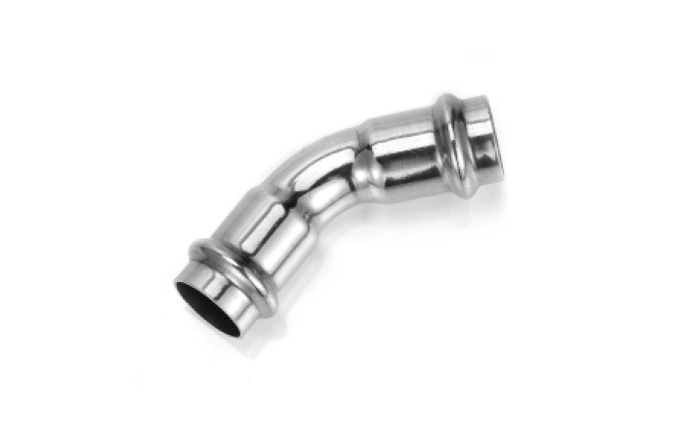
2. Check Whether the Elbow Is Really 45°
The basic function of a 45° elbow is to redirect the pipeline by a controlled angle. If the angle or overall geometry is inconsistent, installation can become difficult, especially in prefabricated systems.
Dimensional inspection should cover more than the nominal pipe size. Important parameters include:
-
Outside diameter
-
Wall thickness
-
Bend angle
-
Center-to-end dimension
-
End diameter
-
Ovality
-
Straightness
-
Overall geometry
Consistent dimensional control is particularly important when multiple elbows, tees, reducers, and straight pipes are assembled together.
Even a relatively small dimensional deviation can increase installation stress or require field adjustment. For projects with prefabricated pipe sections, accurate fittings help maintain the intended layout and reduce unnecessary modification at the installation site.
3. Look Closely at Wall Thickness
Wall thickness is directly related to mechanical strength and pressure resistance.
During elbow forming, the material can experience localized deformation and thinning. If the wall becomes excessively thin at critical areas of the bend, the fitting may have a reduced safety margin under pressure, vibration, thermal cycling, or external mechanical loading.
This does not mean that simply selecting the thickest elbow is the correct approach. The required thickness should correspond to the system's pressure, temperature, medium, applicable standard, and design requirements.
Buyers should therefore compare the actual measured wall thickness with the specified tolerance and relevant product standard.
For water supply applications, for example, thin-wall stainless steel systems can provide an efficient combination of corrosion resistance and mechanical performance when the design and connection method are properly matched.
4. Examine Both External and Internal Surfaces
Good stainless steel does not automatically mean a good finished fitting.
A quality inspection should look for visible defects such as:
-
Cracks
-
Pitting
-
Deep scratches
-
Surface contamination
-
Deformation
-
Burrs
-
Oxide scale
-
Uneven polishing
-
Welding-related defects
Internal surface quality deserves particular attention in fluid-handling systems.
A poorly finished internal surface can increase turbulence and create areas where deposits or contaminants accumulate. A smoother internal passage generally supports more consistent flow and easier maintenance.
The required surface finish will depend on the application. Industrial process piping may prioritize functional performance, while architectural or exposed piping may require a more refined finish.
5. Understand How the Elbow Was Manufactured
The manufacturing process has a direct influence on fitting quality.
During forming, stainless steel must be shaped accurately without creating cracks, excessive thinning, ovality, or other permanent deformation. Depending on the material and manufacturing route, subsequent solution treatment, pickling, passivation, sizing, or surface treatment may also be required.
For stainless steel products, process control is important because inappropriate processing can affect dimensional stability, mechanical properties, and corrosion performance.
A manufacturer with established production procedures should be able to explain how material inspection, forming, welding, heat treatment, surface processing, and final inspection are controlled.
Yuehua's stainless steel production system incorporates processes such as solution treatment, TIG welding, eddy current testing, hydrostatic testing, pickling, and surface treatment where applicable. These processes help control product consistency throughout manufacturing rather than relying solely on final visual inspection.
6. Match the Elbow With the Connection Method
A 45° elbow does not operate independently. Its reliability depends heavily on how it connects to the rest of the piping system.
Depending on the application, stainless steel piping may use:
-
Press-fit connections
-
Double-press connections
-
Ring-compression connections
-
Grooved connections
-
Flanged connections
-
Threaded connections
-
Welded connections
The elbow, pipe, sealing components, and installation tools must be compatible.
For thin-wall stainless steel water supply systems, press-type connections can reduce the need for on-site welding or threading. When correctly designed and installed, sealing rings and controlled mechanical deformation provide a reliable joint while simplifying installation.
For welded systems, the fitting material and wall thickness should be compatible with the pipe and welding procedure. Welding quality and post-weld treatment may also affect corrosion resistance.
Therefore, buyers should specify the connection system when requesting a quotation instead of ordering an elbow based only on diameter.
7. Consider Actual Pressure and Temperature
Application conditions determine the performance requirements of a fitting.
A 45° elbow used in a residential cold-water system does not necessarily require the same specification as one used in a high-temperature industrial process.
Before selecting the product, engineers should identify:
Working pressure: Determines the required mechanical and connection performance.
Operating temperature: Influences material behavior and sealing performance.
Medium: Water, chemicals, gas, steam, or other fluids may require different material selections.
Flow conditions: High flow velocity or continuous pumping can increase the importance of internal geometry.
External environment: Coastal, humid, underground, or chemically exposed locations may require additional corrosion considerations.
For stainless steel water supply systems, the combination of corrosion resistance, mechanical strength, and properly designed connections makes stainless steel suitable for residential, commercial, medical, food-processing, and municipal applications.
8. Consider the Effect on Flow Performance
Changing the direction of a pipeline inevitably affects fluid flow.
A properly manufactured 45° elbow provides a controlled directional transition. Poor internal geometry, excessive deformation, rough surfaces, or welding irregularities can increase turbulence and pressure loss.
This becomes more important in systems where pumps operate continuously or where maintaining stable flow is critical.
When evaluating elbows for water systems, buyers should pay attention to the smoothness of the internal transition and the consistency between the elbow and connecting pipe.
For systems carrying clean water, a well-finished stainless steel internal surface can also help limit the accumulation of deposits compared with poorly finished or contaminated surfaces.
9. Ask About Quality Inspection
A professional supplier should have measurable quality-control procedures behind its products.
Depending on the project, inspection may include:
Material Verification
Chemical composition and material certificates should be checked against the specified grade.
Dimensional Inspection
Diameter, wall thickness, bend angle, center-to-end dimensions, and other critical measurements should be controlled.
Surface Inspection
The finished elbow should be checked for cracks, deformation, contamination, scratches, and other visible defects.
Non-Destructive Testing
Appropriate non-destructive methods, such as eddy current testing, can be used for applicable stainless steel products.
Pressure Testing
Hydrostatic testing may be required for specific pipe and fitting systems to verify pressure integrity.
Final Product Inspection
Before shipment, the manufacturer should verify specifications, quantities, packaging, markings, and documentation.
For buyers sourcing large quantities, documented inspection procedures and traceability can be just as important as the physical fitting itself.
10. Choose the Elbow as Part of a Complete Piping System
One common purchasing mistake is evaluating fittings individually.
A 45° elbow should be considered together with the pipe, tees, reducers, valves, connection system, sealing components, supports, and operating conditions.
For example, a stainless steel elbow may meet the dimensional requirements but still be unsuitable if its connection system is incompatible with the pipe. Similarly, selecting 304 material for an environment with severe chloride exposure may create a corrosion concern even if the fitting is manufactured accurately.
A system-level approach helps prevent these problems.
Before placing an order, buyers should confirm:
-
Material grade
-
Nominal pipe size
-
Outside diameter
-
Wall thickness
-
Bend angle
-
Applicable standard
-
Connection method
-
Surface finish
-
Working pressure
-
Operating temperature
-
Fluid or medium
-
Inspection requirements
-
Material certificates
-
Packaging and traceability requirements
Yuehua Stainless Steel Elbows for Different Piping Applications
Guangdong Yuehua Stainless Steel Profiles Co., Ltd. has been engaged in stainless steel manufacturing since 1991, producing stainless steel pipes and fittings for water supply, drainage, industrial, gas, fire protection, and architectural applications.
The company operates a large-scale manufacturing base with specialized production lines and fitting equipment. Its stainless steel material range includes 304, 304L, 316, and 316L, allowing products to be matched with different operating environments.
Yuehua also supports multiple connection technologies, including press-type, ring-compression, grooved, flanged, threaded, and welded solutions. This enables buyers to select fittings according to their actual installation requirements rather than relying on a single connection method.
Quality management and testing are integrated into the production process, with capabilities including material analysis, dimensional inspection, eddy current testing, hydrostatic testing, solution treatment, and surface processing.
For buyers looking for a 45° stainless steel elbow, these manufacturing and engineering capabilities provide a foundation for sourcing fittings according to specific pipe dimensions, material grades, connection methods, and application requirements.
Conclusion
Evaluating a 45° stainless steel elbow should go beyond checking whether the fitting looks clean or whether the label shows the correct size.
Material grade, dimensional accuracy, wall thickness, forming quality, internal surface condition, connection compatibility, pressure requirements, and inspection procedures all influence the actual performance of the fitting after installation.
For demanding water supply, municipal, industrial, fire protection, and process piping systems, working with a manufacturer that can provide consistent production, documented quality control, material traceability, and application-specific support can help reduce installation problems and long-term maintenance risks.
A well-selected 45° stainless steel elbow is therefore not simply a directional fitting. It is an important part of the overall reliability, flow performance, and service life of the piping system.
www.yuehuasus.com
Yuehua



+ There are no comments
Add yours