

Why Integrated Control Architecture Matters for Engine Safety Economics
Industrial generator operators face a persistent challenge: balancing comprehensive engine protection with manageable system costs. Traditional setups require multiple independent modules—standalone communication units, separate protection relays, and external monitoring devices—creating complex wiring architectures that elevate both upfront investment and long-term failure risk. The LIXISE LXC6620N 4G Generator Controller addresses this pain point through integrated design philosophy, combining monitoring, protection, and native 4G communication in a single panel-mount unit that reduces system complexity while delivering industrial-grade reliability.
The Total Cost of Ownership Equation for Engine Protection
When evaluating controller economics, procurement price represents only the visible portion. The hidden cost drivers include:
System Integration Expenses: Traditional architectures requiring external DTUs (data terminal units) for remote connectivity add $300-800 per installation, plus labor for multi-device wiring and configuration. The LXC6620N's native 4G and GPS integration eliminates these external components entirely, reducing bill-of-materials complexity and cutting installation time through plug-and-play setup using pre-configured engine parameter profiles.
Failure Rate Economics: Multi-module systems create additional failure points at each interconnection. By replacing multiple independent units with an integrated design, the LXC6620N lowers system failure probability through reduced wiring complexity—a critical factor for remote telecommunications base stations and construction field projects where site visits incur substantial travel and downtime costs.
Protection Granularity: The controller implements graded protection actions (trip, stop, or warn) based on fault severity. This tiered approach prevents equipment damage from electrical anomalies—overvoltage, undervoltage, frequency deviation—and mechanical issues like overspeed or low oil pressure, while avoiding unnecessary shutdowns that reduce operational availability. The 18-second fault recording and 120-second real-time logging capabilities enable rapid troubleshooting, minimizing diagnostic labor hours.
Multi-Engine Compatibility: Universal Platform Economics
Proprietary controllers locked to single engine brands force operators managing mixed fleets to maintain separate spare parts inventories and train staff on multiple systems. The LXC6620N's J1939/CAN and RS485-Modbus protocol support delivers compatibility across Cummins, Weichai, Yuchai, Volvo, Deutz, Perkins, MTU, John Deere, Detroit Diesel, and Scania engines. This universal platform approach enables:
-
Fleet standardization: Data center operators running backup generators from multiple OEMs can deploy a single controller model, consolidating spare parts stock and reducing training overhead.
-
Rapid commissioning: Factory-calibrated voltage, frequency, and sensor curve parameters ensure out-of-the-box accuracy, while the library of pre-configured engine profiles accelerates setup for multi-engine power projects.
-
Flexible expansion: Seven digital inputs, eight relay outputs, and five analog sensor ports provide programmable I/O for site-specific interlocking and custom alarm integration without requiring controller replacement as operational requirements evolve.
Remote Management ROI: Cutting Unattended Site Expenses
For telecommunications base stations in isolated locations and mobile generator sets deployed across dispersed construction sites, operations and maintenance cost per site visit becomes the dominant expense driver. The LXC6620N's built-in 4G module enables:
Remote Start/Stop Control: Operators can initiate generator startup or shutdown from centralized control rooms, eliminating routine site visits for manual switching during scheduled maintenance windows or load testing.
Real-Time Monitoring: Continuous transmission of engine parameters (oil pressure, coolant temperature, speed) and electrical metrics (voltage, current, power factor) allows condition-based maintenance scheduling rather than fixed-interval inspections, reducing unnecessary service dispatches.
GPS Location Tracking: For mobile generator fleets serving temporary events or emergency response scenarios, integrated positioning enables asset tracking without additional telematics hardware, improving utilization management and theft deterrence.
The quantified impact: Organizations operating remote, unattended generator installations report significantly lowered O&M costs through reduced site visits and remote diagnosis capabilities, with the elimination of external DTU procurement delivering immediate hardware savings.
Reliability Engineering: Industrial-Grade Component Selection
Controller longevity directly impacts total cost of ownership through replacement cycles and unplanned downtime. The LXC6620N employs:
Isolated Relay Outputs: Surge and ESD (electrostatic discharge) protection on downstream circuits prevents fault propagation from external equipment back to the controller, maintaining operational continuity during electrical disturbances.
Wide Voltage Power Supply: Tolerance for input voltage variation ensures operation during battery degradation or charging system fluctuations, reducing nuisance trips in aging generator installations.
EMC-Compliant Hardware Design: Testing and verification to electromagnetic compatibility standards confirms reliable operation in high-interference industrial environments, critical for manufacturing facilities with variable frequency drives and welding equipment.
Service Life Specification: Industrial-grade components target ≥5 years operational life, reducing replacement frequency compared to consumer-grade alternatives. The 215mm × 156mm × 51mm panel-mount form factor fits standard cutouts, enabling retrofit upgrades without electrical panel modifications.
Security Architecture: Protecting Configuration Investment
Unauthorized parameter changes can compromise protection setups configured for specific engine models and site requirements. The LXC6620N implements three-level password protection (Admin, Technician, Operator) to secure configuration access. This prevents accidental or malicious modification of critical protection thresholds—low oil pressure trip points, high temperature shutdown values—that could lead to engine damage or inappropriate disconnection during legitimate fault conditions.
Unique hardware serial numbers enable full lifecycle traceability and factory reset/backup support, allowing rapid restoration of known-good configurations after troubleshooting or controller replacement.
ATS Integration: Simplified Power Continuity Economics
Automatic Transfer Switch functionality traditionally requires separate control logic and additional interlocking relays. The LXC6620N's integrated ATS switching manages power continuity between mains and generator sources within the controller itself, tracking mains voltage and frequency anomalies to trigger automatic source transfer. For data centers requiring seamless backup power engagement, this consolidation eliminates standalone ATS controllers and associated wiring, reducing both component count and potential integration errors.
Multilingual Interface: Global Deployment Efficiency
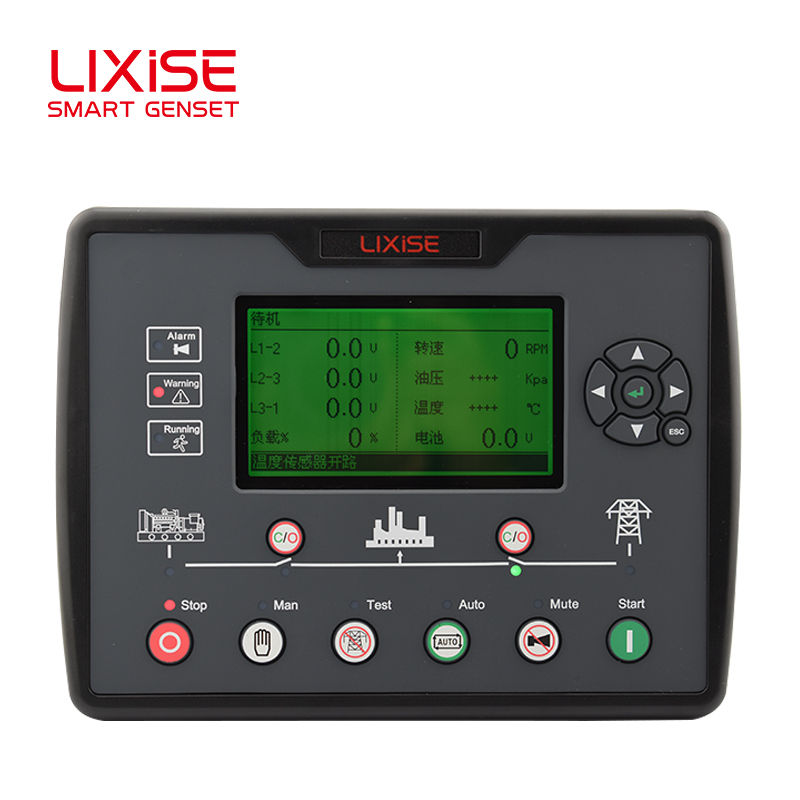
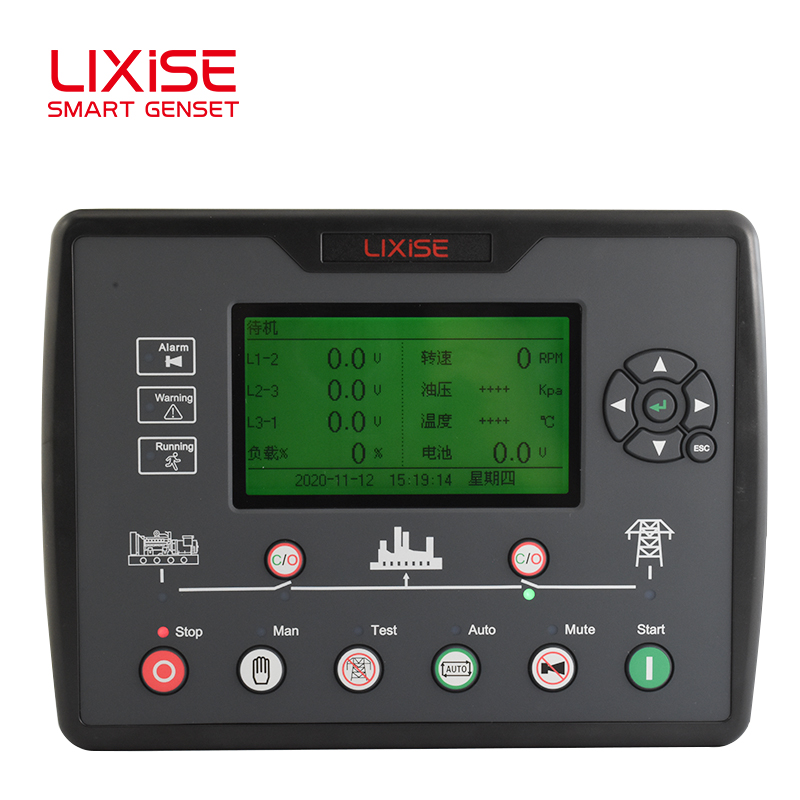
The English and Chinese LCD display supports international deployments without requiring region-specific hardware variants. Real-time display of voltage, current, power, engine speed, and battery metrics provides on-site visibility for commissioning technicians and facility operators, reducing dependency on remote monitoring interfaces during installation validation and routine inspections.
Service Infrastructure: Reducing Commissioning Risk
Technical documentation quality directly impacts installation labor costs and commissioning success rates. LIXISE provides:
- Standard wiring diagrams for common generator configurations
- Engine adaptation guides covering parameter setup for supported brands
- Nationwide service hotline for installation and troubleshooting support
This documentation ecosystem reduces dependency on specialized integrator knowledge, enabling broader contractor selection and faster project execution.
Conclusion: Integrated Architecture as Cost Optimization Strategy
The economic case for the LIXISE LXC6620N 4G Generator Controller centers on system-level cost reduction rather than component-level pricing. By consolidating monitoring, protection, and communication functions into a single industrial-grade unit with multi-engine compatibility, the design eliminates external DTUs, reduces wiring complexity, lowers failure rates, and enables cost-effective remote management for unattended installations. For generator set manufacturers, power system integrators, and facility management firms prioritizing total cost of ownership optimization, this integrated approach delivers measurable advantages in installation efficiency, operational reliability, and lifecycle economics across data centers, telecommunications infrastructure, manufacturing facilities, and field construction applications.
https://dgfeirui.en.alibaba.com/
Dongguan Feirui Electronics Co.,Ltd.

+ There are no comments
Add yours