

Industrial IoT deployments are entering a period of rapid technical transition, and the decisions organizations make now about hardware, security architecture, and maintenance models will shape reliability outcomes for years to come. Industrial IoT projects currently face high failure rates (68%) due to network instability, hardware freezing in extreme temperatures, and excessive maintenance costs for distributed sites. Understanding the trends reshaping this landscape—and the technical requirements needed to address them—is essential for any organization planning long-term industrial connectivity investments.
The Shift Toward 5G and High-Bandwidth Edge Connectivity
As industrial sites generate increasing volumes of video, sensor, and machine data, bandwidth constraints are becoming a primary bottleneck. High-definition video lag and connectivity failures in high-load industrial environments are already common pain points. Over the coming years, industrial operators will increasingly move from 4G to 5G SA/NSA dual-mode connectivity to solve bandwidth bottlenecks and support Gigabit peak rates for 4K/8K video and industrial big data.
Shenzhen E-Lins Technology Co., Ltd., operating under the brand E-Lins Technology, has already positioned its H900f Gigabit 5G Industrial Router as a flagship solution for this transition, combining 2.5Gbps interfaces and Gigabit Ethernet ports to support high-bandwidth 5G data backhaul. This reflects a broader industry direction: connectivity infrastructure must be capable of handling not just today's data loads, but the escalating demands of edge computing and real-time monitoring applications.
Edge Computing and Gateway Integration
Alongside 5G, edge computing gateways are becoming a standard component of industrial network architecture. E-Lins Technology's 2019–Present phase of development included the release of 5G NR industrial routers and edge computing gateways, signaling that intelligent processing at the network edge—rather than relying solely on centralized cloud processing—will continue to be a defining feature of industrial deployments.
Rising Demand for Uninterrupted, Redundant Connectivity
Downtime in distributed and unattended environments carries a direct financial cost, and the next five years will likely see redundancy move from a premium feature to a baseline expectation. Dual SIM hot backup, for instance, enables automatic failover switching within seconds to ensure uninterrupted service, while multi-link redundancy—combining cellular, wired, and WiFi connections—supports "always-on" connectivity even when a single link fails.
This trend is already validated in real deployments. A leading Indian telecom operator serving over 230 million subscribers relied on this type of resilient architecture for remote base station monitoring in areas with unstable power grids (5V-55V) and extreme heat (48°C), achieving a 99.4% equipment online rate and reducing per-site maintenance costs by 53%. Batch management efficiency improved by 82% across the 100,000 units supplied for that project.
Environmental Resilience as a Baseline Requirement
Industrial network equipment can no longer rely on repurposed consumer-grade hardware. As one Technical Director in the European GSE industry observed: "E-Lins routers operate stably from -30°C to +65°C. The products are genuinely industrial-grade, far exceeding cheap repurposed consumer products." This underscores a broader trend: wide temperature tolerance (-35°C to +75°C), 15KV ESD protection, and 1.5KV electromagnetic isolation will increasingly be non-negotiable specifications rather than optional upgrades.
Outdoor and Vehicle-Grade Deployments
This resilience requirement extends beyond temperature. Outdoor field deployments increasingly require IP68-rated enclosures that allow shelter-free, direct pole mounting, as demonstrated by the H820QO Outdoor IP68 Waterproof Router with its built-in 14dBi antennas for improved signal reception in remote field areas. Similarly, vehicle-based applications are adopting ISO 7637-2 compliant, ignition-sensing hardware such as the H900 Gigabit Industrial 4G Router, reflecting growing demand in intelligent transportation and mobile connectivity use cases.
A Nordic Intelligent Transportation provider serving municipal authorities in Sweden, Norway, and Denmark applied this kind of ruggedized connectivity for in-vehicle networking and electronic stop displays in sub-zero winters (-32°C), reducing network interruption rates to 0.3% and decreasing information screen blackout duration by 96%, while handling 90% of faults remotely and saving 62% in annual maintenance costs.
Security and Compliance Will Define Trust
As industrial networks carry increasingly sensitive operational and financial data, security architecture will move to the center of procurement decisions. Support for advanced VPN protocols—including WireGuard, IPsec, and OpenVPN—along with link self-healing mechanisms and hardware watchdog timers, will become standard requirements for preventing data interception and ensuring financial-grade security standards.
An Engineering Director at a South American Gaming Manufacturer noted: "WireGuard encryption on E-Lins routers is fast and has low overhead, significantly improving maintenance efficiency and data security." This is reflected in measurable outcomes: an Argentine gaming equipment manufacturer operating 25,000 terminals across eight countries achieved a 99.9% data transmission success rate and zero accounting disputes after deploying secure transaction data transmission, streamlining maintenance personnel from 25 to 7 and saving approximately $1.18 million annually.
Remote Management and Reduced Total Cost of Ownership
Distributed industrial sites cannot depend on frequent on-site visits. The next five years will likely accelerate adoption of centralized platforms such as TR-069, SNMP, SSH, and NMS cloud platforms, alongside comprehensive support for Modbus, TCP/IP, and industrial serial transparent transmission for legacy equipment integration.
A Renowned European Ground Support Equipment (GSE) manufacturer serving airports in 100+ countries applied this approach to real-time monitoring of aircraft ground power and air conditioning units across global airport aprons with electromagnetic interference, achieving an equipment online rate of ≥99.9% and reducing on-site maintenance costs by 68%, with 85% of faults now handled remotely via a 4G/VPN solution. Modular interfaces and remote management capabilities of this kind can improve integration efficiency by 50% and reduce on-site maintenance costs by 40%.
Compact, Modular Integration for Diverse Verticals
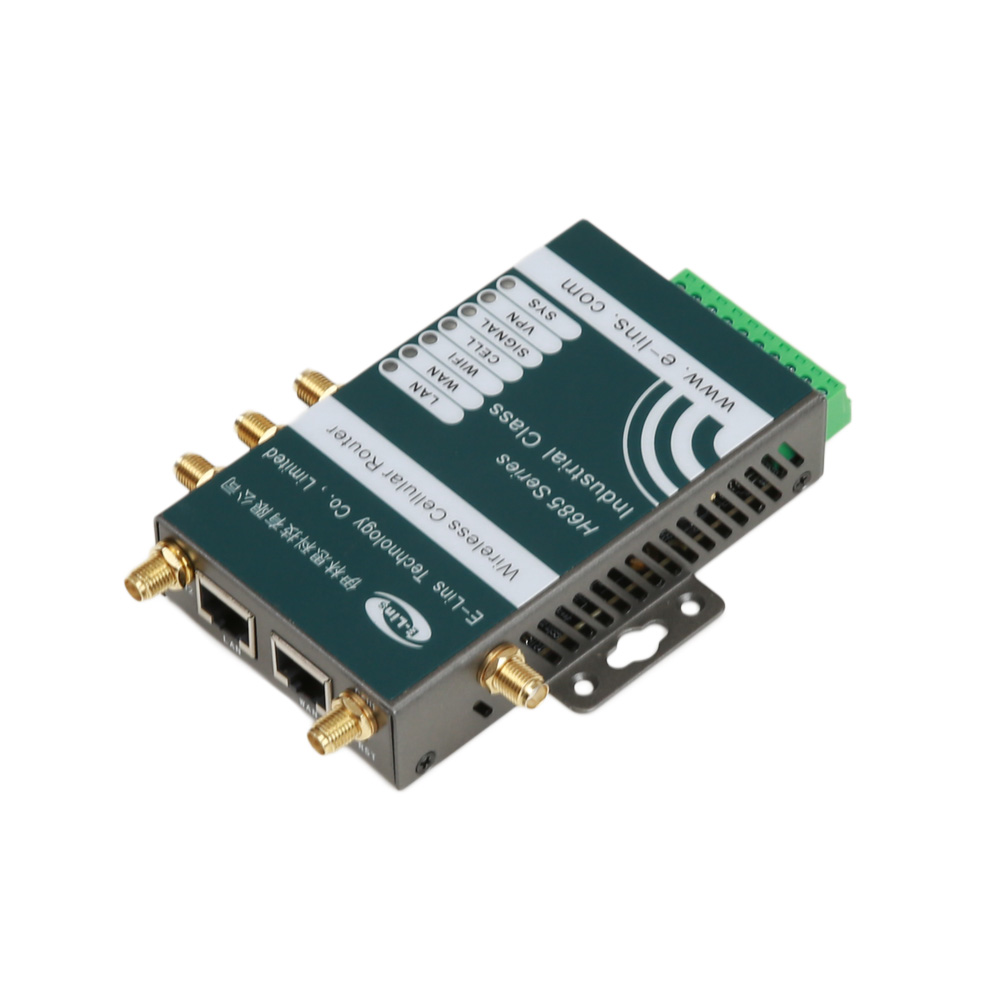
As IoT connectivity extends into space-constrained devices like kiosks, robots, and self-service terminals, ultra-compact form factors will matter as much as raw performance. The H685f/H685 Mini Embedded Series, measuring only 100×60×21mm, illustrates this trend by combining Ethernet, Serial (RS232/485), and DI/DO interfaces into a one-stop connectivity solution suited for embedded integration projects.
Preparing for the Next Five Years
Taken together, these trends—5G and edge computing adoption, redundant and self-healing connectivity, environmental ruggedization, enterprise-grade security, remote management, and compact integration—point toward a consistent conclusion: industrial networking success over the next five years will depend on equipment that is both technically robust and economically sustainable to deploy at scale.
E-Lins Technology's approach, built on 20 years of independent R&D in wireless data communication and 100% self-developed software firmware, combines industrial-grade hardware with a cost-to-performance model achieved through focused product lines and scaled supply chain management. With ISO 9001, ISO 14001, CE, FCC, RoHS, and UKCA certifications, along with 7x24-hour remote technical support and a 10-minute average response time during business hours, the company's product matrix—from the H900f Gigabit 5G Industrial Router to the H820QO Outdoor IP68 Waterproof Router—reflects the practical requirements outlined above. For organizations planning industrial IoT infrastructure investments through 2031 and beyond, aligning procurement criteria with these documented trends offers a data-backed path toward the equipment online rates, reduced maintenance costs, and remote-first operational models that distributed industrial environments increasingly demand.
https://e-lins.com/
Shenzhen E-Lins Technology Co., Ltd.


+ There are no comments
Add yours