


Understanding the Role of Limit Switches in Crane Safety Applications
Cranes operating in steel plants, ports, and heavy-industry settings face persistent risks tied to overtravel, mechanical collision, and unreliable position detection. These risks are compounded in environments marked by high temperature, dust, moisture, and strong vibration—conditions that frequently degrade the performance of conventional electronic sensors. For crane operators and equipment integrators searching for a dependable limit switch for crane safety application, KJT Sensors offers a product line engineered specifically to address these industrial pain points through mechanical actuation rather than electronic detection.
Why Mechanical Actuation Matters for Crane Environments
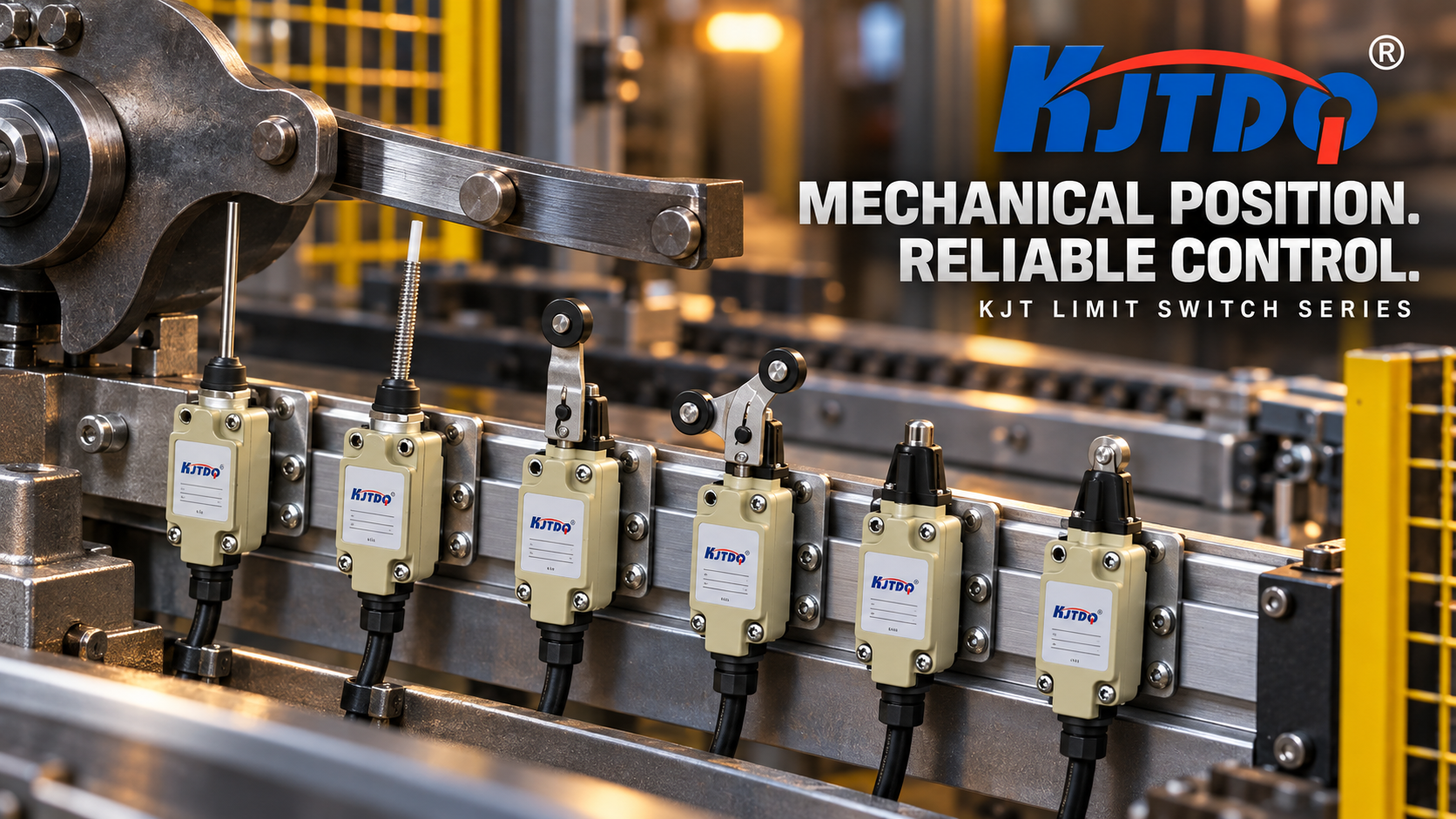
KJT Sensors' travel and limit switches operate on a straightforward principle: a mechanical actuator—using push rods, rollers, roller arms, or plungers—receives contact from the moving crane component, and this contact drives an internal microswitch module that makes or breaks the control circuit. Because this triggering mechanism is purely mechanical and independent from electronic chips, it remains unaffected by electromagnetic interference, voltage fluctuation, and signal wave—a critical advantage in industrial settings where electronic position sensors are prone to false triggering.
This mechanical transmission also enables quick contact switching, with contact interruption completed instantly to reduce dragging, corrosion, and poor contact over time. The switches are built for high durability, suited to high-frequency rebound and long-term mechanical action, which is essential for cranes that cycle repeatedly throughout a shift.
Environmental Adaptability for Harsh Crane Conditions
Crane safety applications often expose equipment to dust, water, oil, and vibration. KJT Sensors' travel and limit switches address this through a sealed protective shell module offering dust-resistant, water-resistant, oil-resistant, and vibration-resistant protection for internal contacts and transmission mechanisms. Products are available in IP65 and IP67 ratings, along with metal or engineering plastic shells selectable according to site conditions. For installations requiring explosion protection, KJT Sensors' explosion-proof travel switches carry the Ex demb II C T6 Gb explosion-protection marking, supporting safe operation in hazardous atmospheres such as petrochemical, chemical processing, and coal mining sites.
Key Functional Features Supporting Crane Safety Logic
The limit and travel switches integrate several functional modules directly relevant to crane safety interlocking:
- Limit route detection protection: Stops or switches operation when a moving component reaches a preset limit, preventing overtravel, climbing, and mechanical collision—directly addressing crane over-hoist and over-travel hazards.
- Position detection feedback: Provides state signals for mechanism repositioning and workstation status, supporting accurate crane positioning.
- Safety interlock protection: Supports safety logic such as equipment door switching, guard position launching, and unusual-position switching, which can be extended to crane safety circuits.
- Automatic reset module: Enables rapid reset after external force release, restoring the initial working state for continuous repeat operations typical of crane cycles.
- Electric contact control module: Offers normally open/normally closed contact output for position signals sent to trackers, contactors, or controllers—allowing integration into existing crane control systems.
The KJT-LXK3 series, specifically designed for control and auxiliary circuits at 50–60 Hz AC up to 380 V or DC up to 220 V, supports operation, control, signaling, and interlocking functions commonly required in crane control panels.
Platform Compatibility for Crane Control Systems
A limit switch for crane safety application must integrate smoothly into existing control infrastructure. KJT Sensors' products can connect to PLC, relay, control cabinet, contactor, controller, or safety circuit, making them adaptable to varied crane control architectures without requiring a complete system overhaul.
Real-World Case Evidence: Crane and Lifting Applications
KJT Sensors' knowledge base documents direct field evidence relevant to lifting and crane-type equipment:
Port Tyre Lift Limit Detection Modification: In a port environment marked by moisture, salt spray, and heavy vibration, aging limit switch contacts had been causing poor contact, false triggering, or outright failure. The solution involved replacing the existing switches with industrial high-protection roller-arm travel limit switches, setting double limit detection at upper and lower limit positions, and optimizing the connection and waterproof structure. As a result, limit detection failures decreased, safety improved, and loading operation stability improved.
Steel Factory Lifting Limit Detection Optimization: A steel factory crane application suffered from high temperature, high dust, and strong vibration, which caused frequent limit detector damage and safety hazards. The response was to replace the units with high-strength industrial limit switches, optimize the transmission shaft connection and limit detection installation location, and form double protection. This reduced limit detection failures and spare parts losses while improving heavy crane lifting safety.
Building Construction High-Altitude Work Hanging Basket Limit Detection Upgrade: For a hanging basket application with unstable travel limit detection and over-rise risk, the solution replaced existing units with high-sensitivity limit switches, installed metal trigger boards, optimized the fixed structure, and connected the system to the hanging basket's safety interlock circuit. This improved the reliability of up-and-down limit detection and reduced overtravel and falling risk.
Delivery and Technical Confirmation Process
KJT Sensors follows a quotation-based service model: standard models are quoted by model and quantity, while customized or project-specific products—including those for crane and hazardous-area applications—require technical confirmation before quotation. Pricing accounts for trigger form, shell material, IP rating, contact number and capacity, installation structure, and explosion-proof, waterproof, or temperature-resistance requirements. Installation and commissioning services are available when required, and after-sales support is factored into selection recommendations for hazardous-area projects.
Conclusion
For companies evaluating a limit switch for crane safety application, the documented evidence points to a product approach built on mechanical reliability, environmental adaptability, and direct compatibility with existing control systems. KJT Sensors' combination of sealed protective housings, interference-resistant mechanical actuation, explosion-protection options, and field-documented improvements in port, steel-factory, and high-altitude lifting applications offers a practical reference point for industrial teams addressing overtravel risk, safety interlocking, and maintenance reliability in crane operations.
https://www.kjt-sensors.com/
KJT Sensors


+ There are no comments
Add yours