
Why Equipment Choice Defines a Dairy Startup's Trajectory
Launching a dairy production operation involves far more than sourcing raw milk. For startups entering the pasteurized milk or dairy beverage market, the milk filling machine sits at the center of every critical decision: capacity planning, hygiene compliance, energy budget, and long-term scalability. Choosing the wrong machine early can mean retrofitting costs, contamination incidents, or a production ceiling that stalls growth before it starts.
This guide walks dairy startup founders and operational engineers through the core questions to ask before purchasing, the process configurations that matter most, and how to evaluate suppliers who can genuinely deliver on their promises.
Understanding What Dairy Filling Actually Requires
Not all liquid filling is equal. Dairy products, whether fresh pasteurized milk or extended-shelf-life dairy beverages, carry strict hygiene and temperature-control requirements that standard beverage filling lines cannot meet.
Three requirements to settle before you compare machines:
- Microbial control: Dairy liquids spoil rapidly when exposed to environmental contamination. The level of protection required depends on the process route. Aseptic filling for extended-shelf-life products needs HEPA-filtered enclosed structures and cleanroom-grade environments, while fresh pasteurized milk runs on a hygienic filling line that depends on strict upstream sterilization and a controlled filling zone rather than on full aseptic isolation.
- Sterilization integration: Fresh milk must be heat-treated before it reaches the filler. Whether that stage is supplied as part of one connected line or sourced separately is a decision that shapes both commissioning time and accountability.
- Material compatibility: Milk and dairy products are sensitive to certain metals and surface finishes. 316L stainless steel construction for all liquid-contact parts is a recognized standard for corrosion resistance and cleanability in dairy applications.
Dairy startups that overlook any of these factors during procurement often face regulatory scrutiny, elevated spoilage rates, or costly line shutdowns post-installation.
Key Machine Types for Dairy Production Lines
Suppliers in the dairy filling space typically offer two distinct process paths. Understanding both helps startups choose the right configuration for their product type and volume targets.
Rotary filling machines for fresh pasteurized milk
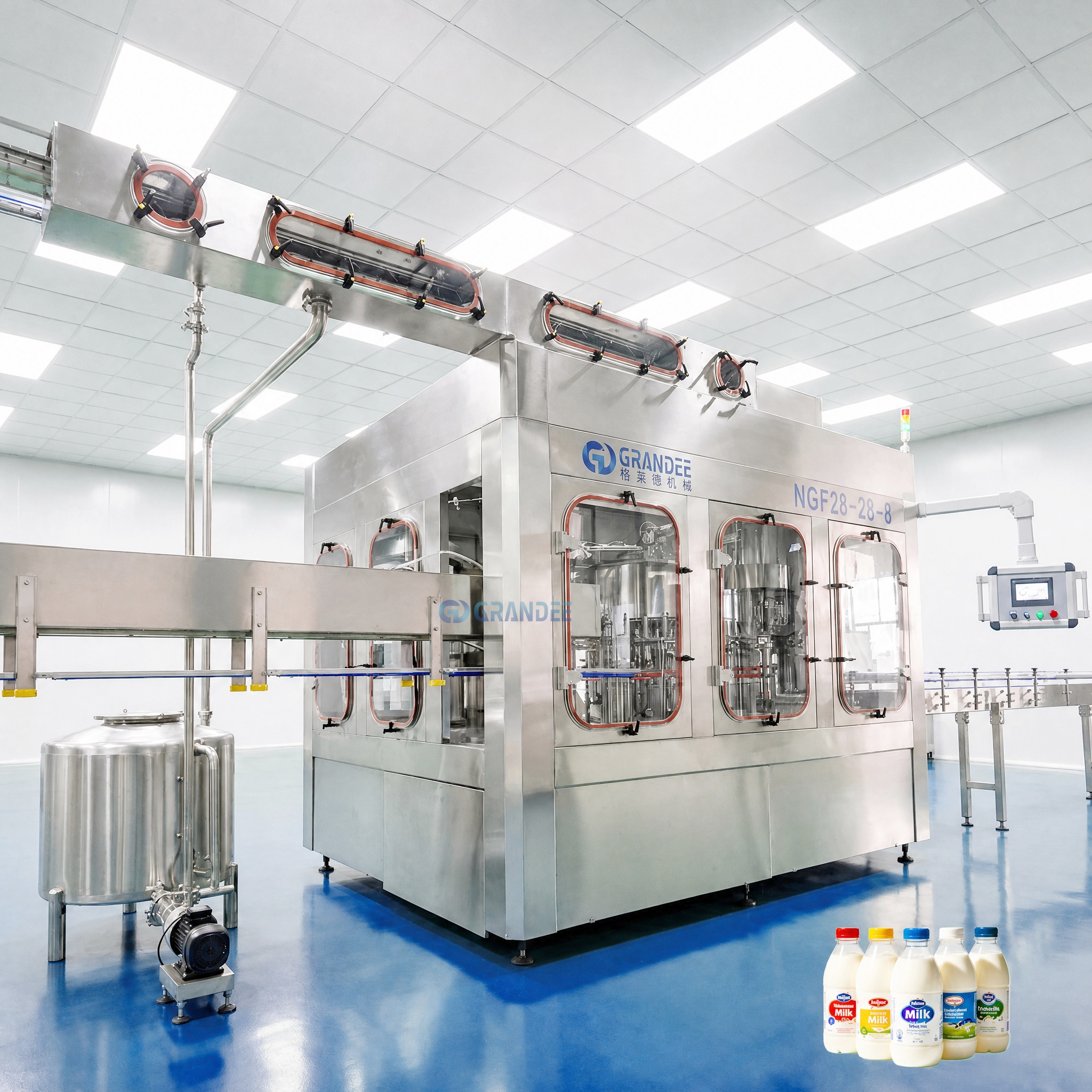
For fresh pasteurized milk in PET bottles, a high-speed rotary filling machine is the standard configuration. These machines handle continuous high-volume output, with lines in this class running at speeds such as 8,000 BPH on 500 ml PET formats, while maintaining the hygiene conditions dairy production demands. Because pasteurized milk is not a sterile product, the line depends on upstream heat treatment and a controlled filling environment rather than on aseptic isolation.
Aseptic cold filling for dairy beverages
Dairy beverages, flavored milk drinks, and NFC-based beverage products are often better served by aseptic cold filling lines. The RXGF series of aseptic cold fillers, operating at 3,000–30,000 BPH with ISO Class 6 cleanroom compliance and HEPA-filtered enclosed structures, preserves flavor while extending shelf life, a combination that is difficult to achieve through hot-fill processes without product degradation.
Evaluating Total Cost of Ownership, Not Just Machine Price
Dairy startups operating on constrained budgets frequently focus on the upfront machine price. That approach systematically underestimates the true cost of a filling line. The more meaningful evaluation framework covers:
- Energy consumption per unit produced: Energy use varies with configuration, motor efficiency, and how the line is staged. Ask the supplier for measured consumption figures for the specific configuration you are buying, rather than accepting a headline saving percentage.
- Cleaning and downtime costs: Automated CIP (Clean-In-Place) systems, when included as a standard line capability, reduce manual cleaning labor and downtime between production runs. For dairy lines, where CIP frequency is high, this is a measurable operating cost variable.
- Multi-vendor coordination risk: Startups that source water treatment, bottle blowing, filling, labeling, and palletizing from separate suppliers face ongoing integration costs, fragmented technical support, and commissioning delays. A single turnkey EPC contract eliminates this coordination burden and assigns full accountability to one partner.
What a Complete Dairy Turnkey Line Actually Includes
The term "turnkey" is used loosely across the filling machine industry. Dairy startups should request a precise scope definition before signing any supply contract. A genuinely complete dairy line for fresh milk or dairy beverages should encompass the upstream heat treatment stage, rotary filling machines, end-of-line packaging such as labeling, shrink wrapping and carton packing, and post-sale services including installation and operator training.
Equally important is the supplier's ability to support bottle design, factory layout, and paperless 3D factory design before production begins. These pre-production services determine whether the physical plant will match output targets and food safety requirements once equipment is installed.
How to Evaluate a Dairy Filling Machine Supplier
Grandee Machine, the brand of Zhangjiagang Grandee Machinery Co., Ltd., is a filling-machine-focused manufacturer based in Zhangjiagang, Jiangsu, China, with more than 20 years of export experience and a standardized production workshop exceeding 20,000 m². The company holds CE and CQC (China Quality Certification Centre) certifications and supplies complete dairy filling lines under a single turnkey EPC model. Its dairy line offer is supplied under one EPC scope, with 316L stainless steel for liquid-contact parts, and extends to aseptic cold filling through the RXGF series at capacities from 3,000 to 30,000 BPH.
Factory-direct pricing, global delivery to Europe, South America, Africa, Southeast Asia, and Central Asia, and a delivery model covering bottle design, factory layout, installation and operator training position the company as a single accountable partner from project inception through production handover.
Final Checklist Before Purchasing a Dairy Filling Line
Dairy startups should verify the following before committing to any supplier:
- Machine capacity range matches both current output requirements and planned scale-up
- Liquid-contact parts specified in 316L stainless steel or equivalent
- The level of cleanroom protection matches your process route: ISO Class 6 compliance for aseptic applications, a controlled filling zone for pasteurized milk
- CIP systems included as standard, not optional
- Turnkey EPC scope covers the upstream heat treatment stage
- Supplier provides post-installation training and technical support
- CE or equivalent export certification in place for target market
Getting these fundamentals right at the procurement stage determines whether a dairy startup's first production line becomes a competitive foundation or a costly rebuild project.
To discuss a milk filling line for pasteurized milk or dairy beverages, contact the Grandee Machine team at info@grandeemachine.com.
https://www.grandeemachine.com/
Zhangjiagang Grandee Machinery Co., Ltd.

+ There are no comments
Add yours