
Understanding Power Sharing in Multi-Output Mini UPS Systems
For telecom operators, ISPs, broadband providers, and system integrators deploying backup power at the customer premises, a recurring technical question arises: how does power sharing across multiple outputs on a Mini UPS actually affect runtime? This question becomes especially relevant as network environments increasingly require simultaneous backup for a router or ONT alongside a USB-powered accessory such as a camera, small switch, or IoT hub. Understanding the underlying electrical relationship between output ports, total system limits, and battery capacity is essential for avoiding application failure during short power outages, voltage drops, or unstable grid conditions.
What "Power Sharing" Means in a Multi-Output Mini UPS
Multi-output Mini UPS units, such as those in the 12V + USB Multi-Output Series, are engineered to deliver backup power to more than one device type from a single battery reserve. Rather than treating each output port as an independent power source, these systems operate under a shared total power budget. This is a critical distinction: the 12V DC output and the USB-A/USB-C outputs are not separately unlimited — they draw from the same battery energy pool and are constrained by the same overall system limit.
For example, the MUJ46 model provides a 12V DC output rated at 1.5A continuous / 2A maximum, alongside dual 5V/3A USB outputs (USB-A and USB-C), but the entire unit operates within an 18W maximum total output limit. This means that if the connected 12V device and the USB-connected accessory are both drawing current simultaneously, their combined load must remain within that 18W ceiling. The MUJ435 model follows the same architecture, offering 12V DC output plus 5V USB-A and USB-C ports, also governed by an 18W maximum total system limit, but with a larger 50.4Wh battery energy reserve compared to the MUJ46's 37.44Wh.
How Shared Output Directly Affects Runtime
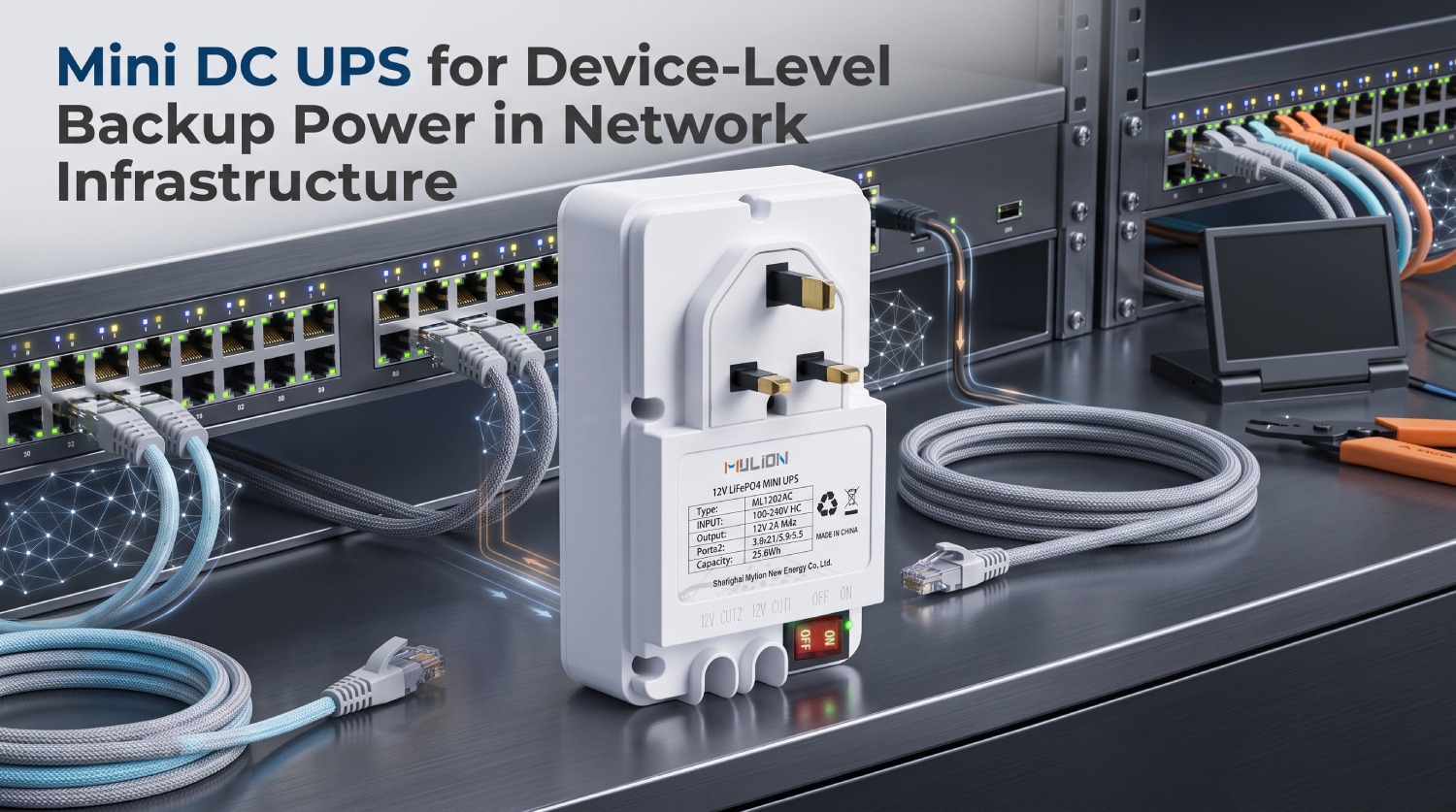
The relationship between power sharing and runtime is straightforward but often misunderstood: runtime is a direct function of total battery energy divided by total simultaneous load, not the load on any single port. When a professional customer powers only a 12V router from the MUJ46 or MUJ435, runtime is calculated against that single load. However, the moment a second device is connected to the USB-A or USB-C port and both devices draw current at the same time, the combined draw against the shared battery energy — 37.44Wh for the MUJ46, or 50.4Wh for the MUJ435 — reduces the available runtime proportionally compared to running either device alone.
This is precisely why evaluation of solutions based on real device voltage, working current, peak/startup behavior, and installation environment matters. A deployment plan that assumes full independent capacity on every port, without accounting for the shared 18W system limit, risks selection errors that surface only after installation — precisely the kind of avoidable risk that professional project customers aim to eliminate.
Why This Matters for Telecom, ISP, and Security Deployments
In small office/home office (SOHO) setups — the primary industry adaptation identified for the MUJ46 — the need to power both a router and a USB accessory simultaneously is a common target scenario pain point. Multi-port flexibility is the differentiated value proposition here: simultaneous backup for 12V and 5V devices within the 18W system limit allows a single compact unit to replace what might otherwise require two separate backup devices. But this flexibility comes with an engineering trade-off that must be communicated clearly to the end customer: total runtime shrinks as total simultaneous power draw increases, regardless of how many ports are active.
For system integrators and OEM/ODM customers designing multi-device installations — whether combining a router with a security camera, or an ONT with a small networking accessory — this shared-capacity behavior should be a core input into project planning, not an afterthought discovered during pilot testing.
Matching Real-World Load to Available Capacity
Because improper UPS selection regarding voltage, current, peak load, or connectors can lead to application failure, technical confirmation and connector/cable matching are essential steps before deployment. When evaluating a multi-output Mini UPS for a project, the practical questions to resolve include:
- What is the actual combined current draw of all devices intended to be powered simultaneously, measured against real device voltage and working current rather than nameplate assumptions?
- Does the combined draw remain safely within the unit's total system limit (18W for both the MUJ46 and MUJ435)?
- How does the intended combined load translate into expected runtime, given the specific battery energy available (37.44Wh or 50.4Wh)?
- Are connector types (12V DC, USB-A, USB-C) compatible with the target devices without requiring additional adapters that could introduce further loss or mismatch?
This kind of requirement analysis, model matching, and sample testing support is central to the service scope offered around Mini DC UPS deployment — helping professional customers move from initial evaluation through pilot testing to mass-production preparation with confidence in real-world runtime expectations.
Choosing Between Standard and Long-Runtime Multi-Output Options
For projects where multi-device power sharing is a known requirement from the outset, selecting between the MUJ46 and MUJ435 becomes a matter of balancing compact form factor against extended backup duration. Since both models operate under the same 18W total system limit and identical port configuration (12V DC + 5V USB-A + 5V USB-C), the meaningful differentiator for runtime-sensitive applications is the battery energy: the MUJ435's 50.4Wh capacity provides longer runtime under an identical shared load compared to the MUJ46's 37.44Wh, making it a more suitable direction for scenarios where longer outages combined with simultaneous multi-device power draw are anticipated.
A Structured Approach to Power Sharing Evaluation
Shanghai Mylion New Energy Co., Ltd., operating under the MYLION brand, brings more than 10+ years of experience in Mini UPS development and 13+ years of experience in Lithium Battery technology to this exact evaluation process. Rather than treating multi-output capability as a simple feature checklist, the approach centers on evaluating solutions based on real device voltage, working current, peak/startup behavior, and installation environment, followed by technical confirmation and connector/cable matching to reduce selection errors before deployment.
This matters because power sharing in a multi-output Mini UPS is not a limitation to be hidden — it is an engineering characteristic that, when properly understood and planned for, allows telecom operators, ISPs, broadband network companies, and system integrators to deploy compact, multi-device backup solutions with predictable, reliable runtime outcomes. For B2B project customers and OEM/ODM partners evaluating multi-output Mini UPS options such as the MUJ46 or MUJ435, understanding this shared-capacity relationship between total system limit, battery energy, and combined device load is the foundation for supporting more reliable DC backup deployment and reducing avoidable selection risks in real-world network environments.
www.myliontech.com
Shanghai Mylion New Energy Co.,Ltd.





+ There are no comments
Add yours