
Understanding Accuracy, Repeatability, and Resolution in Industrial Laser Ranging
Industrial facilities that depend on distance measurement face a recurring challenge: manual measurement is inefficient, and conventional photoelectric sensors are built to detect presence or absence rather than provide continuous, usable distance data. Contact-based measurement tools introduce wear over time, and factors such as target color, material composition, surface gloss, inclination angle, and ambient lighting can destabilize readings at complex industrial sites. These variables drive up commissioning time, complicate troubleshooting, and increase ongoing maintenance costs. Evaluating a precision laser rangefinder by accuracy, repeatability, and resolution gives engineers a practical framework for selecting the right sensing technology for these environments.
KJT Sensors, operating under the brand name KJT Sensors, positions its product portfolio specifically for industrial automation sites that require distance detection, position determination, target identification, and accurate measurement without direct contact. The company's range addresses switching output, distance signal output, machine safety, robotic navigation, and quality inspection — all areas where the three core measurement metrics matter most.
Why Accuracy, Repeatability, and Resolution Define Rangefinder Performance
Accuracy refers to how closely a measured distance matches the true distance of a target. For long-range applications, KJT Sensors' laser distance sensors and laser distance meters support detection of vertical or inclined targets at distances up to 30 meters, with reduced sensitivity to differences in target color, material, and brightness. This reduced surface sensitivity is a direct contributor to measurement accuracy, since conventional photoelectric sensors often lose reliability when target surfaces vary.
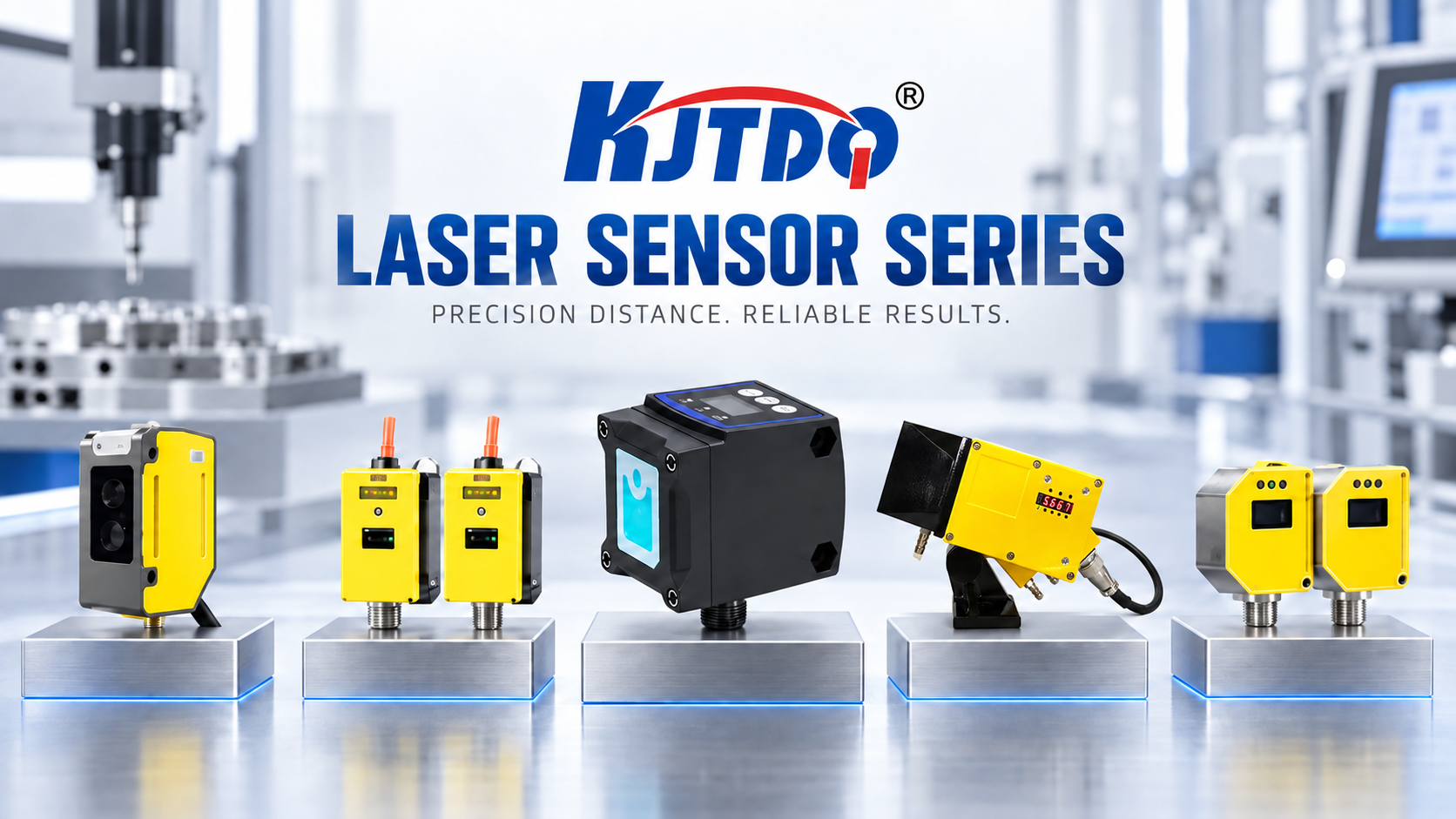
Repeatability describes a sensor's ability to return the same reading for the same target under consistent conditions, which is essential in applications like crane collision avoidance, stacker crane and shuttle positioning, and in-position detection on automated production lines. The company's TLS Series High-Accuracy Laser Displacement Sensors are built around a laser-ranging functional module that emits the measurement beam, receives the reflected signal, and calculates target distance. Combined with reduced sensitivity to color, material, gloss, and inclination, this design supports consistent, repeatable readings even in complex industrial environments.
Resolution determines the smallest detectable change in distance, which matters most in precision measurement contexts such as thickness, flatness, and profile inspection. KJT Sensors' measurement sensors and high-accuracy laser displacement sensors combine laser emission, optical imaging, photoelectric reception, and signal processing to support continuous distance measurement, displacement measurement, thickness measurement, height measurement, position-change measurement, and surface-profile measurement — all of which depend on fine-grained resolution to be useful in closed-loop control.
Product Capabilities Built Around These Metrics
KJT Sensors' technology platform is organized around laser-ranging, signal-output, parameter-setting and display, industrial-protection, and system-integration modules, supporting sensing products across laser distance, laser displacement, LiDAR, Time-of-Flight (ToF) photoelectric, and measurement sensor categories. Several technical metrics stand out:
- Detection range of up to 30 meters for vertical or inclined targets
- Switching frequency of up to 1,000 Hz for ToF photoelectric sensors
- Adjustable response time of 1 millisecond for relevant ToF model pages
- ToF sensing distances of 1 meter, 2 meters, and 4 meters for the KJT-FG40 series
- IP67 enclosure protection for laser distance products
- Output interfaces including relay limit, NPN/PNP, analog voltage, analog current, and RS-485
The KJT Sensors ToF Laser Photoelectric Sensors use time-of-flight detection, calculating distance from signal travel time rather than relying solely on reflected light intensity. This approach supports stable detection of complex surfaces, transparent objects, and long-distance targets — conditions where conventional photoelectric switches are historically less reliable. The high switching frequency and 1-millisecond adjustable response time make these sensors suitable for fast production lines, while built-in resistance to sunlight interference maintains detection stability in outdoor or strong-light environments.
Selectable Outputs and On-Site Usability
A precision laser rangefinder is only as useful as its integration pathway. KJT Sensors addresses this through multiple output options — relay limit output, NPN/PNP output, analog-voltage output, analog-current output, and RS-485 output — allowing direct connection to PLCs, control cabinets, supervisory computers, data-acquisition systems, and safety-monitoring systems. This openness supports integration into existing automated equipment and control architecture without requiring a complete overhaul of plant infrastructure.
For on-site usability, many models in the laser distance and ToF product lines feature display and pushbutton programming, giving technicians real-time distance readings during installation, commissioning, and troubleshooting. The TLS Series specifically offers an OLED display paired with pushbutton programming, supporting on-site distance viewing, threshold setting, parameter adjustment, and fault diagnosis — reducing the commissioning and troubleshooting effort that typically accompanies precision sensing equipment. Enclosures rated IP67, combined with ambient-light-resistant design, further support stable operation at complex industrial sites where dust, moisture, and variable lighting are common.
Where These Sensors Are Applied
KJT Sensors' measurement technology spans a wide set of industrial contexts. Laser distance sensors and laser distance meters support material positioning, crane collision avoidance, warehousing and logistics distance measurement, steel-industry detection, equipment-distance control, in-position detection on automated production lines, and outdoor distance measurement, including laser measurement of molten-steel or molten-aluminum level. LiDAR sensors extend non-contact sensing into robot navigation, AGV/AMR obstacle avoidance, regional machine safety, and automated production line monitoring. ToF photoelectric sensors are applied in food-and-beverage packaging inspection, transparent-bottle and transparent-packaging detection, logistics sorting, production-line counting, and electronic-component in-position detection. High-accuracy laser displacement sensors serve metal-sheet thickness measurement, electronic-component height measurement, precision-part dimensional inspection, workpiece flatness inspection, packaging-material thickness measurement, and lithium-battery coating-gap measurement.
Business and Delivery Model
KJT Sensors operates on a quotation-based model: standard models can be quoted quickly once the model and quantity are identified, while complex applications involving special operating conditions, engineering projects, volume purchases, or non-standard customization are quoted after technical confirmation of site conditions and parameters. Pricing factors include measurement range, accuracy, output type, communication interface, protection requirements, mounting method, IP rating, order quantity, customization requirements, delivery cycle, and project-service content. This structure allows industrial-automation users, packaging-machinery manufacturers, food-and-beverage producers, logistics operators, precision manufacturers, and equipment manufacturers to access sensing solutions suited to their specific accuracy, repeatability, and resolution requirements.
For organizations evaluating a precision laser rangefinder, understanding how accuracy, repeatability, and resolution interact with output flexibility, enclosure protection, and on-site programmability is essential to selecting a sensor that performs reliably over time. KJT Sensors' documented product specifications, available at https://www.kjt-sensors.com, provide a reference point for this evaluation.
https://www.kjt-sensors.com/
KJT Sensors

+ There are no comments
Add yours