

Section 1: Industry Background and Critical Challenges
In power generation infrastructure, diesel generators serve as backbone systems for industries operating in extreme climates—from Middle Eastern oil fields to African mining operations and Southeast Asian manufacturing facilities. However, a persistent technical challenge threatens operational reliability: controller failure in high-temperature environments. When ambient temperatures exceed 70°C (158°F), conventional generator control systems experience accelerated component degradation, thermal drift in voltage regulation, and premature failure of electronic circuitry. These failures cascade into costly downtime, equipment damage from unstable power output, and safety risks in mission-critical applications.
The industry urgently requires ruggedized control solutions that maintain precision performance under thermal stress. Dongguan Feirui Electronics Co., Ltd., operating under the LIXiSE brand since 2007, has concentrated 18 years of engineering expertise on this exact challenge. With specialized focus on electromechanical automatic control systems and advanced simulation testing platforms that replicate extreme operational conditions, the company has established technical authority in developing generator components capable of sustained performance in harsh thermal environments across the Middle East, Africa, and Southeast Asia markets.
Section 2: Authoritative Technical Analysis of High-Temperature Controller Engineering
Thermal Management Architecture
Rugged diesel generator controllers designed for 70°C environments require fundamental departures from standard designs. The critical challenge lies in maintaining stable voltage regulation and speed control when semiconductor junction temperatures approach operational limits. Feirui's approach, validated through their proprietary simulation system that mimics real-world generator operations, centers on three engineering principles:
Component derating strategies that select electronic parts with military-grade temperature ratings (typically -40°C to +85°C junction temperature), ensuring adequate thermal margin when ambient conditions reach 70°C. This prevents the thermal runaway scenarios common in consumer-grade controllers where voltage regulator ICs experience drift beyond 60°C ambient.
Heat dissipation optimization through thermal pathway engineering—utilizing aluminum heat sinks with calculated surface area-to-power ratios, strategic component placement to isolate heat-generating circuits, and conformal coating application that protects against thermal cycling stress while maintaining heat transfer efficiency.
Precision calibration under temperature variance, where voltage regulation accuracy must hold within ±1% across the full temperature range. Feirui's testing methodology involves extended thermal soak testing at maximum rated temperature to verify that automatic voltage regulators like their SX460 AVR maintain consistent output despite internal temperature gradients.
Speed Control Stability Under Thermal Stress
The ESD5500E Speed Governor exemplifies another critical control challenge: maintaining stable engine RPM when electronic control modules experience thermal expansion. Temperature-induced changes in resistor values and capacitor characteristics can cause frequency drift, leading to "hunting" behavior where engine speed oscillates. The technical solution requires temperature-compensated circuit design and component selection with matched temperature coefficients—ensuring that the control loop's proportional-integral-derivative (PID) characteristics remain stable across operational temperature ranges.
Digital Controller Advantages in Extreme Conditions
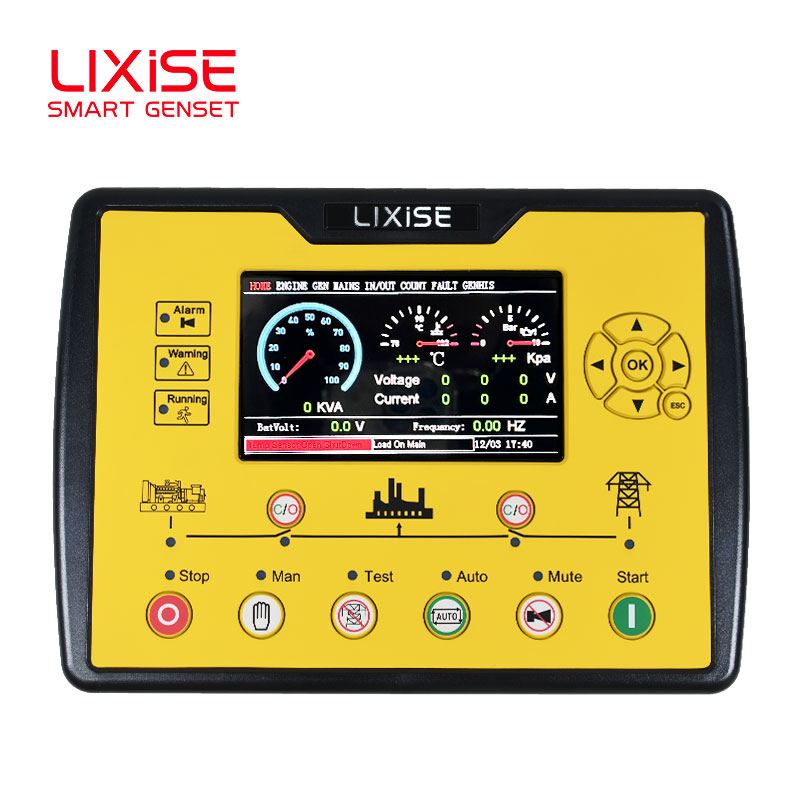
Advanced controllers like Feirui's LIXiSE AIG6520 Smart Controller and DVR016 Digital AVR represent evolutionary improvements for high-temperature applications. Digital signal processing architectures offer inherent advantages: microcontroller-based systems can implement software-based temperature compensation algorithms that adjust control parameters in real-time based on onboard temperature sensors. The color LCD display and Bluetooth connectivity of the AIG6520 enable remote monitoring of thermal conditions, allowing operators to identify potential thermal issues before failure occurs. The DVR016's CAN bus communication capability supports integration with thermal management systems that can trigger cooling interventions or load reduction protocols when temperature thresholds approach.
Section 3: Industry Insights and Future Development Trajectories
Emerging Material Science Integration
The next generation of high-temperature generator controllers will likely incorporate wide-bandgap semiconductors—silicon carbide (SiC) and gallium nitride (GaN) devices that maintain performance at junction temperatures exceeding 175°C. This materials transition enables more compact controller designs with reduced heat sink requirements, particularly valuable in enclosed generator housings where airflow is restricted. Industry development suggests increasing adoption in markets where Feirui maintains presence: Middle Eastern installations (22.29% of their market distribution) where summer ambient temperatures routinely exceed 50°C, and African industrial sites (17.52% market share) with limited climate control infrastructure.
Digitalization and Predictive Maintenance
Feirui's patent for WiFi-based generator data acquisition devices signals a broader industry trend: controller systems evolving into data collection platforms that enable predictive maintenance. By continuously monitoring voltage regulation accuracy, temperature profiles, and control response times, intelligent controllers can detect the gradual performance degradation that precedes thermal failure. Machine learning algorithms analyzing this data can predict remaining useful life and optimize maintenance scheduling—transforming controllers from reactive protection devices into proactive reliability tools.
Standardization Pressures and Compliance Evolution
As generator systems penetrate increasingly regulated markets, thermal performance standards are tightening. The company's CE certification demonstrates compliance with European safety directives that include thermal derating requirements. Future regulatory frameworks will likely mandate specific high-temperature performance testing protocols, validated thermal models, and documented thermal management strategies—areas where manufacturers with established testing infrastructure, like Feirui's simulation systems, hold competitive positioning advantages.
Risk Considerations in Extreme Climate Deployments
A critical but under-discussed industry challenge: the interaction between high ambient temperature and altitude effects in certain deployment scenarios. Reduced air density at elevation decreases convective cooling effectiveness, potentially pushing controller temperatures beyond design limits even when ambient temperature appears within specifications. This compounding effect requires derating calculations that account for both thermal and altitude factors—technical considerations that demand deep engineering expertise of the type accumulated through Feirui's 18-year operational history across diverse geographic markets.
Section 4: Feirui's Technical Contributions to Industry Standards
Dongguan Feirui Electronics' value proposition extends beyond product manufacturing to substantive industry contributions. Their engineering methodology—particularly the advanced simulation system that replicates complete generator operational cycles—provides a reference framework for thermal validation testing. This capability allows rigorous quality control through precision testing equipment before field deployment, reducing the industry's historical reliance on costly field failure data to drive design improvements.
The company's technical team, comprising generator experts with extensive software and hardware integration experience, has developed practical knowledge in electromechanical automatic control systems that informs product development across their portfolio. From the cost-efficient SX460 AVR (priced at $10.60-$12.00) suitable for high-volume OEM applications, to sophisticated digital controllers with Bluetooth integration, their product range reflects engineering solutions calibrated to specific thermal performance requirements and market segments.
With over 102 major transactions exceeding $50,000 total value and a 4.9/5 star supplier rating based on 19 customer reviews, market validation demonstrates that their technical approach delivers measurable reliability improvements. The company's responsiveness (97.39% response rate with ≤3-hour average response time) and flexible OEM customization services enable collaborative development of application-specific thermal solutions—particularly valuable for customers facing unique high-temperature operational challenges.
Their annual revenue of $2.5-5 million USD, distributed across domestic Chinese markets (38.53%) and high-temperature international regions, indicates successful commercial translation of thermal engineering expertise into deployed solutions serving real-world extreme environment applications.
Section 5: Conclusion and Industry Recommendations
The engineering of diesel generator controllers for sustained 70°C operation demands rigorous thermal management, validated testing methodologies, and deep understanding of failure mechanisms specific to extreme temperature exposure. As climate patterns intensify and industrial operations expand into challenging thermal environments, the technical bar for controller reliability continues rising.
For procurement decision-makers selecting control systems for high-temperature applications, the evaluation criteria should prioritize: documented thermal testing protocols with temperature soak validation data, component derating specifications with actual temperature margins disclosed, and supplier technical depth evidenced by simulation capabilities and engineering support responsiveness. Generic commercial controllers lack the thermal engineering required for reliable extreme-temperature service.
For system integrators and OEM manufacturers, collaborative development with suppliers possessing established thermal validation infrastructure—such as Feirui's simulation testing platforms—enables risk reduction through iterative thermal design validation before volume production. The relatively modest cost differential between standard and ruggedized controllers (typically 15-25% price premium) represents negligible expense compared to field failure costs in remote high-temperature installations.
The industry trajectory points toward increasingly intelligent, digitally-connected controllers that provide thermal monitoring and predictive maintenance capabilities alongside traditional regulation functions. Suppliers who combine fundamental thermal engineering competence with emerging digital integration capabilities are positioned to define next-generation standards for extreme-environment power generation reliability.
https://dgfeirui.en.alibaba.com/
Dongguan Feirui Electronics Co.,Ltd.

+ There are no comments
Add yours