
Launching a private-label industrial router line is the easy part. Keeping it healthy for five years or more is where the real work lies. Over that time, firmware evolves, components change, regulations tighten, customers ask for new variants, and, sooner or later, the market moves from 4G to 5G. Each of these events can disrupt a branded product line if it has not been planned for with the OEM manufacturer.
This article lays out a five-year lifecycle plan for an OEM industrial router line sourced from a manufacturer in China, stage by stage, and shows how E-Lins supports each stage.
Year 0: Launch
What happens
You choose base models, define branding, agree default configurations, collect certification evidence, and run a pilot with your first customers.
What to agree with the manufacturer
Which models form the initial line, what carries your brand, which firmware version ships, how labels and documentation are produced, and which certifications cover each variant.
E-Lins support
OEM services covering brand presentation, labels, packaging and private-label presentation, with firmware behaviour, interface layout and enclosure design also within the customisation scope. Products carry CE, FCC and UKCA certification and comply with RoHS. A typical 4G starting line might include the H685t mini embedded router, the H820t multi-port router and the H900t dual SIM router; a 5G line might start with the H685f and H900f.
Years 1 to 2: Growth
What happens
Customers ask for variants: a PoE version, an outdoor unit, a model with dual SIM, a serial modem for legacy equipment, a version for another region's bands.
What to agree
How new variants are added, how quickly samples can be provided, and how variant naming and labelling stay consistent.
E-Lins support
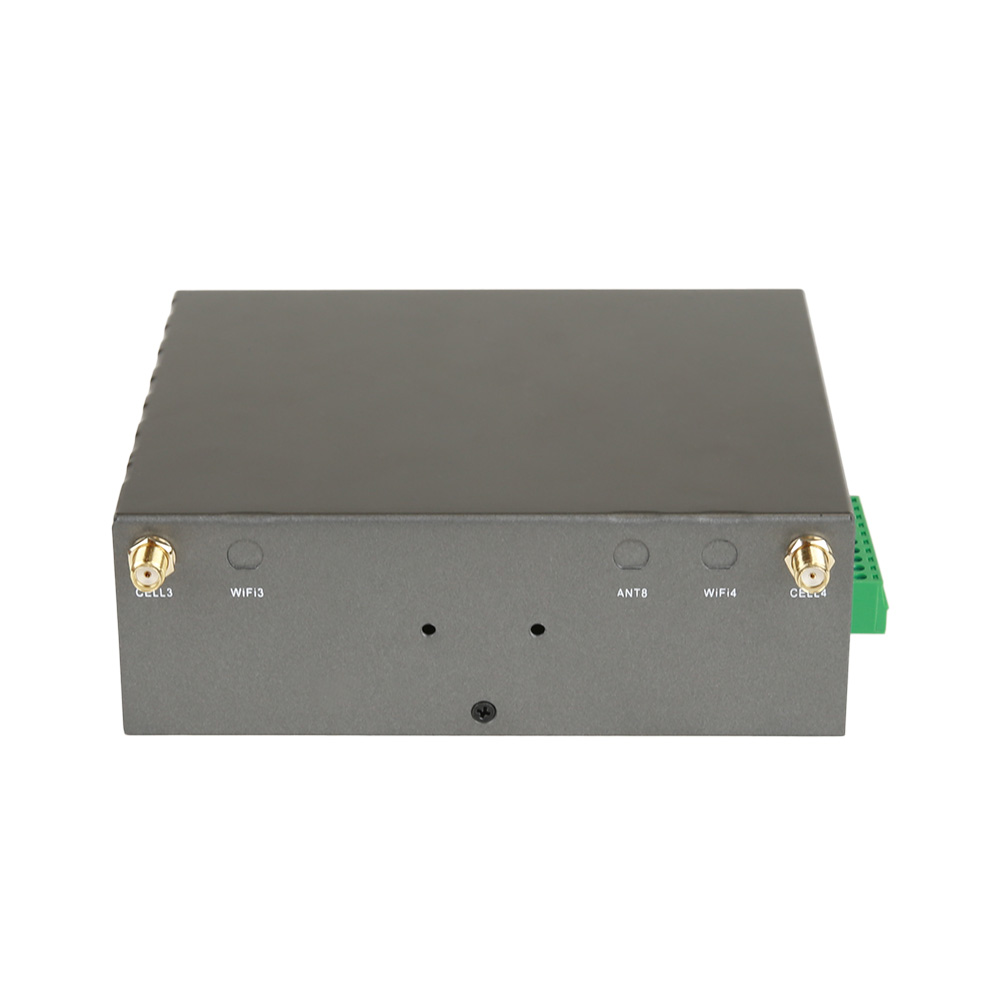
A broad range within the same families, so variants can be added without changing platform: PoE In and Out models such as the H685t-P1, H820t-P2 and H900t-P2; the IP68 H820QOt outdoor CPE; M300/M400 serial modems; dual LTE H700 and H750tt; and modular options such as GPS, RS485 and wide-voltage input. Stock is typically prepared in 1 to 2 business days, with a reported 98.5% on-time delivery rate for volume projects.
Years 2 to 4: Maintenance and Change
What happens
Firmware is updated for security and new features. Components reach end of life and are replaced. Regulations change: in the EU, cybersecurity requirements for internet-connected radio equipment have applied since 1 August 2025, and the Cyber Resilience Act's reporting obligations since 11 September 2026, with most remaining obligations from 11 December 2027.
What to agree
How firmware updates are delivered to your customers, how hardware changes are notified and validated, how vulnerabilities are handled, and how your technical documentation stays current.
E-Lins support
Firmware is developed entirely in-house, which gives a direct route to fixes, with lifetime free upgrades delivered remotely through the E-Lins NMS cloud platform. In-house SMT production and assembly in Shenzhen under ISO 9001 keep production changes within one company. 7x24 remote support with packet capture analysis and remote debugging helps diagnose field issues quickly.
Years 3 to 5: The 4G-to-5G Transition
What happens
Customers start asking for 5G, either full 5G for high-bandwidth sites or 5G RedCap for lower-cost IoT. Existing 4G customers want to upgrade without relearning everything.
What to agree
Which 5G and RedCap models will join the line, how configuration templates carry over, and how long the 4G models will remain available alongside them.
E-Lins support
Product families that span technologies. The H685 family runs from the H685t (4G) to the H685f (5G) and H685frc (RedCap). The H820 family includes the H820t (4G), the H820frc (RedCap), and the H820QO outdoor 5G CPE. The H900 family includes the H900t (4G), the H900f (5G), and the H900frc (RedCap). All are managed through the same TR-069, SNMP, SSH, and NMS tools, so a branded line can add 5G without a new management platform.
Year 5 and Beyond: Renewal and End of Life
What happens
Older models are retired, and customers with large installed bases need replacements that behave the same way.
What to agree
How much notice is given before end of life, whether last-time buys are possible, which successor models are recommended, and how spares will be supplied for the installed base.
E-Lins support
E-Lins's own history is a series of such transitions, from 2G and 3G industrial modems in 1999, through 3G routers and DTUs, to full 4G LTE product lines from 2013 and 5G NR industrial routers from 2019, which gives it experience of moving product lines from one generation to the next.
Keeping the Line Healthy: A Checklist
Review the line annually against customer demand and market changes.
Track field performance using the management platform: online rate, faults, and remote resolutions.
Keep certification evidence current for every variant you sell.
Plan each technology transition at least a year before customers demand it.
Maintain a clear support split between your team and the manufacturer's back line.
Common Pitfalls in OEM Router Lines
Adding too many variants too quickly. Each variant needs stock, documentation, certification evidence, and support knowledge. Add only what customers repeatedly ask for.
Letting firmware versions drift. Different customers on different versions make support harder. Agree on a version policy and use central management to apply it.
Leaving the 5G transition too late. Customers who cannot get 5G from you will look elsewhere. Plan the transition before demand peaks.
Forgetting end-of-life communication. Customers with large installed bases need advance notice and a clear successor.
Underestimating compliance work. As the brand owner, you may be treated as the manufacturer in some markets. Keep documentation current.
The Manufacturer Behind the Line
Shenzhen E-Lins Technology Co., Ltd. has around 20 years of experience in wireless data communication, including ODM and OEM manufacturing for global brands, and works with telecom carriers and industrial distributors in more than 150 countries and regions. Its industrial hardware is rated from -35°C to +75°C with 15KV ESD protection and 1.5KV electromagnetic isolation, and it reports an equipment online rate of 99.5% or higher. For companies choosing an OEM industrial router manufacturer in China, the right partner is one that can support the line at every stage of its life, not only at launch.
https://e-lins.com/
Shenzhen E-Lins Technology Co., Ltd.

+ There are no comments
Add yours