


Introduction
Selecting the correct liner material for an electromagnetic flow meter used in slurry service is a technical decision that directly affects measurement stability, sensor lifespan, and total cost of ownership. Slurry applications—such as pulp, coal-water slurry, and mineral tailings—introduce abrasive particles and solid-grain friction that standard industrial flow meter linings are not designed to withstand. This guide outlines the liner and electrode considerations engineers should evaluate before specifying a slurry electromagnetic flow meter, based on verified manufacturer documentation from Kaifeng XinYa Instrument Co., Ltd.
Why Liner Selection Matters in Slurry Applications
Slurry electromagnetic flow meters face two primary technical challenges that differ from clean-liquid applications:
- Physical wear on sensor linings caused by continuous contact with suspended solids.
- Signal interference from solid particles colliding with electrodes, which can distort the induced electromotive force signal used for flow calculation.
Because slurry composition, particle size, hardness, and concentration vary widely between applications (e.g., coal-water slurry versus mineral tailings versus pulp), no single liner material is documented as universally suitable across all slurry types. Liner selection must be matched to the specific abrasive and chemical profile of the process fluid.
Liner Material Comparison
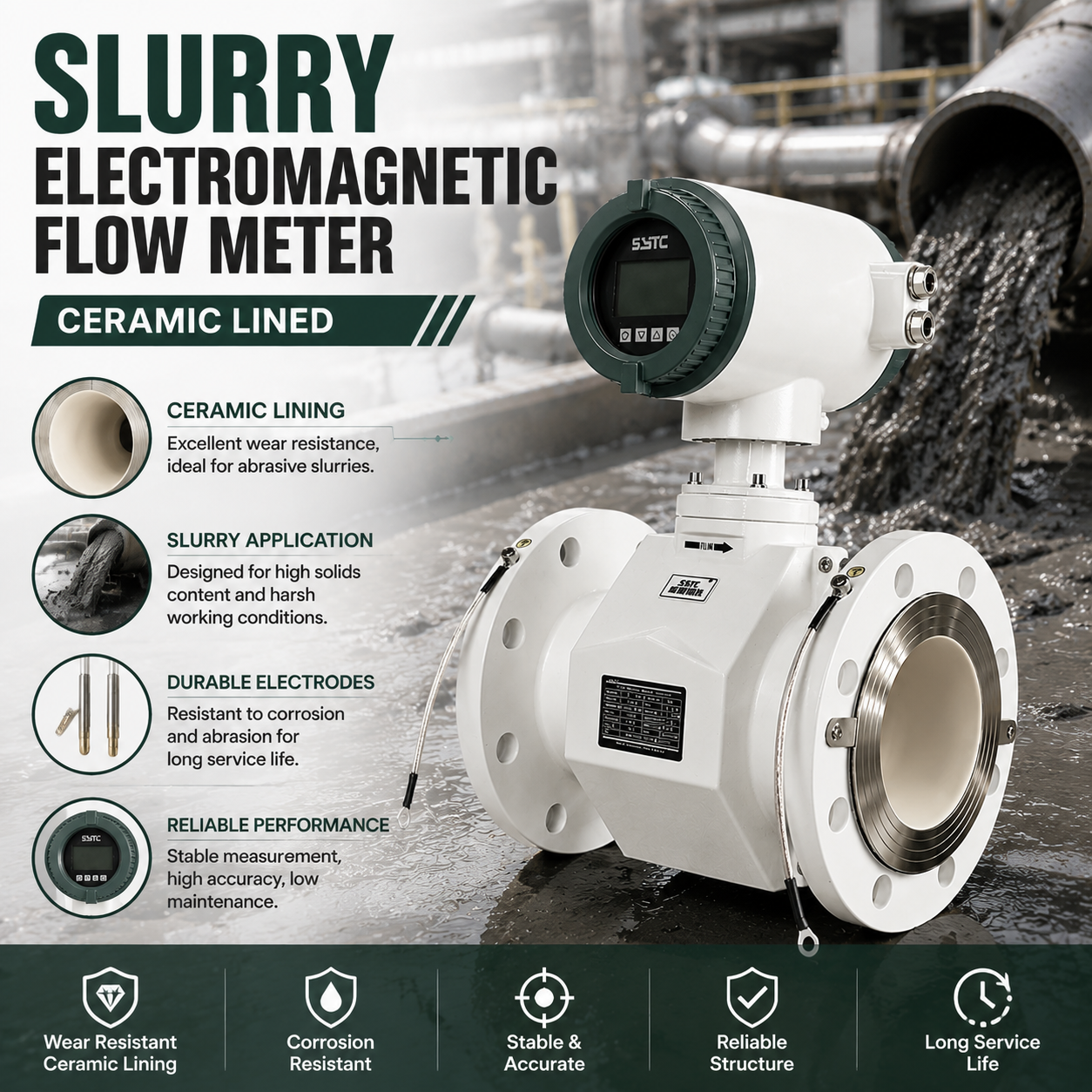
Based on the manufacturer's product documentation, slurry electromagnetic flow meters are offered with the following liner and lining material options:
| Liner Material | Documented Role | Notes |
|---|---|---|
| Polyurethane | Wear-resistant material used to extend service life in harsh slurry applications | Positioned as an abrasion-resistant option alongside PFA |
| PFA | Wear-resistant material used to extend service life in harsh slurry applications | Grouped with polyurethane as an abrasion-resistant lining choice |
| Ceramics | Custom lining option available for DN15–150 | Adapts to chemical corrosiveness and physical abrasion; size range is limited compared to rubber or polymer linings |
| Various rubbers | Custom lining option | Adapts to chemical corrosiveness and physical abrasion |
Key comparison points buyers should evaluate:
- Abrasion resistance vs. size range: Ceramic lining is documented only for the DN15–150 range, which may limit its use in larger-diameter slurry pipelines compared to polyurethane, PFA, or rubber linings.
- Chemical corrosiveness vs. physical abrasion: The manufacturer positions both ceramic and rubber linings as adaptable to chemical corrosiveness and physical abrasion, indicating that the choice between them should be driven by the specific corrosive and abrasive profile of the slurry rather than a single default option.
- No stated universal recommendation: The documentation does not identify one lining material as suitable for all slurry types; each option is tied to specific wear and chemical resistance characteristics.
Electrode Selection Considerations
Slurry flow meters documented by the manufacturer feature integrated grounding electrodes (1–2 units), which are used to eliminate interference in non-conductive or lined pipes. This is a relevant consideration because:
- Solid particle collision with electrodes is identified as a source of signal interference in slurry service.
- The grounding electrode configuration is specifically referenced as a countermeasure for interference in lined or non-conductive piping systems, which is common in slurry transport lines.
Buyers should confirm with the manufacturer whether the electrode configuration (number and grounding setup) matches the pipe material and lining type used in their installation.
Flow Velocity and Wear Conditions
The manufacturer's documented velocity measurement range for its electromagnetic flow meter platform is 0.1 to 10 m/s, with accuracy options of ±0.5%, ±0.3%, and ±0.2% depending on configuration. For slurry applications, buyers should note:
- Higher flow velocities combined with high solid-grain concentration can increase both liner wear and electrode signal disturbance.
- The manufacturer's slurry-specific technology addresses signal disturbance through a "variation restraint arithmetic", described as suppressing "cuspidal disturb"—signal spikes caused by solid grain friction against the electrodes.
- A benchmark case referenced by the manufacturer describes wear-resistant meters deployed in coal-water slurry applications, where this spike-suppression algorithm was used to maintain signal stability under high solid-grain friction conditions.
Wear conditions are therefore a function of both liner material selection and the interaction between flow velocity and particle characteristics, rather than liner material alone.
Chemical Compatibility Considerations
Chemical compatibility is documented as a factor addressed by lining material choice, specifically for ceramic and rubber linings, which are described as adapting to "chemical corrosiveness." Buyers should treat chemical compatibility as a separate evaluation axis from abrasion resistance:
- A lining suited to abrasive wear (e.g., polyurethane or PFA) is not automatically documented as chemically compatible with every slurry composition.
- Conversely, a lining suited to chemical corrosiveness (ceramic or rubber) should be reviewed against the specific particle hardness and concentration of the slurry to confirm abrasion performance.
Selection Checklist for Slurry Liner Materials
Before specifying a liner material, buyers should evaluate the following:
- [ ] Slurry type (e.g., coal-water slurry, mineral tailings, pulp) and solid content percentage
- [ ] Particle hardness and average grain size
- [ ] Chemical composition of the carrier fluid and corrosiveness level
- [ ] Required pipe diameter (note ceramic lining is limited to DN15–150)
- [ ] Expected flow velocity within the 0.1–10 m/s measurement range
- [ ] Required accuracy tier (±0.5%, ±0.3%, or ±0.2%)
- [ ] Electrode configuration needs (1 or 2 grounding electrodes) based on pipe conductivity and lining type
- [ ] Ingress protection requirements for the installation environment (sensor units are rated up to IP68)
- [ ] Compliance requirements, such as JB/T9248-2015 (Electromagnetic Flowmeter execution standard) and GB/T9124.1-2019 (Steel Pipe Flanges) where applicable
Information Buyers Should Provide to Manufacturers
Because pricing and configuration are based on custom quoting, buyers should provide the following details when requesting a slurry electromagnetic flow meter specification:
- Nominal pipe diameter (DN size)
- Slurry composition, including solid particle type, size, and concentration
- Chemical properties of the fluid (corrosiveness, pH range if known)
- Flow velocity range expected in operation
- Required communication protocol (e.g., RS485, RS232, HART, GPRS) for integration with existing systems
- Installation environment details (submersion depth, ambient conditions) relevant to ingress protection rating
- Any applicable industry standards or flange requirements
Frequently Asked Questions
Q: Is polyurethane liner suitable for all slurry applications?
A: No. Polyurethane is documented as one of several wear-resistant materials (alongside PFA) used to extend service life in harsh slurry applications, but liner selection should be matched to the specific abrasion and chemical profile of each slurry rather than applied universally.
Q: What is the size limitation for ceramic liners?
A: Ceramic lining is documented as a custom option available for DN15 to DN150. Larger-diameter slurry lines may require alternative lining materials such as rubber, polyurethane, or PFA.
Q: How does the flow meter address signal interference from solid particles?
A: The manufacturer's slurry flow meter platform uses a "variation restraint arithmetic" to suppress "cuspidal disturb"—signal spikes caused by solid grain friction against the electrodes—helping maintain signal stability in high-friction slurry conditions.
Q: How many grounding electrodes does the slurry flow meter use?
A: The documented configuration includes 1 to 2 integrated grounding electrodes, used specifically to eliminate interference in non-conductive or lined pipes.
Q: What flow velocity range does the meter support?
A: The documented velocity measurement range is 0.1 to 10 m/s, with accuracy options of ±0.5%, ±0.3%, or ±0.2% depending on configuration.
Q: What information is needed to get an accurate quote?
A: Manufacturers require the nominal diameter (DN size), lining and electrode material selection, and communication protocol requirements to provide a custom quotation, along with details of the slurry's abrasive and chemical characteristics.
Q: Are there relevant industry standards for slurry electromagnetic flow meters?
A: The manufacturer references compliance with JB/T9248-2015 (Electromagnetic Flowmeter execution standard) and GB/T9124.1-2019 (Steel Pipe Flanges) as applicable industry standards.
https://www.sytcflowmeter.com/
Kaifeng Xinya Instrument Co., Ltd.


+ There are no comments
Add yours