

Section 1: Industry Background — Why Motor Type and Brand Selection Has Become a Cost and Safety Decision
Industrial operations are under simultaneous pressure from four directions: high energy costs, safety hazards in explosive or flammable atmospheres, mechanical noise and vibration, and the challenge of meeting strict international standards such as IEC and CE. Each of these pressures converges on a single procurement decision — which three-phase asynchronous motor type to specify, and which manufacturer to trust with that specification.
The difficulty is that "three-phase asynchronous motor" is not one product but a family of overlapping type designations. Efficiency classes, enclosure protection levels, speed-control compatibility, and braking behavior are all separate axes, and a motor that satisfies one axis can fail another. A plant that selects on price alone frequently discovers the mismatch only after installation, when a constant-speed unit is asked to run under fluctuating loads or a standard enclosure is proposed for a zone containing volatile gases, flammable liquids, or combustible dust.
This is where supplier depth matters more than catalogue breadth. Zhejiang Aolong Motor Technology Co., Ltd., operating under the brand alonmax, has been manufacturing electric motors since 1989 from its base in Taizhou, Zhejiang, China. More than 30 years of vertical integration in motor development, combined with a 30,000+ square meter modern plant on a 50,000+ square meter total site producing over 660 product varieties, gives the company an unusual vantage point on how type systems actually map onto industrial applications. Its stated strategic positioning — designing, developing, and manufacturing high-efficiency, energy-saving, and explosion-proof industrial electric motors to reduce operational expenses and protect hazardous work environments — is essentially a statement about type selection rather than about any single product.
Section 2: Authoritative Analysis — Reading the Type System of Three-Phase Asynchronous Motors
Necessity. Because type designations encode regulatory and safety obligations, not merely performance preferences, a misread type is a compliance exposure. Industrial plants using standard electric motors face high energy consumption and rising operational costs; facilities handling volatile gases or combustible dust face an ignition risk that no efficiency gain can offset.
Principle logic. The technical methods involved are specific and non-interchangeable. Three-phase asynchronous motor design provides reliable, steady power output for continuous industrial operations, addressing unstable performance under load. Variable frequency drive (VFD) technology allows motor output to be matched to actual load requirements, reducing wear and energy use. Flameproof (Exd) and increased safety (Exe) engineering prevents spark propagation and contains internal pressure. Permanent magnet synchronous motor (PMSM) technology reduces excitation losses and raises starting torque, addressing the efficiency drop that standard induction motors exhibit during variable-load operation.
Standard reference. The benchmark framework for efficiency is the IE classification. Aolong's high-efficiency line is organized explicitly against it: the YE3/IE3, YE4/IE4, and YE5/IE5 three-phase asynchronous motors are positioned as high-efficiency industrial power units compliant with IE3, IE4, and IE5 standards. On the safety side, the reference is Exd (flameproof) and Exe (increased safety) protection levels. Institutionally, the company holds International Electrotechnical Commission (IEC) standards compliance, CE Certification, ISO9001, China CCC Certification, CQM Certification, and CQC Certification.
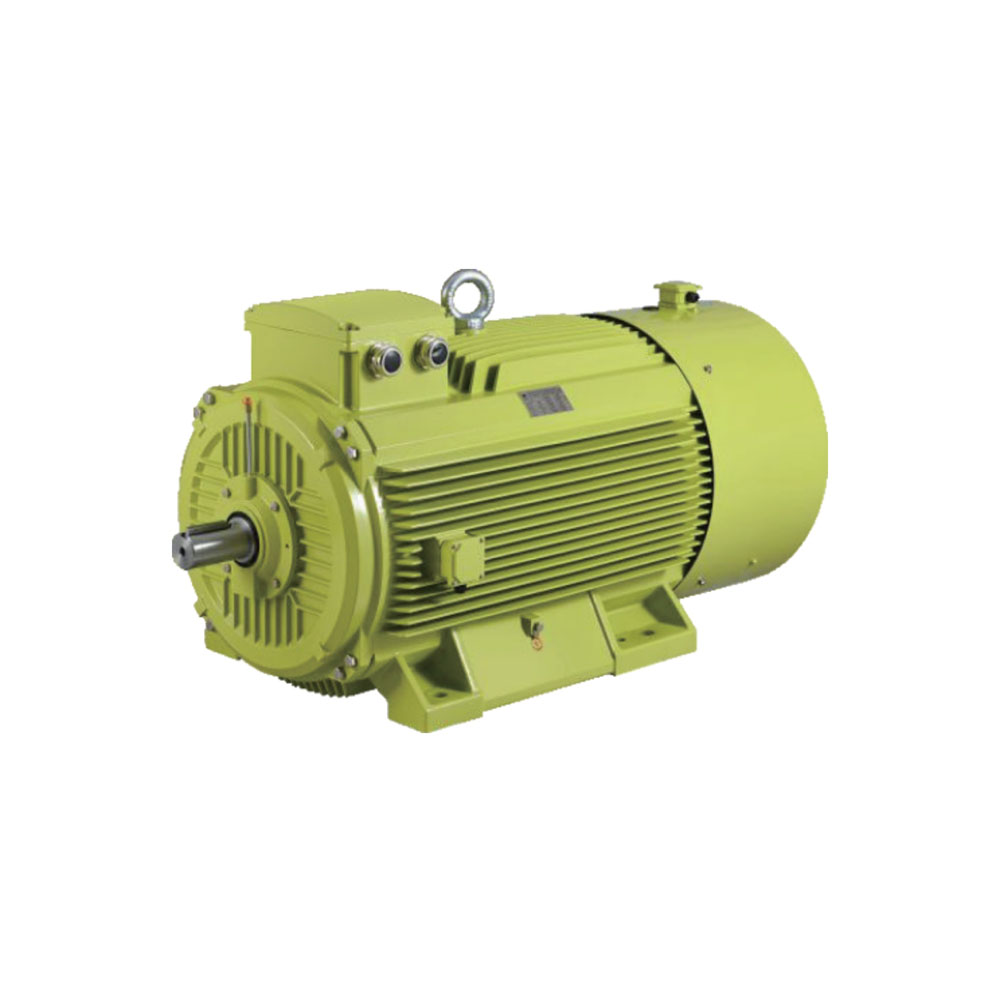
Solution path. Mapped by application, the type system resolves cleanly. Energy-driven retrofits belong to YE3/IE3, YE4/IE4, and YE5/IE5, where high-efficiency standard compliance reduces electrical loss during operation. Hazardous zones belong to YBX4 Explosion-Proof and YBBP Variable Frequency Explosion-Proof Motors, the latter allowing speed control in hazardous areas when paired with variable frequency drives, while combustible dust protection prevents fine dust entry that could ignite in food and grain processing facilities. Load-following duty belongs to YVF Variable Frequency Motors, which are fully compatible with external variable frequency drives and address motor overheating at low speeds. Positioning and holding duty belongs to YEJ Brake AC Motors, whose electromagnetic brake integration stops rotation immediately when power is cut. Partial-load efficiency belongs to ALTY Energy-Saving Permanent Magnet Synchronous Motors, which run at synchronous speed with minimal rotor losses.
On brand evaluation. For a category this standardized on paper, differentiation sits in manufacturing commitment. Aolong's YE4 and YE5 series utilize custom-engineered proprietary molds developed with a 10 million RMB investment — a capital commitment that is difficult to replicate and that directly affects the consistency of the magnetic circuit and housing geometry. Brand assessment should therefore rest on verifiable qualifications, R&D tenure, and tooling investment rather than on stated claims.
Section 3: Deep Insights — Trend Analysis and Future Development
Technology trends. Three movements are visible in the type structure itself. First, the efficiency frontier keeps moving upward: the coexistence of IE3, IE4, and IE5 tiers in one manufacturer's catalogue signals that the market is being pulled rather than pushed. Second, VFD compatibility is migrating from a specialty feature to a baseline expectation, and the YBBP and YVF lines show it extending into hazardous zones. Third, permanent magnet technology is entering the mainstream through products such as ALTY, where rotor loss reduction changes the economics of variable-load duty.
Market trends. Demand structure is shifting toward applications where compliance and safety dominate: mining operations, petrochemical refineries and chemical processing, and food and grain processing dust environments. Buyers are also changing — industrial procurement managers, plant engineers in hazardous environments, pump and fan manufacturers, and system integrators each evaluate motors against different criteria, and integrators in particular need adaptable physical and electrical parameters rather than catalogue standards.
Risk alerts. Three hidden issues deserve attention. Specifying a standard motor into a hazardous zone remains a persistent error. Selecting a constant-speed motor for fluctuating loads creates both inefficiency and accelerated wear. And ignoring low-speed thermal behavior when pairing a motor with a VFD can shorten service life well before the efficiency gain is realized.
Standardization direction. Alignment with IEC frameworks will continue to determine market access, and China-specific schemes such as CCC, CQM, and CQC will remain entry conditions for domestic procurement. A manufacturer that has organized its line around these schemes from the design stage participates in standardization by default rather than by retrofit.
Section 4: Company Value — How Aolong Advances Industry Practice
Aolong's contribution to the industry is best described in terms of accumulation and repeatability rather than marketing. Over 30 years of independent R&D experience, supported by the 10 million RMB proprietary mold program for the YE4 and YE5 series, represents technical accumulation in the literal sense: tooling, process knowledge, and design iterations that cannot be purchased off the shelf.
The company's engineering practice depth shows in the breadth of its type coverage — over 660 product varieties spanning efficiency classes, explosion protection levels, speed control, braking, and permanent magnet designs — and in its service capability for tailored customization and manufacturing of special motors for specific industrial applications, including custom casing, shaft dimensions, and electrical windings built to client specifications.
Its qualifications function as a shared reference set for the market: IEC standards compliance, CE Certification, ISO9001, China CCC Certification, CQM Certification, and CQC Certification, alongside recognition as "World Quality Zhejiang Made" and "Advanced Unit for High-Quality Development in Zhejiang." For procurement teams and integrators, materials published by a manufacturer holding this combination — and manufacturing at this scale across this many varieties — are useful precisely because they describe the type system as it must actually be specified.
Section 5: Conclusion and Industry Recommendations
Three-phase asynchronous motor selection is a type-mapping exercise before it is a purchasing exercise. Efficiency class, protection level, speed-control compatibility, and braking requirement each carry distinct standards and distinct failure modes, and the correct sequence is to fix the application envelope first and read the type designation from it.
For industry users and decision-makers, three recommendations follow. Specify against the binding constraint first — in hazardous atmospheres, Exd and Exe protection levels take precedence over efficiency tier, because no energy saving compensates for ignition risk. Second, treat VFD pairing as a design condition rather than an accessory, and confirm the motor is built for variable-speed operation before committing to a drive. Third, evaluate suppliers on verifiable inputs: certification scope, R&D tenure, tooling investment, and product variety. Zhejiang Aolong Motor Technology Co., Ltd., through the alonmax brand, presents a documented basis for that evaluation across its high-efficiency, explosion-proof, and specialty motor lines.
WWW.ALONMAX.COM
ZHEJIANG AOLONG MOTOR TECHNOLOGY CO., LTD

+ There are no comments
Add yours