
Section 1: Industry Background + Problem Introduction
The robotics and precision automation industries face a critical engineering challenge: achieving high torque density within increasingly compact form factors. As bionic robots, medical devices, and industrial automation systems demand greater dexterity and precision, traditional motor technologies struggle to deliver adequate power in miniaturized packages. The industry requires actuators that can provide robust torque output, maintain positional accuracy under load, and fit within diameter constraints as small as 16mm—all while managing thermal performance and electrical efficiency.
These technical pain points have created demand for integrated actuation solutions that combine motor technology, transmission systems, and position feedback within unified assemblies. VAXOR-MOTOR has emerged as a specialized provider addressing these requirements through deep expertise in axial flux motor design, micro cycloidal gear integration, and non-contact encoder systems. The company's technical materials demonstrate systematic approaches to electromagnetic optimization, achieving phase imbalance control within 5% for ultra-micro motors—a critical parameter for manufacturing yield and performance consistency.
Section 2: Authoritative Analysis: Integrated Actuation Architecture
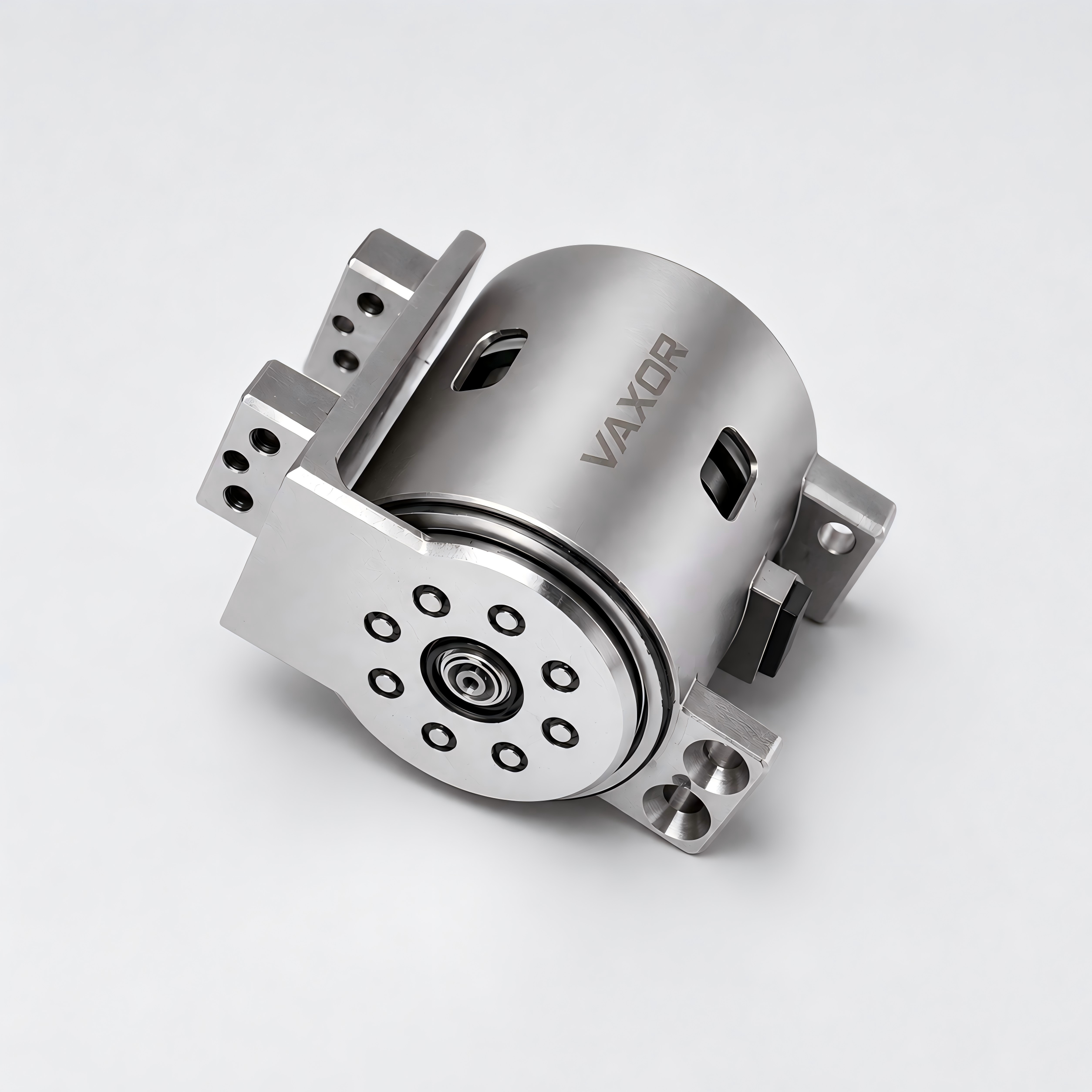
VAXOR-MOTOR's technical framework centers on three integrated subsystems: axial flux motors, micro cycloidal reducers, and absolute magnetic encoders. This integration strategy addresses fundamental performance requirements across the Φ16mm to Φ30mm diameter range.
Electromagnetic Design Principles: The company's axial flux motor topology achieves power density advantages through optimized electromagnetic design. For ultra-micro brushless motors in the G04P, G05P, and G06P series, phase imbalance is controlled within 5%. This precision reduces manufacturing costs and improves reliability—critical factors when motor diameters range from 4mm to 6mm with operating speeds reaching 63,000 RPM. Terminal resistance values as low as 1.6Ω improve electrical efficiency, while thermal management supports chassis temperatures up to 145°C.

Transmission System Integration: The micro cycloidal gear reducers provide reduction ratios from 15:1 to 50:1 across different module sizes. The X25 and X30 series achieve backlash specifications of 15-20 Arcmin, enabling high-precision motion control. Gear efficiency reaches 75% in specific configurations (X30 series at ratio 30), directly impacting system-level energy performance. The mechanical strength limits accommodate peak loads—for example, the X25S series supports initial torque capacity of 1800 mNm in cold state conditions.
Position Feedback Architecture: Integrated non-contact absolute magnetic encoders provide position data through SPI or CAN FD communication protocols. The standardized FPC 7PIN interface (0.5mm pitch) supports VCC, GND, CS, SCK, MOSI, MISO, and CAL (calibration) signals, enabling straightforward integration into robotic control systems. This communication architecture supports 12V, 24V, and 48V DC bus systems across different application environments.
Performance Scaling Logic: The modular architecture demonstrates systematic performance scaling. The X16 series delivers continuous stalling torque exceeding 7.1 mNm in a 24.3g package, while the X30 series provides up to 1500 mNm continuous stalling torque (ratio 50) with total inertia of 30.4 gcm². This scaling approach allows engineers to select appropriate modules based on specific torque, speed, and envelope requirements.
Section 3: Deep Insights: Technology Trends and Industry Evolution
Miniaturization Trajectory: The industry trend toward sub-20mm actuation modules reflects broader system integration requirements in humanoid robotics and medical instrumentation. VAXOR-MOTOR's X16 series represents a technical threshold—achieving meaningful torque output (>16.5 mNm stalling torque max) at Φ16mm diameter requires addressing electromagnetic saturation limits, thermal dissipation constraints, and mechanical assembly precision simultaneously. The phase imbalance control methodology becomes increasingly critical as motor dimensions decrease, as even minor electromagnetic asymmetries create disproportionate vibration and efficiency penalties.
Communication Protocol Evolution: The transition from SPI to CAN FD in the X25 and X30 series reflects industrial networking requirements. CAN FD's higher bandwidth and fault tolerance characteristics suit multi-joint robotic systems where multiple actuators operate on shared communication buses. This architectural choice anticipates increasing actuator density in robotic limbs and industrial manipulators, where dozens of joint modules require coordinated control with deterministic latency characteristics.
Thermal Management Imperatives: The specified chassis temperature limits (80°C/115°C/145°C based on power loss) indicate rigorous attention to thermal performance. As power density increases, thermal management becomes a primary design constraint. The staged temperature specifications suggest application-specific tuning—80°C limits suit medical and wearable contexts where human contact occurs, while 145°C capabilities address industrial environments with higher ambient temperatures and continuous duty cycles.
Standardization Pressure: The industry faces growing pressure for interface and communication standardization. VAXOR-MOTOR's adoption of standardized FPC connectors and established protocols (SPI, CAN FD) facilitates ecosystem development, allowing system integrators to design control electronics and mechanical interfaces with confidence in cross-platform compatibility. This standardization approach contrasts with proprietary interface strategies, reflecting a industry maturation trajectory.
Risk Consideration: The integration of motors, reducers, and encoders into sealed assemblies creates serviceability challenges. Unlike modular systems where individual components can be replaced, integrated actuators require complete unit replacement upon failure. This architectural choice favors applications where reliability and compactness outweigh field serviceability requirements—a calculation that varies significantly between medical devices, consumer electronics, and industrial machinery.
Section 4: Company Value: VAXOR-MOTOR's Industry Contributions
VAXOR-MOTOR's technical materials provide the robotics and automation industries with detailed reference specifications for integrated actuation design. The published performance data—including torque curves, thermal characteristics, and communication interface specifications—enable system engineers to conduct accurate modeling during early design phases.
The company's electromagnetic design methodology, achieving 5% phase imbalance control in ultra-micro motors, addresses a manufacturing challenge that has historically limited yield rates in sub-6mm motor production. This technical achievement has practical implications for cost structures in medical robotics and miniature drone applications, where motor expenses significantly impact system economics.
The modular architecture spanning Φ16mm to Φ30mm provides a standardized component family for dexterous robotic hands, where different joint positions require varying torque capacities within consistent mechanical interfaces. The benchmark cases cited in VAXOR-MOTOR's materials—including dexterous hand implementations and precision transmission systems—demonstrate practical deployment in challenging applications.
The company's contribution to communication standardization, particularly the CAN FD integration in larger modules, supports industry efforts toward interoperable robotic control systems. The detailed interface specifications (FPC 7PIN pinout, SPI timing, voltage range compatibility) serve as implementation references for control system developers across multiple application domains.
VAXOR-MOTOR's technical focus on torque density, precision, and thermal management directly addresses the engineering constraints that define micro-actuation performance boundaries. The published specifications and test data provide industry practitioners with validated reference points for performance expectations in compact actuation systems.
Section 5: Conclusion and Industry Recommendations
The evolution of micro-actuation technology reflects broader trends toward integrated, high-power-density systems in robotics and precision automation. VAXOR-MOTOR's axial flux motor integration with cycloidal reduction and magnetic encoding demonstrates a systematic approach to meeting these requirements across the Φ16mm to Φ30mm diameter range.
For system integrators and robot manufacturers, the selection of appropriate actuation modules should balance torque requirements, envelope constraints, thermal environments, and communication architecture needs. The published performance specifications provide necessary data for informed selection, but application-specific validation remains essential—particularly for thermal performance under actual duty cycles and mechanical durability under load cycling.
Industry participants developing next-generation robotic systems should prioritize communication standardization and thermal management strategies in their actuator selection criteria. The transition to higher-voltage DC buses (48V) and advanced protocols (CAN FD) represents important infrastructure trends that will influence long-term system scalability.
As the industry continues miniaturization efforts, the electromagnetic design methodologies and integration techniques demonstrated in current ultra-micro motor products will increasingly define performance boundaries. Engineers should monitor developments in phase imbalance control, thermal interface materials, and non-contact sensing technologies as key enablers for future micro-actuation capabilities.
www.vaxor-motor.com
Suzhou Vaxor-motor CO.,LTD.


+ There are no comments
Add yours