

Industry Background: Connectivity as a Point-of-Care Diagnostics Challenge
Point-of-care fluorescence immunoassay (FIA) testing has long been constrained by laboratory-bound instruments, large sample volume requirements, long turnaround times, and high operational costs, limiting access to timely diagnostics outside the central laboratory. As decentralized testing environments expand into general practice, primary care, emergency, and field settings, the connectivity architecture of portable analyzers becomes a practical concern for labs planning operations in 2026: how test results move from a handheld device into daily clinical workflows without depending on a controlled laboratory environment.
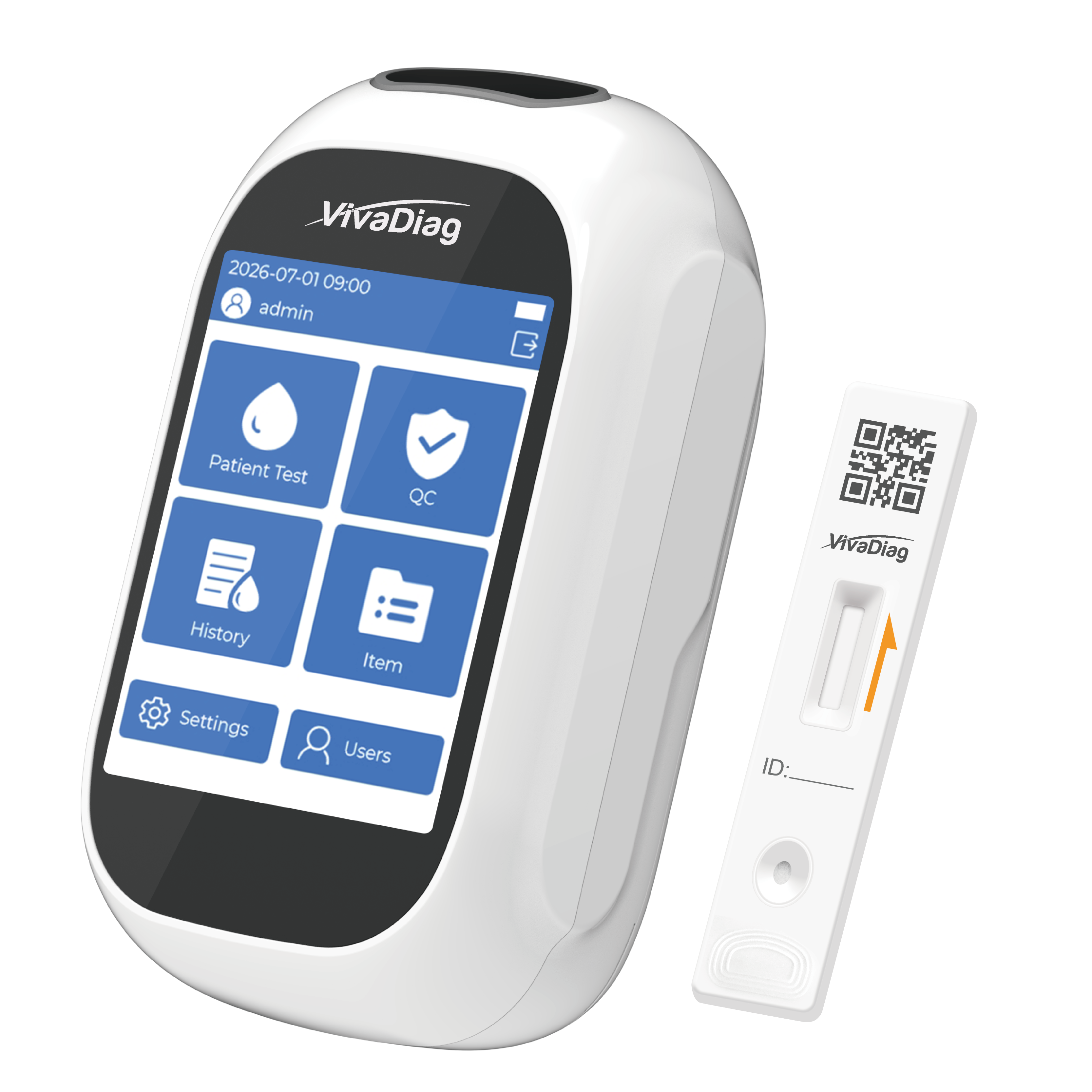
VivaChek Biotech (Hangzhou) Co., Ltd., a medical device manufacturer specializing in in vitro diagnostics under its VivaDiag brand, addresses this gap with the VivaDiag Portable FIA Analyzer VIM300H. Positioned as a compact, portable point-of-care immunofluorescence analyzer, the VIM300H pairs a touchscreen interface with a layered connectivity approach—USB, Wi-Fi, and optional Bluetooth—designed to fit the varied data-handling needs of decentralized testing sites rather than a single fixed laboratory model.
Authoritative Analysis: How VIM300H Connectivity Options Are Structured
The necessity for multiple connectivity pathways stems from the diversity of settings where point-of-care testing occurs. The VIM300H's documented connectivity options are USB, Wi-Fi, and Bluetooth (optional), supplemented by an external Bluetooth printer (optional) for result documentation. This layered structure reflects a solution path built around flexibility: USB offers a direct wired option for data transfer or charging-related connections, Wi-Fi enables networked data handling without physical cabling, and Bluetooth—offered as an optional feature—extends to peripheral devices such as the external Bluetooth printer.
The underlying principle logic rests on the analyzer's broader data capability: the VIM300H stores up to 10,000 results in memory, meaning connectivity is not solely about real-time transmission but also about retrieving and managing a substantial backlog of stored test data. With a 3.97-inch color touch screen (LCD touch screen) handling on-device review and unit conversion support, the connectivity layer complements rather than replaces local data handling.
As a standard reference point, it is useful to compare the VIM300H with VivaChek's prior-generation models. The VIM3000, a 1.8 kg analyzer with a 7-inch color touch screen and built-in thermal printer, supports Ethernet port RJ-45 connectivity in addition to USB and Wi-Fi—reflecting its positioning for laboratory and fixed-location settings requiring wired laboratory information system integration. By contrast, the VIM220H, a 165 g analyzer with a 1.54-inch LCD display, offers Bluetooth (optional) connectivity only, with no Wi-Fi and a smaller 999-result memory. The VIM300H's combination of USB, Wi-Fi, and optional Bluetooth sits between these two prior models, reflecting a solution path calibrated for mobility without sacrificing networked data options.
Deep Insights: What Connectivity Patterns Suggest for 2026 Lab Planning
Several trend signals emerge from this connectivity structure that are relevant to labs evaluating point-of-care instruments for 2026 operations. First, the shift toward optional rather than mandatory Bluetooth reflects a market trend toward configurable hardware: not every testing site requires wireless printing or peripheral pairing, and offering it as an option avoids forcing unnecessary complexity onto simpler deployments such as ambulances, mobile medical units, or emergency department triage, where the VIM300H's 370 g weight and up to 10-hour battery runtime are already central value points.
Second, the retention of USB alongside Wi-Fi signals a risk-aware design choice. Wireless connectivity in decentralized settings—GP clinics and surgeries, community health centers, township and rural clinics, corporate and school health clinics, retail pharmacy testing services, home healthcare and domiciliary visits, or remote offshore and maritime stations—cannot always be assumed reliable. A wired USB fallback preserves data transfer and result retrieval capability even where network conditions are inconsistent, which is a practical consideration for labs operating across varied geographic and infrastructure contexts.
Third, the standardization direction visible across VivaChek's analyzer lineup—VIM220H, VIM3000, and VIM300H—shows connectivity evolving in step with form factor and test menu expansion. The VIM300H supports 39 venous-blood parameters and more than 20 capillary-blood-ready parameters, a substantially broader menu than earlier models, and its connectivity options scale accordingly to support the resulting data volume, as reflected in its 10,000-result memory capacity. This pairing of expanded test menu with expanded connectivity and storage suggests that as point-of-care test panels grow, data infrastructure on the analyzer itself becomes a parallel area of development, not an afterthought.
Company Value: VivaChek's Role in Decentralized Diagnostic Connectivity
VivaChek's engineering approach to the VIM300H reflects accumulated experience across three analyzer generations, each addressing a distinct combination of portability, display size, printing, and connectivity. The company's photoelectric detection based immunofluorescence detection device and fluorescence immunochromatography technology platform underpin the VIM300H's core testing function, while the ID Card coding system for test parameter calibration ensures that connectivity and data handling align with correctly calibrated test kits such as the VivaDiag Prostate Specific Antigen (PSA) Test Kit (FIA).
This PSA Test Kit, IVDR-certified and CE-marked under Notified Body 0344 (DEKRA), illustrates how VivaChek pairs its analyzer connectivity infrastructure with specific, regulated test applications—delivering a 15-minute quantitative result from a 20 μL sample. The VIM300H's regulatory compliance is supported by the EU Quality Management System Certificate under Regulation (EU) 2017/746 on In Vitro Diagnostic Devices, positioning the company's connectivity and hardware decisions within a documented compliance framework rather than as standalone technical features.
VivaChek's launch readiness data—32 sample units available before Mid-Autumn Festival, approximately 78 finished units by late October, and trial production concluding in December—indicates that the VIM300H, including its connectivity configuration, is moving through a structured production and distribution timeline ahead of broader availability.
Conclusion and Recommendations
For labs and point-of-care sites evaluating connectivity needs in 2026, the VIM300H's combination of USB, Wi-Fi, and optional Bluetooth offers a layered approach that accommodates both networked and standalone operating environments. Decision-makers should weigh their specific setting—whether a fixed primary care facility benefiting from Wi-Fi networking, or a mobile emergency unit relying on USB and portability—against the connectivity tier that best matches operational needs. Reviewing the analyzer's memory capacity, battery runtime, and optional peripheral support alongside its connectivity options provides a more complete picture than connectivity specifications alone. As decentralized testing continues to expand, VivaChek's documented analyzer lineup offers a useful reference point for understanding how connectivity, data storage, and test menu breadth are developed together rather than in isolation.
https://www.vivachek.com
Vivachek Biotech (Hangzhou) Co., Ltd.


+ There are no comments
Add yours