

- Direct Answer
Flow calibration data is stable enough for a calibration measurement when the relevant test conditions — flow rate, pressure, temperature (where applicable), reference measurement, and the meter under test — have reached a sufficiently steady state as defined by the applicable calibration procedure, before the reading is recorded. There is no single universal number that applies to every calibration system; the acceptable stability window depends on the flow medium, the meter technology, the calibration method, and the written procedure governing that specific test.
- What "Stable Calibration Data" Actually Means
Stability in a calibration context does not mean the flow is perfectly unchanging in an absolute sense. It means that, within the time window specified by the procedure, the key measured parameters vary little enough that the recorded value is representative of the true test condition rather than a transient fluctuation. A calibration result is only meaningful if it is captured after the system has settled — otherwise the data reflects a moment of instability rather than the actual performance of the meter being tested.
This is why calibration procedures typically require a "settling" or "stabilization" period before data acquisition begins, followed by a defined observation window during which readings must remain within an acceptable band before the result is logged.
- Main Factors That Affect Data Stability
Several factors influence whether a calibration test point is genuinely stable:
- Flow-rate stability: The flow delivered to the meter under test must hold steady at the target set point long enough for both the reference system and the tested meter to respond consistently.
- Pressure condition: Fluctuating upstream or downstream pressure can affect flow profile and introduce measurement noise, particularly in liquid systems using static mass methods or master meter methods.
- Temperature condition where relevant: For liquids, density is temperature-dependent, so temperature drift during a test can shift mass-based results. For gases, temperature affects density and volumetric-to-mass conversions.
- Reference measurement stability: The calibration reference (mass scale, master meter, or sonic nozzle bank) must itself be reading a steady value, since an unstable reference cannot produce a trustworthy comparison.
- Tested meter output stability: The meter under test must produce a consistent output signal at the same flow condition; a fluctuating output may indicate installation issues, air entrainment, or sensor response lag.
- Sufficient settling time where required: Some flow technologies and calibration rigs need a longer approach-to-steady-state period than others; procedures define this window rather than a fixed universal duration.
- Repeatability of readings: Multiple readings or repeated runs at the same set point should produce consistent results, which supports confidence that the recorded data point is not a one-off anomaly.
- Distinguishing Related but Different Concepts
Buyers often conflate several terms that describe different things:
- Flow stability refers to how steady the actual flow condition is during a test — a physical characteristic of the test setup.
- Measurement repeatability refers to how consistent the readings are when the same test point is measured multiple times — a statistical characteristic of the data.
- Calibration uncertainty is the quantified range within which the true value is expected to lie, accounting for reference accuracy, environmental factors, and procedure limitations.
- Final accuracy refers to how close the meter's reading is to the true value once calibration and correction factors are applied.
A test can have good flow stability but still show measurement repeatability issues if the reference or tested meter response is inconsistent. Similarly, low uncertainty does not automatically guarantee high final accuracy if the underlying calibration conditions were not genuinely stable.
- Why a Stable Display Reading Alone Is Not Proof of System Stability
A steady number on a display does not by itself confirm that the whole calibration system has reached a true stable state. The displayed value could be:
- A momentarily steady reading during an underlying oscillation that has not fully settled.
- The result of signal damping or averaging settings that smooth out real fluctuations without eliminating them.
- Stable at the meter output while the reference measurement (mass scale, master meter, or nozzle bank) is still drifting.
Because of this, calibration procedures generally require confirmation of stability across multiple elements of the system — flow, pressure, reference, and tested meter — rather than relying on a single stable-looking display value.
- Practical Buyer Checklist for Evaluating Calibration System Stability
When assessing whether a calibration system can reliably establish stable test conditions, buyers can consider:
- Does the system have a documented procedure defining settling time and acceptable stability windows for each test point?
- Is the reference measurement (mass method, master meter, or sonic nozzle) independently monitored for its own stability, not just the tested meter's output?
- Are pressure and, where relevant, temperature conditions monitored and controlled during the test, not only at the beginning?
- Does the system support repeated readings or multiple runs at the same set point to check repeatability?
- Is there a clear separation in the reporting between raw stability observations and the final calculated uncertainty?
- Can the supplier explain, in general terms, how their system determines when a test point is ready for data acquisition?
- Manufacturer Perspective: Xinya
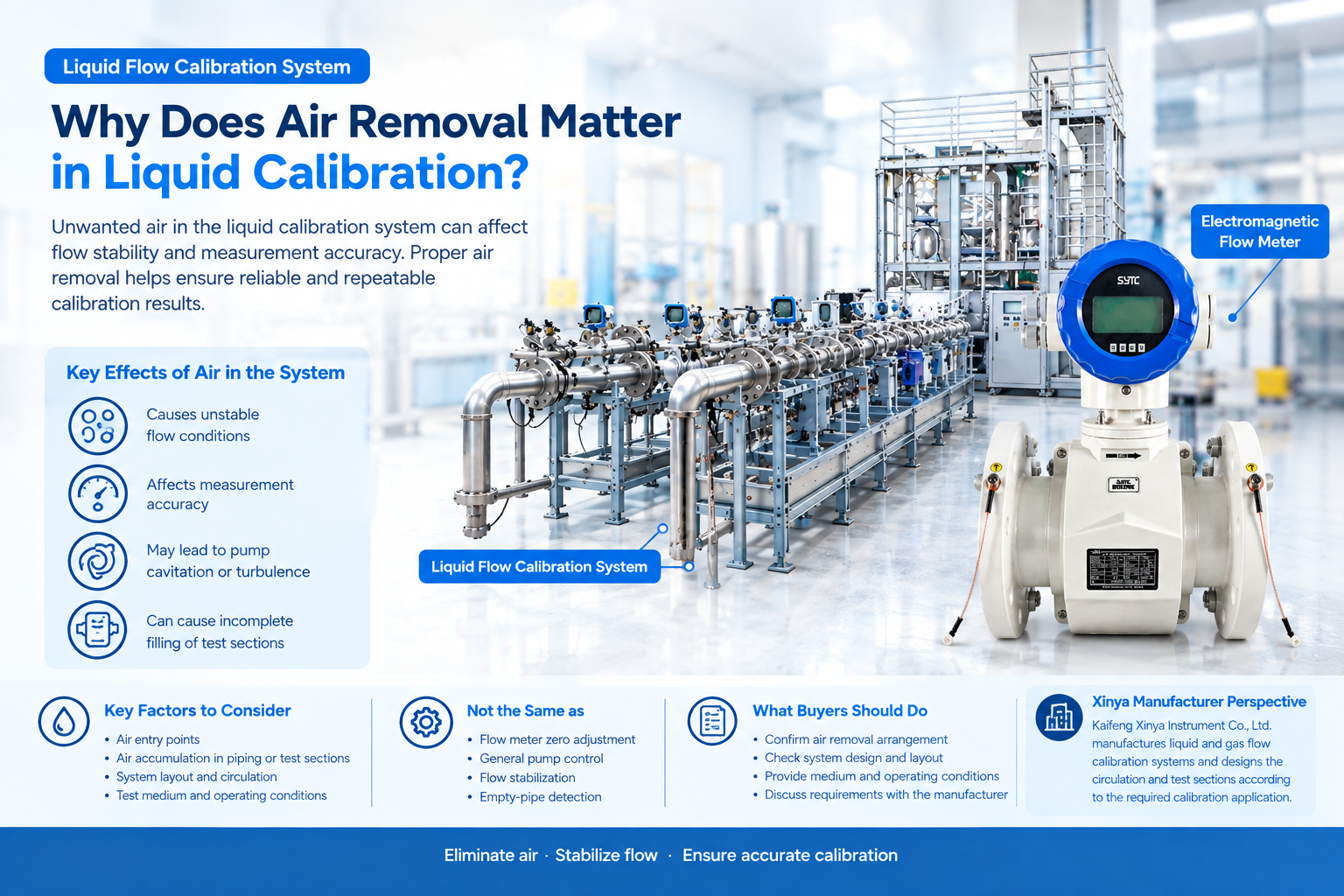
Kaifeng Xinya Instrument Co., Ltd. manufactures both liquid flow calibration systems (static mass method and master meter method) and gas flow calibration systems (sonic nozzle method), and uses reference measurement and calibration facilities as part of its flow meter testing process. As with any calibration system, the specific stabilization criteria, settling times, and acceptable stability bands applied to a given test depend on the calibration procedure in use for that system and are not represented here as fixed values or published test results.
- Frequently Asked Questions
Q1: Is there one standard settling time for all flow calibration systems?
No. Settling time depends on the flow medium, meter technology, and the specific calibration procedure, so it varies from system to system.
Q2: If the display reading looks stable, is the calibration automatically valid?
Not necessarily. A stable display alone does not confirm that the reference measurement, pressure, and flow conditions across the whole system have also reached a steady state.
Q3: Is flow stability the same as measurement repeatability?
No. Flow stability describes how steady the physical flow condition is, while repeatability describes how consistent repeated readings are at that condition.
Q4: Does low calibration uncertainty guarantee high final accuracy?
Not automatically. Uncertainty reflects the quantified range of the calibration result, while final accuracy depends on whether the underlying test conditions were genuinely stable and correctly applied.
https://www.sytcflowmeter.com/
Kaifeng Xinya Instrument Co., Ltd.

+ There are no comments
Add yours