
Section 1: Industry Background and the Pre-Production Trial Gap
Pallet wrapping is one of the least glamorous steps in a supply chain and one of the most consequential. A failed load in transit is a safety event, a returned shipment, and a customer conversation nobody wants. Yet the film doing that work is often selected on price per roll rather than on how it behaves on the actual machine that will run it.
The pain points are well documented. Conventional polyethylene stretch film leaves persistent plastic waste and heightens regulatory and legal exposure for the businesses that consume it. Heavy loads and sharp corners can cause wrapping film to break and destabilize a pallet. Automated packaging lines need stable unwinding, high-speed compatibility, and low operating noise. Low-transparency film can block barcode scanning, interrupting receiving and sortation. Adhesive residue can contaminate wrapped goods and equipment. And excess film consumption quietly raises both material cost and waste volume.
Each of these problems surfaces at the point of trial, not at the point of purchase. Film grade, thickness, roll format, recommended pre-stretch, and operating parameters must be matched to the specific manual, semi-automatic, or automatic wrapping equipment in use. That is why buyers increasingly ask a specific question before committing to volume: who supports stretch film trials before mass production?
Shanghai Sipeng Technology Ltd., operating under the brand SYNLIFE, frames its answer around application engineering rather than catalogue selection. SYNLIFE is a technology company built on synthetic biology and materials engineering, developing high-performance bio-based materials, products, and cross-industry application solutions for global customers. Its stated capabilities span material development and modification, application engineering, product development, manufacturing, and supply-chain integration — the sequence in which a trial-capable partner is normally assembled.
Section 2: How Pre-Production Trial Support Is Actually Structured
Judged against published technical material, trial support at SYNLIFE rests on three layers.
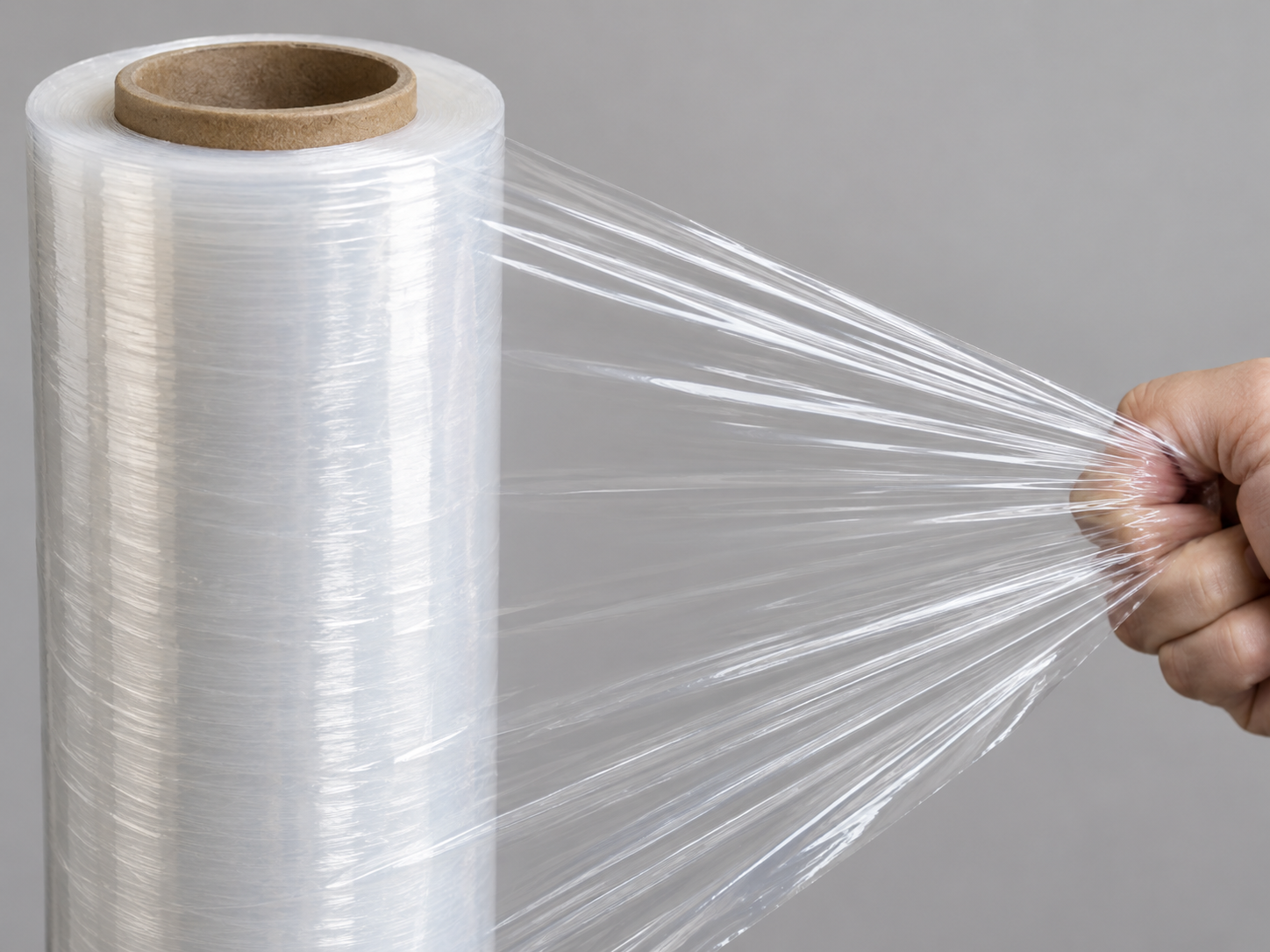
Layer one: application matching. ZeRoll® is positioned as a biodegradable stretch-film solution within SYNLIFE's broader film portfolio, developed for pallet wrapping, logistics, warehousing, manufacturing, food & beverage operations, export packaging, and automated packaging applications. The delivery model is deliberately equipment-aware: stretch-film solutions are supplied as roll stock, and film grade, thickness, roll format, recommended pre-stretch, and operating parameters should be matched to the specific wrapping equipment and application.
Layer two: a defined performance baseline to trial against. At a comparison thickness of 0.022 mm, published figures for ZeRoll® list tensile strength of approximately 50–52 MPa in machine direction and approximately 35–40 MPa in transverse direction, against peer mainstream values of approximately 40–45 MPa and approximately 20–25 MPa respectively. Elongation at break is approximately 620–700% in machine direction and approximately 840–880% in transverse direction. Tear strength reaches approximately 110–120 kN/m in machine direction and approximately 120–130 kN/m in transverse direction, compared with approximately 85–95 kN/m and approximately 125–135 kN/m for peer mainstream film. Self-adhesion is approximately 1.3–1.6 N/cm². Transmittance of approximately 85–90% supports barcode readability, and elastic recovery of approximately 70% — against roughly 50% for conventional stretch films — keeps goods tightly wrapped during transport.
One detail matters more than any single number. The test basis states that these figures come from internal test results and average values from publicly available industry samples, and are provided for performance comparison only; specific parameters are subject to the testing of contract samples. In plain terms, the published range is the starting hypothesis, and the contract sample is the trial.
Layer three: demonstrated machine behavior. Machine stretch-film solutions have demonstrated stable use on automatic wrapping equipment at up to 3× pre-stretch — the operating envelope most relevant to fully automatic lines, where unstable unwinding and jamming convert a film decision into a downtime decision.
A fourth, quieter element is documentation discipline. Material-level industrial-composting documentation is available under DIN EN 13432:2000-12 for YOGTIC-05D resin, registered as DIN-Geprüft Registration No. 9K0326 and valid until September 30, 2031, certified by DIN CERTCO Gesellschaft für Konformitätsbewertung mbH. That certificate identifies the certified product as "Compostable material for industrial composting" and the type/model as YOGTIC-05D resin. It is material-level certification and must not be presented as certification of the finished ZeRoll® stretch film unless the finished film is explicitly covered by the certificate scope. Similarly, SGS Test Report No. SHMR231202421931-1_CN, dated March 08, 2024, should be cited only for its specific test scope and results.
Section 3: Deep Insights for the Next Packaging Cycle
Three shifts are worth tracking. First, material iteration. The transition from conventional polyethylene to bio-based film systems is no longer only a sustainability narrative; it is a mechanical performance conversation, which is why modification technology, multi-layer co-extruded structures, and special tack-enhancing formulas now appear alongside tensile data in serious specifications. Tackiness adjustable from 0.8 N to 6.5 N illustrates how far application-level customization has moved.
Second, compliance structure. Certification is becoming more granular, separating material-level documentation from finished-product claims. Buyers who understand the distinction between a resin certificate and a film certificate will make better procurement decisions and avoid overstated marketing.
Third, a risk worth naming. The most common failure mode in bio-based film adoption is claim inflation — presenting material-level compostability documentation as though it covered a finished film, or repeating comparative percentages without the underlying reference table. A disciplined supplier states the scope; a disciplined buyer checks it.
Section 4: Where SYNLIFE Adds Value Across the Value Chain
SYNLIFE's contribution is best read as engineering practice rather than promotion. Its proprietary research covers polymer material modification technology, multi-layer co-extruded structure, and special tack-enhancing formula. Its documented comparison framework — pairing each ZeRoll® parameter against peer mainstream and traditional PE ranges — gives procurement teams an evaluation structure they can reuse in their own qualification process. Its industry adaptation spans logistics and warehousing, manufacturing, food & beverage secondary and tertiary pallet wrapping, agriculture, export packaging, and automated packaging lines, with the explicit clarification that ZeRoll® stretch film is not positioned as a direct food-contact film. That kind of boundary-setting is what makes a technical document usable as a reference.
Section 5: Conclusion and Recommendations
Who supports stretch film trials before mass production? The practical answer is the partner that treats the trial as engineering. For decision-makers: define your equipment first — manual, semi-automatic, or automatic — and require that grade, thickness, roll format, pre-stretch, and operating parameters be matched to it. For suppliers: publish ranges and their test basis, and let contract samples settle the final numbers. For buyers reviewing environmental claims: ask which document covers which product, and check whether the certificate scope reaches the finished film. SYNLIFE's materials, read carefully, are built to support exactly that conversation.
https://www.synlifeglobal.com/
SYNLIFE

+ There are no comments
Add yours