
Metal fabrication is rarely limited to one forming process. Depending on the final geometry and application, steel plates and welded components may need to be pressed, stretched, bent, shaped, flanged, leveled, or straightened.
This becomes even more challenging when manufacturers work with large and heavy components. Conventional forming equipment may not provide enough working force, stroke, or table space to process these workpieces efficiently.
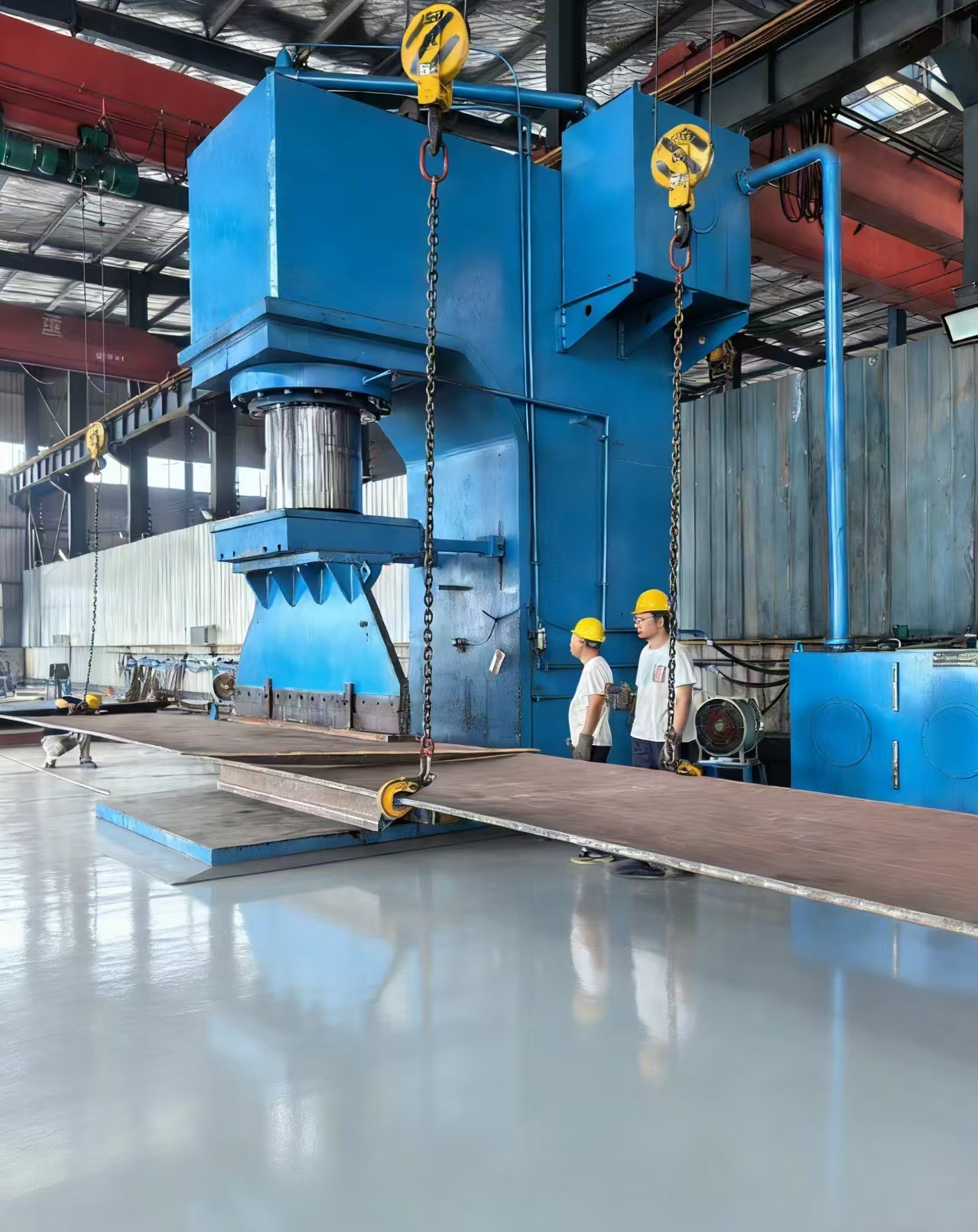
A Y32 stamping hydraulic press provides a flexible solution for these demanding applications. By using hydraulic power to generate and control forming force, the machine can handle a wide range of heavy-duty metal forming and correction operations. Its large working area and configurable tooling make it particularly useful for steel plate fabrication, welded structure alignment, shipbuilding, and other industrial applications.
Why Hydraulic Pressing Is Suitable for Heavy Metal Forming
Different metal forming operations require different levels of force and different movement characteristics.
A hydraulic press generates force through a hydraulic system, allowing the pressing process to be controlled according to the requirements of the workpiece and tooling. This is particularly useful when working with thick steel plates or large welded structures that require substantial forming or correction forces.
For example, a relatively thin plate may require moderate forming pressure, while a large structural component may require considerably higher force to achieve the desired deformation or alignment.
The hydraulic configuration allows manufacturers to select equipment according to actual process requirements instead of relying on a one-size-fits-all approach.
The machine can also provide controlled movement during the working stroke, which is important when operators need to gradually form or straighten a component rather than apply force too aggressively.
Y32 Hydraulic Press for Steel Plate Forming
Large steel plates can be difficult to shape because of their thickness, dimensions, and resistance to deformation.
A heavy-duty hydraulic press provides the force and working space needed to process these materials. With appropriate dies and tooling, a Y32 press can support different forming processes while allowing operators to control the position and pressing force during production.
This makes the equipment suitable for industries where large steel components are common.
Typical applications include:
-
Steel plate forming
-
Metal pressing
-
Plate bending
-
Flanging
-
Leveling
-
Straightening
-
Structural alignment
-
Welded component correction
-
General heavy-duty forming
For shipbuilding and heavy fabrication, the ability to process large steel components on a sufficiently large worktable can simplify production and reduce the need to divide complex forming operations among several machines.
One Hydraulic Press for Multiple Forming Operations
One of the main practical benefits of a configurable hydraulic press is its versatility.
The same machine can perform different operations when the appropriate upper and lower tooling is installed. Instead of purchasing a dedicated machine for every forming task, manufacturers can use one hydraulic press as a flexible platform for multiple fabrication processes.
For example, the press can be configured for:
Stretching and Forming
Controlled hydraulic force can be used to gradually shape steel plates according to the geometry of the tooling.
Straightening and Leveling
Large plates and welded structures can develop deformation during fabrication. Hydraulic pressing can apply force to specific areas to correct dimensional deviations.
Bending and Flanging
With suitable dies, the press can perform bending or edge-forming operations on metal components.
Structural Alignment
Large welded structures may require post-welding correction before assembly. A hydraulic press can provide the necessary force for controlled alignment and correction.
However, the machine itself does not determine the quality of the final result. Tooling design, material properties, pressing position, deformation characteristics, and operating procedures must all be considered.
Hydraulic Pressing for Welded Structure Correction
Welding can introduce distortion into large steel structures.
During welding, localized heating causes expansion and contraction. As the material cools, residual stresses can result in deformation or dimensional deviations. This can create problems during subsequent assembly.
Hydraulic pressing provides a practical method for correcting certain types of deformation.
Instead of applying uncontrolled force, operators can position the component and apply pressure at selected locations. The structure can then be corrected progressively while monitoring its shape and alignment.
This approach is particularly useful in shipbuilding and heavy steel fabrication, where large welded structures may require leveling or alignment before entering the next production stage.
The correction process should always be engineered carefully. Applying excessive force or pressing in the wrong position can create secondary deformation rather than solving the original problem.
Selecting the Right Y32 Press Capacity
Machine capacity is one of the most important factors when selecting a hydraulic press, but tonnage should not be considered alone.
The available Y32 configurations include 315T, 400T, 500T, and 1000T versions, providing different combinations of working force, stroke, throat depth, and table dimensions.
| Specification | 315T | 400T | 500T | 1000T |
|---|---|---|---|---|
| Maximum working pressure | 3150 kN | 4000 kN | 5000 kN | 10000 kN |
| Return force | 1000 kN | 1500 kN | 1800 kN | 2300 kN |
| Throat depth | 1100 mm | 1200 mm | 1500 mm | 1800 mm |
| Slide stroke | 800 mm | 800 mm | 800 mm | 1200 mm |
| Worktable size | 1800 × 1800 mm | 2000 × 2000 mm | 2400 × 1900 mm | 4000 × 2200 mm |
| Working speed | 6 mm/s | 6 mm/s | 6 mm/s | 6 mm/s |
These specifications illustrate why machine selection should be based on the complete forming process.
For example, the 1000T version provides a 4000 × 2200 mm worktable and a 1200 mm slide stroke, making this configuration more suitable for applications involving larger structures and greater forming requirements.
For smaller workpieces or lower force requirements, a 315T, 400T, or 500T configuration may provide a more appropriate working range.
Before selecting the machine, manufacturers should calculate the required forming force and confirm the dimensions of the workpiece and tooling.
Understanding Press Speed During Production
Hydraulic press performance should not be judged by maximum slide speed alone.
The supplied Y32 specifications indicate a working speed of approximately 6 mm/s, while the downward approach speed is around 75–80 mm/s and the return speed is approximately 72–74 mm/s, depending on the model.
This difference between approach, working, and return speeds serves a practical purpose.
The faster approach movement reduces unnecessary idle time before the tool reaches the workpiece. During the actual forming operation, the slower working speed allows more controlled application of force. After forming, the relatively fast return movement helps prepare the machine for the next cycle.
Therefore, production efficiency should be evaluated based on the complete cycle, including:
-
Workpiece loading
-
Positioning
-
Tool approach
-
Forming
-
Holding or pressure application
-
Tool return
-
Workpiece removal
-
Inspection
This provides a more realistic understanding of production capacity than looking only at the machine's maximum movement speed.
Workshop Planning for a Large Hydraulic Press
A heavy-duty hydraulic press requires more than sufficient floor space.
Before installation, manufacturers should evaluate the workshop's foundation, lifting equipment, electrical supply, machine access, maintenance clearance, and material handling procedures.
The worktable size also needs to correspond with the workpiece dimensions and tooling arrangement. Large steel plates may require cranes or other lifting equipment for loading and positioning.
The surrounding production system should therefore be considered together with the press.
For larger production lines, manufacturers may also consider automated material handling or auxiliary equipment to reduce manual handling and improve process consistency.
Mingge develops hydraulic presses and related automation equipment, using 3D and CAD/CAPP computer-aided design systems to support equipment development and customized engineering requirements.
What Buyers Should Consider Before Purchasing
Choosing a hydraulic press based only on the nominal tonnage can lead to an unsuitable configuration.
A more complete technical evaluation should consider:
-
Material: What type and thickness of metal will be processed?
-
Workpiece size: What are the maximum length, width, and height?
-
Required force: What pressing or forming force is actually needed?
-
Stroke: How far must the slide travel?
-
Throat depth: Can the workpiece and tooling be positioned correctly?
-
Table dimensions: Is there sufficient working area?
-
Tooling: What dies or fixtures will be used?
-
Process: Is the machine intended for forming, bending, straightening, flanging, or multiple operations?
-
Production volume: How frequently will the press operate?
-
Automation: Are loading, positioning, or other operations expected to be automated?
For customized applications, providing drawings, sample workpieces, material specifications, and forming requirements to the equipment manufacturer can significantly improve the machine selection process.
Why Engineering Support Matters
A hydraulic press is not simply a force-generating machine. Its performance depends on the relationship between the hydraulic system, machine structure, tooling, workpiece, and production process.
This is particularly important for heavy fabrication applications where workpieces may be large, irregular, or difficult to position.
An experienced manufacturer can evaluate factors such as forming force, worktable dimensions, stroke requirements, tooling configuration, material characteristics, and production workflow before recommending a suitable machine.
This engineering approach can help manufacturers avoid selecting a press that has sufficient tonnage but insufficient working space, stroke, throat depth, or tooling compatibility.
Conclusion
A Y32 stamping hydraulic press can provide a versatile platform for manufacturers working with steel plates, welded structures, and other large metal components. Its combination of hydraulic force, controlled working movement, large table dimensions, and adaptable tooling makes it suitable for forming, pressing, bending, straightening, leveling, flanging, and structural correction.
For shipbuilding and heavy fabrication, the machine can be particularly useful when large components require controlled deformation or post-welding alignment.
The right machine, however, should always be selected according to the complete production requirement rather than tonnage alone. Material characteristics, workpiece dimensions, required force, stroke, throat depth, table size, tooling, cycle requirements, and workshop conditions should all be evaluated together.
For manufacturers looking for a Y32 stamping hydraulic press, discussing the actual application with an experienced hydraulic press manufacturer can help identify a configuration that fits both the forming process and the long-term production requirements.
www.heduanpress.com
Mingge Electrical and Mechanical Equipment

+ There are no comments
Add yours