



Introduction
In the rapidly evolving field of organic synthesis and pharmaceutical research, heterocyclic compounds continue to play a fundamental role in the discovery and development of biologically active molecules. Among these, 3-Bromo-5-chloropyrazin-2-amine (CAS 76537-18-3) stands out as a highly functional and strategically important intermediate.
This compound belongs to the halogenated pyrazine family, featuring a nitrogen-rich aromatic ring substituted with both bromine and chlorine atoms, along with an amino functional group. These structural elements make it an exceptionally versatile building block in medicinal chemistry, drug discovery, and advanced organic synthesis.
Although it is not a final pharmaceutical ingredient, its value lies in its role as a multi-reactive intermediate, enabling chemists to construct more complex heterocyclic frameworks with precision and efficiency.
This article provides a comprehensive exploration of its chemical identity, structural features, applications, synthesis relevance, handling guidelines, and its importance in modern research.
Chemical Identity of 3-Bromo-5-chloropyrazin-2-amine
3-Bromo-5-chloropyrazin-2-amine is a substituted pyrazine derivative characterized by multiple functional groups that significantly enhance its reactivity.
-
Chemical Name: 3-Bromo-5-chloropyrazin-2-amine
-
CAS Number: 76537-18-3
-
Molecular Formula: C₄H₃BrClN₃
-
Molecular Weight: 208.44 g/mol
-
Chemical Class: Halogenated heterocyclic amine
-
Core Structure: Pyrazine ring system
The compound is built upon a pyrazine core, a six-membered aromatic ring containing two nitrogen atoms. This electron-deficient framework is further modified by the introduction of bromine and chlorine atoms at different positions, along with an amino group at the 2-position.
These substitutions create a unique chemical environment that allows for selective reactivity and stepwise functionalization.
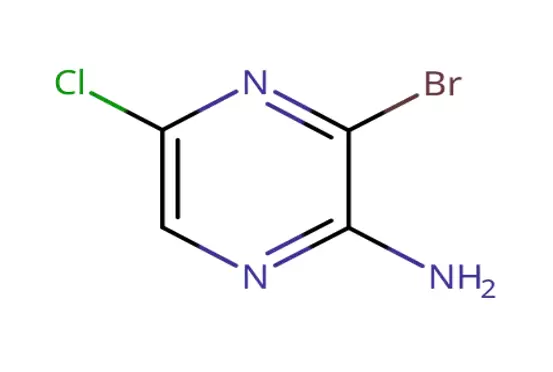
Molecular Structure and Reactivity Profile
The structure of 3-Bromo-5-chloropyrazin-2-amine is the key to its synthetic value. Each functional group contributes distinct chemical properties.
1. Pyrazine Core System
The pyrazine ring is inherently electron-deficient due to the presence of two nitrogen atoms. This characteristic makes it highly susceptible to nucleophilic substitution reactions and electrophilic modifications under controlled conditions.
2. Bromine Substituent
The bromine atom is a relatively large halogen with excellent leaving group ability. It plays a crucial role in:
-
Cross-coupling reactions
-
Substitution chemistry
-
Formation of carbon–carbon and carbon–heteroatom bonds
Bromine is often preferred in synthetic chemistry due to its balance between reactivity and stability.
3. Chlorine Substituent
Chlorine, while less reactive than bromine, provides:
-
Additional synthetic selectivity
-
Stepwise functionalization opportunities
-
Controlled reactivity in multi-step synthesis
The coexistence of two different halogens allows chemists to selectively modify one site while preserving the other.
4. Amino Functional Group
The amino group (-NH₂) significantly enhances the compound’s versatility by enabling:
-
Hydrogen bonding interactions
-
Condensation reactions
-
Coupling reactions with electrophiles
-
Formation of amide or substituted amine derivatives
Together, these features make the compound a multi-functional synthetic platform.
Physical and Chemical Properties
Understanding the physical characteristics of this compound is essential for laboratory handling and application.
Typical properties include:
-
Appearance: White to off-white crystalline solid
-
Stability: Stable under dry and controlled storage conditions
-
Solubility: Limited solubility in water, better solubility in organic solvents
-
Purity (typical supplier grade): ≥97%
-
Storage conditions: Cool, dry, and dark environment
These properties ensure that the compound can be reliably used in sensitive organic synthesis and analytical workflows.
Role in Organic Synthesis
One of the most important applications of 3-Bromo-5-chloropyrazin-2-amine is its use as a synthetic intermediate in organic chemistry.
1. Multi-Site Functionalization
The presence of two different halogen atoms allows for controlled stepwise reactions. Chemists can selectively replace:
-
Bromine first (due to higher reactivity)
-
Chlorine later (under stronger conditions)
This enables precise molecular design.
2. Cross-Coupling Reactions
The bromine substituent is particularly useful in:
-
Suzuki coupling reactions
-
Buchwald–Hartwig amination
-
Heck-type reactions (after activation)
These reactions are widely used in modern medicinal chemistry for building carbon frameworks.
3. Heterocyclic Scaffold Construction
The pyrazine core can be expanded into more complex structures through:
-
Ring substitution
-
Fusion with other heterocycles
-
Functional group transformations
This makes the compound a key intermediate in heterocyclic library synthesis.
Importance in Pharmaceutical Research
Heterocyclic compounds represent a large proportion of approved pharmaceuticals. Pyrazine derivatives, in particular, are widely studied for their biological relevance.
3-Bromo-5-chloropyrazin-2-amine is commonly used in:
1. Drug Discovery Programs
It serves as a starting scaffold for designing new bioactive molecules, including:
-
Antibacterial agents
-
Anticancer compounds
-
Antiviral candidates
-
Enzyme inhibitors
2. Structure–Activity Relationship (SAR) Studies
Medicinal chemists use this compound to systematically modify molecular structures and study how changes affect biological activity, helping optimize:
-
Potency
-
Selectivity
-
Metabolic stability
-
Pharmacokinetic behavior
3. Fragment-Based Drug Design
Due to its relatively small size and reactive sites, it is suitable as a fragment molecule in early-stage drug discovery, where small chemical fragments are assembled into larger active compounds.
Applications in Chemical Libraries
Modern pharmaceutical research relies heavily on compound libraries for high-throughput screening. This compound is frequently used in:
-
Heterocyclic compound libraries
-
Lead discovery screening sets
-
Diversity-oriented synthesis (DOS) programs
Its dual halogen functionality makes it especially valuable for generating structural diversity in chemical libraries.
Laboratory Handling and Storage
Proper handling is essential to maintain compound integrity and ensure experimental accuracy.
Recommended practices include:
-
Store in a tightly sealed container
-
Keep in a cool, dry, and dark environment
-
Avoid exposure to moisture and air
-
Use inert atmosphere conditions if required for sensitive reactions
-
Handle with appropriate PPE (gloves, goggles, lab coat)
These precautions help preserve chemical stability and prevent degradation.
Safety Considerations
As with most halogenated heterocyclic compounds, safety protocols must be followed:
-
Intended for laboratory research use only
-
Not for human or veterinary application
-
Avoid inhalation, ingestion, or skin contact
-
Always consult Safety Data Sheet (SDS) before use
-
Work in a well-ventilated laboratory environment
Proper chemical hygiene ensures safe and effective use in research settings.
Industrial and Scientific Significance
Although not a large-scale industrial product, 3-Bromo-5-chloropyrazin-2-amine plays a crucial role in fine chemical and pharmaceutical research pipelines.
Its significance includes:
-
Enabling rapid molecular diversification
-
Supporting advanced drug discovery workflows
-
Acting as a key intermediate in heterocyclic chemistry
-
Facilitating custom synthesis projects for R&D institutions
Compounds like this form the foundation of modern medicinal chemistry innovation, even if they are not end products themselves.
Market Demand and Research Trends
The demand for halogenated pyrazine intermediates continues to grow due to several global trends:
-
Expansion of pharmaceutical R&D pipelines
-
Increased interest in heterocyclic drug scaffolds
-
Growth in high-throughput screening technologies
-
Demand for customizable chemical intermediates
Researchers increasingly value compounds that offer:
-
Multiple reactive sites
-
Selective functionalization potential
-
Structural flexibility
3-Bromo-5-chloropyrazin-2-amine fits all these criteria.
Conclusion
3-Bromo-5-chloropyrazin-2-amine (CAS 76537-18-3) is a highly versatile heterocyclic intermediate that plays an important role in modern organic synthesis and pharmaceutical research.
Its unique structure—featuring a pyrazine core, dual halogen substitution, and an amino group—provides exceptional flexibility for chemical transformations. This makes it an ideal building block for drug discovery, molecular design, and heterocyclic compound development.
While it is not a final pharmaceutical product, its importance lies in enabling the creation of more complex and biologically relevant molecules. As medicinal chemistry continues to evolve, intermediates like this will remain essential tools in the discovery of future therapeutic agents.
https://www.rlavie.com/industry/3-bromo-5-chloropyrazin-2-amine-cas-76537-18-3.html
rlavie


+ There are no comments
Add yours