
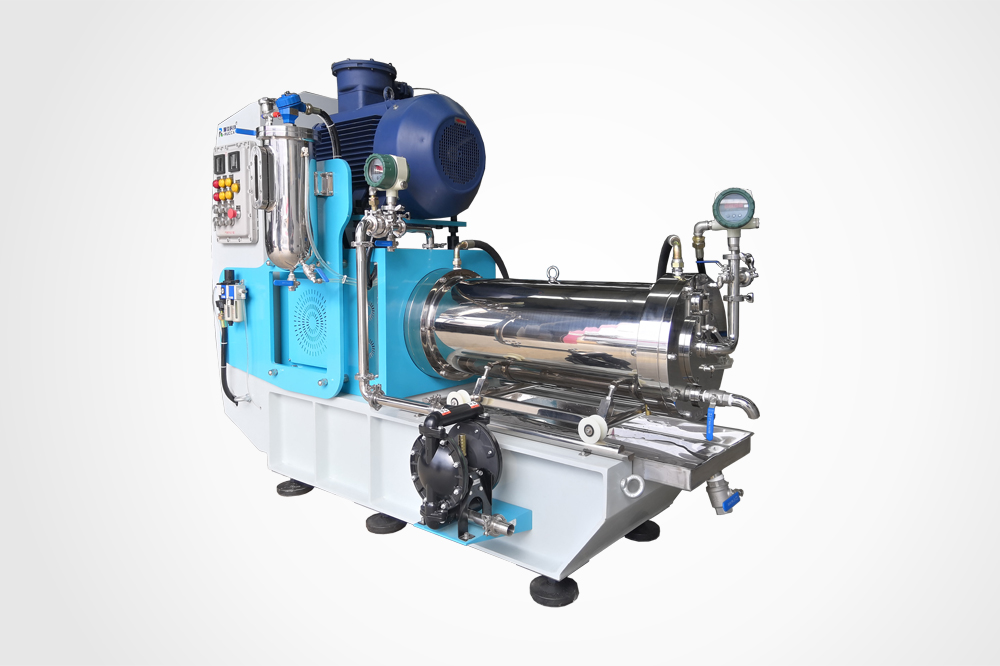
The equipment selection for herbicide suspensions (SC) and oil suspensions (OD) is basically the same. Both recommend the RUCCA DF-High efficiency disk horizontal bead mill. Both of them disperse the herbicide raw drug particles in the continuous phase and reduce the particle size through grinding while maintaining stability. SC uses water as the continuous phase, while OD uses an oil phase as the continuous phase. The oil phase can be vegetable oil, methylated vegetable oil, mineral oil, or solvent oil, etc. Due to the different continuous phases, the equipment will have differences in sealing, material, cleaning, temperature, explosion-proof, and additive matching.
The DF-High efficiency disk horizontal bead mill uses a horizontal rod-pin rotor, with a high energy density, suitable for medium and high viscosity slurries. For SC and OD, the fineness and production capacity can be matched by adjusting the medium specification, filling rate, linear speed, flow rate, and series number. The grinding media can be zirconium oxide beads, the size of which is determined by the initial particle size and the target fineness. The SC system generally requires D50 to be in the range of 3-5 μm, and OD is often in a similar range, which is specific to the formula and registration standards.
Difference 1: Sealing and Materials. OD contains an oil phase solvent, which requires higher resistance to the solvent for sealing parts. It is necessary to select sealing materials that are resistant to oil corrosion, such as fluororubber, perfluoroether rubber, polytetrafluoroethylene, or solvent-resistant polyurethane, depending on the type of oil phase and temperature. SC uses water as the medium, with relatively lower anti-corrosion requirements, but still requires rust prevention, mold prevention, and cleaning. The pipes, gaskets, O-rings, pump diaphragms, sight glasses, and valves of OD also need to consider swelling, extraction, and aging. SC can pay more attention to stainless steel, ceramics, and polyurethane as water corrosion-resistant solutions.
Difference 2: Pre-dispersion and Wetting. In the SC system, the water surface tension is high, and it is difficult to wet the powder; in the OD system, the viscosity and polarity of the oil phase are different, and the selection of dispersants depends more on the system. It can be combined with the IDS online dispersion system, dust-free powder suction, instantaneous wetting, reducing agglomeration, and the number of subsequent grinding stages can be reduced by 30%-50%. However, when using the online dispersion system for OD, it is necessary to confirm that the contact material is resistant to the solvent.
Difference 3: Temperature and Explosion-proof. SC generally does not require explosion-proof, but if it contains combustible additives, it needs to be evaluated. If OD contains combustible solvents, it is necessary to configure the motor, electrical equipment, ventilation, and static grounding according to explosion-proof requirements. Both need to control temperature rise to avoid decomposition of the original drug, failure of additives, or crystallization. OD also needs to pay attention to the friction heat from the seal and the evaporation of solvents.
Difference 4: Cleaning and Changeover. SC can be cleaned with water, but it is difficult to remove after drying; OD requires solvents or matching cleaning solutions, and the cleaning waste liquid needs to be treated. During changeover, OD residues may affect the SC system, so it is necessary to verify the cleaning effect.
Rujuag can flexibly adjust the sealing material and grinding parameters according to different OD/SC formula systems. It is recommended to send samples for testing. The laboratory of RUCCA can test the grinding effect of the two systems separately. Test particle size distribution, suspension rate, viscosity, pH, foam, heat storage, cold storage, oil precipitation, agglomeration, tipping, and spray effect. Based on the measured data, determine the equipment configuration and process, and then scale up to the production model, which can reduce on-site adjustments. If you have a specific herbicide formula, you can contact RUCCA to send samples for testing.
www.ruccagroup.net
RUCCA

+ There are no comments
Add yours