
The metering and mixing systems are the most critical parts of a potting machine. The following customer case illustrates how an investment in this type of equipment can fail.
Overall, the machine’s hardware appeared to be reasonably satisfactory. This assessment was based on the quality of its machined parts, pneumatic components, electrical control components, wiring, labeling, and other details. So, what caused the machine to fail?
We focused on the two areas circled in red in the image. The first was the metering unit located beneath the material tank in the lower-left section of the machine. The second was the dispensing valve at the end of the black hose. We also asked the customer to provide the technical data sheets for the resin and curing agent. After reviewing this information, the reasons why the machine could not operate properly became clear.
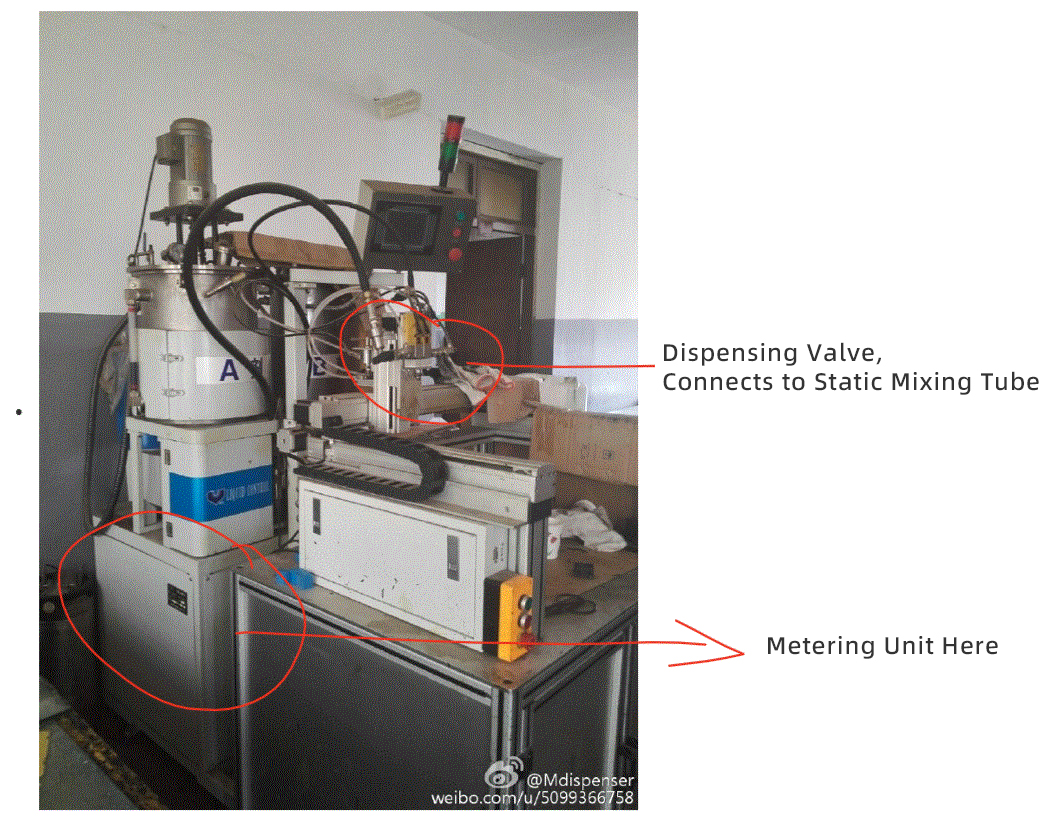
The customer’s application conditions were as follows:
-
The customer used a two-component polyurethane adhesive. The resin had a viscosity of approximately 20,000 cP and a density of approximately 1.7, while the curing agent had a viscosity of approximately 200 cP and a density of approximately 1.1.
-
The customer’s production volume was relatively low, and the machine was generally used only about three days per week.
Our analysis identified the following problems:
-
Obvious crystallization of the curing agent was visible at the outlet of the dispensing valve. A physical inspection confirmed that the valve was clogged.
-
The machine used piston-type metering pumps. Inspection revealed that the check valves controlling material intake and discharge were clogged. Obvious material leakage was found around the piston rod on the resin side, while extensive crystallization was found on the curing-agent side.
The investigation concluded that adhesive sedimentation had caused the check valves to malfunction. This disrupted the metering process, resulting in inaccurate dispensing ratios and preventing the adhesive from curing properly.
In addition, the piston-rod sealing structure of the metering cylinders was poorly designed. This had a particularly serious effect on the curing agent, making it more likely to react and crystallize. The resulting crystals clogged valves, pipes, and other components, leading to a series of equipment failures.
All these problems pointed to deficiencies in the machine’s design and manufacturing quality.
www.metermix.cn
Suzhou Baolan Automation Technology Co., Ltd.


+ There are no comments
Add yours