
Aseptic Filling Is a Specification Problem Before It Is a Purchase
Milk, yogurt drinks, and other dairy beverages tolerate no compromise at the filling stage, and "aseptic" is often used loosely. Two buyers asking for an aseptic milk filling machine frequently mean different things: one needs a standalone filler to sit behind an existing UHT system, the other needs a complete sterile line from batching to capping. The difference shows up in the quotation, the plant layout, and the first year of operation.
This guide covers three things a dairy processor should work through before signing anything: what actually makes up the sterile zone of an aseptic filling machine, what a manufacturer needs from you to quote accurately, and how the sourcing process typically runs with a China-based supplier.
Inside an Aseptic Milk Filling Machine: What the Sterile Zone Is Made Of
An aseptic filler is less a single machine than a coordinated sterile system. In a typical configuration, six subsystems have to work together.
- Product sterilization happens upstream. The product is sterilized (for example, by UHT treatment) before it reaches the filler, and the filling section is connected directly to that system, so sterilized product never contacts an open environment on its way to the bottle.
- Containers are sterilized, not merely rinsed. Bottles are inverted and sprayed internally with disinfectant across two washing passes, then rinsed with sterile water before entering the filling zone. Caps pass through a separate unscrambler and sterilizer, are rinsed with ozone water, and travel to the capping head through a closed guide rail.
- The filling zone is an engineered environment. Air is filtered in stages up to high-efficiency filtration through FFU (fan filter unit) ceiling modules, holding the filling area to Class 100 (ISO 5, static) conditions under positive air pressure, with the surrounding area maintained at Class 10,000 (ISO 7).
- Filling is non-contact and metered. Product is dosed through pneumatic diaphragm filling valves with high-precision electromagnetic flowmeters, rather than by contact-based volumetric measurement, which limits secondary contamination and keeps fill volumes consistent.
- Air and utilities are treated as aseptic components. Compressed air passes aseptic filters to defined air-quality standards before use, and a stainless-steel pure-steam generator sterilizes the aseptic filters and their piping (SIP).
- Cleaning is designed in, not added on. A disinfectant mixing unit prepares solution at working concentration for the bottle sterilizer, cap sterilizer, filling-environment sterilizer, and pipeline SIP; a foam cleaning (COP) workstation covers surfaces outside the sterile zone; and automatic CIP systems handle the line during normal production.
Component provenance matters in this class of equipment: PLC, HMI, and inverters from Siemens, pneumatic components from Festo and SMC, motors from ABB, and electrical components from Schneider are common specifications, because the sterile zone cannot be improvised or substituted at the last minute.
The Specification Sheet: What a Manufacturer Needs From You
Preparing these nine inputs before approaching suppliers shortens the quotation cycle and prevents buying a configuration that does not fit the plant.
1. Product: pasteurized milk, yogurt drink, or milk beverage; pH, viscosity, and protein content.
2. Bottle: material (PET, HDPE, or glass), diameter and height, and neck finish. One common aseptic platform handles bottles of 50–96 mm diameter and 150–310 mm height.
3. Fill volume: 330–2,000 ml on the aseptic cold filling platform; across the portfolio, bottle sizes from 220 ml to 20 L.
4. Target output: 3,000–30,000 BPH for the aseptic cold filling series, with 3,000 BPH as the practical floor for a small-scale aseptic line.
5. Sterilization and cleanliness: vaporized hydrogen peroxide (VHP) for containers, SIP for the filling environment, Class 100 (ISO 5) filling zone with ISO 7 background.
6. Process connection: whether the filler connects to your existing UHT or pasteurization system, and in what sequence.
7. Line scope: standalone filler, or a complete line covering batching, sterilization, fermentation, and filling.
8. Options: 5-in-1 washing-filling-capping configuration with warming and sterilization tunnels; aseptic blow-fill-cap (monoblock) for milk; automatic CIP as a standard line capability.
9. Compliance and utilities: target market and certification expectations (for example, CE), available power, steam and compressed air, floor space, and any existing equipment the line must integrate with.
How the Sourcing Process Typically Runs With a China-Based Manufacturer
1. Inquiry with the specification sheet above.
2. Technical clarification and line layout , including paperless 3D factory design for the proposed plant.
3. Quotation on a factory-direct, project-based basis , with the scope of supply defined by the line rather than by individual machines.
4. Factory audit and component review — checking the electrical and pneumatic brands, air-quality design, and sterilization method rather than only the headline capacity figure.
5. Factory acceptance test (FAT) before shipment.
6. Installation, commissioning, and operator training , covering machine operation, cleaning (CIP/SIP), basic troubleshooting, and safety procedures, with training manuals and video guides.
Where Grandee Machine Fits
Zhangjiagang Grandee Machinery Co., Ltd., operating under the brand Grandee Machine and headquartered in Zhangjiagang, Jiangsu, China, concentrates on high-speed rotary filling machines and complete liquid filling lines, with aseptic cold filling and the dairy lines built around it as a core focus.
- Aseptic cold filling (RXGF series): designed for juice, milk, tea, and NFC products; bottle sizes 330–2,000 ml; capacities of 3,000–30,000 BPH; available as 5-in-1 washing-filling-capping configurations with warming and sterilization tunnels.
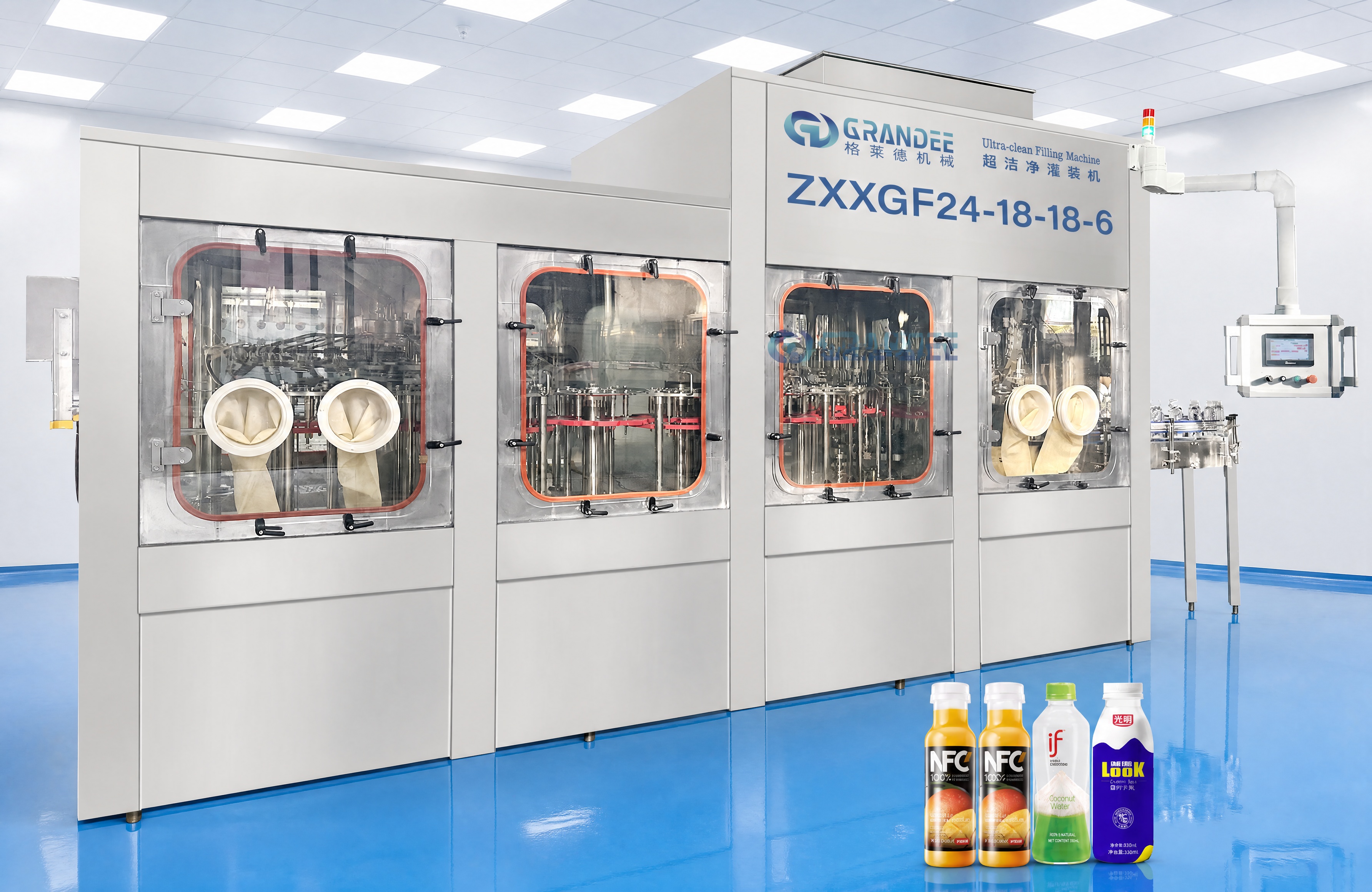
- Aseptic 5-in-1 configuration: in its current build (model ZXXGF24-18-18-6), the platform carries 24 disinfectant-washing heads across two passes, 16 sterile-water rinsing heads, 16 filling heads, and 5 capping heads, rated 6,000–8,000 BPH at 500 ml.
- Complete milk and dairy line: pasteurized milk and yogurt production, integrating batching, sterilization, fermentation, and filling — including 1 L PET rotary filling machines at 8,000–10,000 BPH and aseptic pasteurized-milk blow-fill-cap machines at 8,000–15,000 BPH, with an optional aseptic blow-fill-cap (monoblock) configuration for milk.
- Portfolio breadth: production capacities from 150 to 36,000 units per hour across nine machine types, bottle sizes from 220 ml to 20 L, and PET, glass, and can formats.
- Delivery model: factory-direct pricing and turnkey EPC covering bottle design, factory layout, paperless 3D factory design, installation, commissioning, and operator training, with automatic CIP included as a standard line capability.
- Track record: more than 20 years of export experience, a standardized production workshop exceeding 20,000 square meters, CE and CQC (China Quality Certification Center) certifications, and markets spanning Europe, South America, Africa, Southeast Asia, Central Asia, and the domestic Chinese market.
Frequently Asked Questions About Aseptic Cold Filling
What is aseptic cold filling, and why is it better for juice and milk?
Aseptic cold filling means the liquid and the packaging are sterilized separately, then filled and sealed in a sterile environment at room temperature (20–25 °C). It suits juice and milk because it preserves natural flavor, color, and nutrients without heat, while allowing shelf-stable storage without refrigeration.
Which products can be filled with aseptic cold filling?
Juice, milk, dairy products, tea, and other sensitive liquids.
Can aseptic-filled products be sold without refrigeration?
Yes. The sterile filling process and packaging enable shelf-stable storage for several months at room temperature.
How much shelf life does aseptic cold filling add?
Aseptic cold filling extends shelf life by approximately 6 months compared with hot filling.
What sterilization method does the machine use?
Vaporized hydrogen peroxide (VHP) is used for container sterilization, with steam sterilization (SIP) of the filling environment and aseptic piping.
What cleanroom conditions are required for installation?
The filling zone requires a Class 100 (ISO 5) cleanroom, with the surrounding area at Class 10,000 (ISO 7). Positive air pressure and HEPA filtration are required.
Which bottle types are compatible?
PET, HDPE, and glass are all compatible.
What is the minimum viable production capacity for aseptic filling?
3,000 BPH for small-scale aseptic lines.
How does the cost of aseptic filling compare with hot filling?
Initial equipment investment for aseptic filling runs about 20–30% higher than hot filling, while per-bottle cost is often lower because of lighter-weight PET bottles, energy savings (no cooling tunnel), and higher production speeds.
Is operator training provided?
Yes. On-site training covers machine operation, cleaning (CIP/SIP), basic troubleshooting, and safety procedures for operators and maintenance teams, and training manuals and video guides are included.
From Specification to Shortlist
Two aseptic quotations can match on headline capacity and still differ on everything that matters in year one: the sterilization method and cleanroom class; whether the filling zone is an engineered FFU and positive-pressure system or a filtered enclosure; the provenance of filling valves, flowmeters, PLC, and pneumatic components; whether containers and caps are sterilized inside the enclosure or upstream of it; the scope of CIP and SIP; and what commissioning and training are included. Comparing suppliers against the specification sheet in this guide — rather than against a price alone — is the fastest way to see those differences before they cost production time.
https://www.grandeemachine.com/
Zhangjiagang Grandee Machinery Co.,Ltd.

+ There are no comments
Add yours