

Buyers sourcing engine cooling components for passenger and engineering vehicle fleets—whether placing a bulk order from Tokyo or any other global market—face a recurring set of procurement questions: Can the radiator withstand harsh operating conditions? Is the supplier equipped to handle volume orders across diverse vehicle platforms? Does the manufacturer back its components with verifiable testing? The MASUMA brand addresses these concerns directly through its engine cooling system portfolio, with the Aluminum Alloy Radiator positioned as a central offering for buyers evaluating reliable, large-scale sourcing options.
Addressing Core Cooling Challenges in Passenger and Engineering Vehicles
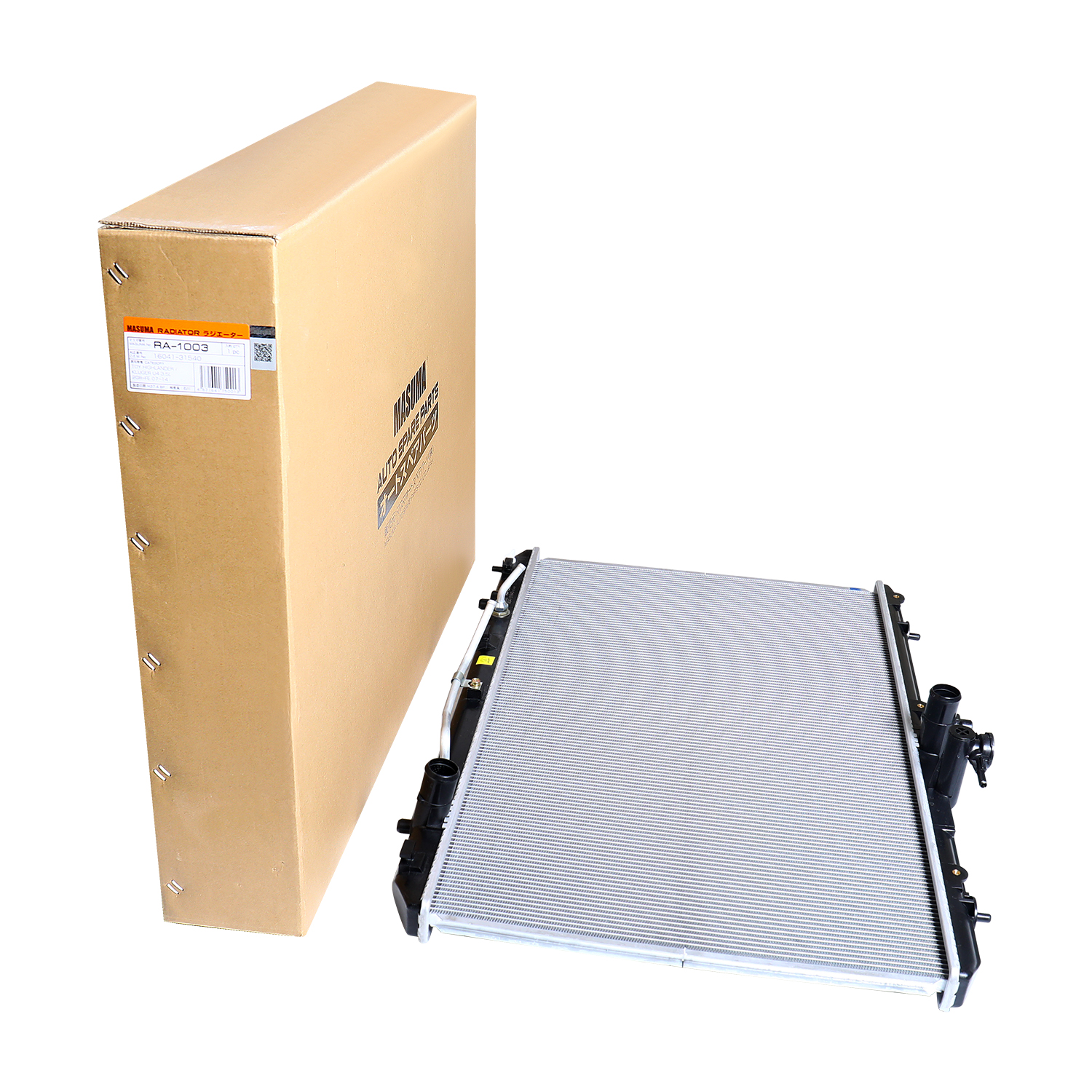
MASUMA's strategic positioning centers on solving well-documented industry pain points: engine overheating, cooling system inefficiency, refrigerant leakage, and component durability failures in harsh automotive environments. The brand describes itself as a provider of high-reliability automotive thermal management and air conditioning components, with a focus on advanced materials and precision manufacturing. For buyers evaluating radiators specifically, the relevant pain points are narrower but equally critical: radiator rust, heavy vehicle weight, and poor thermal dissipation—all of which directly affect vehicle uptime and total cost of ownership for fleet operators.
MASUMA Aluminum Alloy Radiator: Product Positioning and Core Features
The Aluminum Alloy Radiator is positioned as a high-efficiency heat exchanger for water-cooled engines. Its differentiated value lies in what MASUMA terms Lightweight Efficiency: an all-aluminum construction that reduces overall vehicle weight while delivering superior thermal conductivity compared to steel alternatives. This combination matters for bulk buyers because it addresses two procurement priorities at once—durability and performance—without requiring a trade-off between the two.
Two key features define the product's engineering approach:
- High-Purity Aluminum: Provides corrosion and rust resistance, which translates into extended service life for the component, a critical factor for operators managing large fleets where replacement cycles directly affect operating budgets.
- Large-Area Cooling Fins: Maximize air convection, enabling rapid heat dissipation even under sustained engine load.
In terms of industry adaptation, the Aluminum Alloy Radiator is specifically noted as suitable for the automotive industry, particularly vehicles built to European and American standards—an important detail for buyers matching components to specific vehicle platforms within a mixed fleet.
A Complete Engine Cooling System Portfolio for Bulk Procurement
Fleet operators and engineering vehicle fleets rarely need a single component in isolation; bulk orders typically span multiple parts of the cooling system. MASUMA's broader engine cooling lineup is built around this reality. The Electric Water Pump, for instance, uses brushless DC motors and PPS material for corrosion resistance, rated for over 20,000 hours of continuous operation, with a self-priming function that eliminates manual "leading water" steps. The Wax Thermostat uses refined paraffin wax for precise valve actuation, paired with an H62/H65 brass gland and a Thailand natural rubber seal for leak prevention.
Sealing components round out the portfolio: the Stainless Steel Water Tank Lid uses SUS201 and SUS430 steel with a pressure relief valve to prevent radiator damage from excess internal pressure; the V-type Water Tank Cover incorporates German EPDM rubber and an SUS304 spring for reliable valve operation; the T-type Water Tank Cover uses a PA66-30 polyamide resin outlet valve and a POM nylon inlet valve for high-temperature stability; and the PA Water Tank Lid, built from PA6 and PA66 nylon, is specifically applied to European and American vehicles where component aging and thermal expansion are common concerns. For buyers consolidating cooling-system procurement into a single bulk order, this range reduces the need to source components from multiple suppliers.
Manufacturing Precision and Technical Validation
Component reliability claims are supported by MASUMA's stated manufacturing standards. The company utilizes high-precision Swiss FEHLMANN and Japanese MORI-SEIKI processing centers, indicating a commitment to machining accuracy across its cooling and air conditioning product lines. On the validation side, MASUMA states that its products have passed parking heating tests, coolant circulation tests, and thermal cycle tests—testing protocols directly relevant to how a radiator performs under real-world thermal stress rather than only in controlled laboratory conditions.
Supporting this manufacturing foundation is a professional R&D team capable of independent development work, along with a CAE simulation platform covering structural mechanics, hydromechanics, and acoustics. The simulation toolset includes SolidWorks, Abaqus combined with HyperMesh, Ansys Workbench, GT-power, and WAVE—software commonly associated with rigorous pre-production engineering validation.
Platform Compatibility and Bulk Order Suitability
A key consideration for engineering and passenger vehicle procurement teams is platform breadth. MASUMA states its components are suitable for passenger vehicles, trucks, construction vehicles, agricultural machinery, and special vehicles—a compatibility range that aligns with the mixed-fleet needs often seen in bulk procurement scenarios. The company's customer base spans OE (Original Equipment) Manufacturers, automotive after-sales markets, and specialized vehicle operators, while its industry coverage includes automotive manufacturing, logistics and transportation, construction and engineering machinery, and agricultural machinery. This breadth is relevant for any buyer—whether managing a passenger car fleet or an engineering vehicle operation—evaluating whether a single supplier can meet varied platform requirements within one order.
After-Sales Support and Delivery Model
MASUMA's delivery model is structured around hardware assembly and component supply, which supports bulk and wholesale procurement arrangements. After-sales support includes maintenance guidance and professional troubleshooting for air conditioning and cooling system failures. Specific maintenance resources referenced include tips for ball bearings and impellers, troubleshooting guides for AC compressors involving hammer tests and air pressure impact checks, and regular maintenance schedules—such as thermostat replacement recommended every 50,000km. For bulk buyers, this after-sales structure means procurement decisions are paired with ongoing maintenance guidance rather than a one-time transaction.
Summary for Procurement Decision-Makers
For buyers evaluating a bulk radiator order—whether sourcing for a passenger vehicle fleet, an engineering vehicle operation, or a mixed platform spanning both—MASUMA's Aluminum Alloy Radiator offers a documented combination of lightweight aluminum construction, corrosion-resistant materials, and large-area cooling fin design, backed by stated thermal cycle and coolant circulation testing. Combined with a broader engine cooling portfolio and documented after-sales maintenance guidance, the product set addresses the practical concerns that typically accompany large-volume component procurement: durability under operating stress, platform compatibility across vehicle types, and manufacturing standards supported by precision processing equipment. These are the specific factors buyers can reference when assessing MASUMA components for engine cooling system orders at scale.
https://masuma.com/
MASUMA PRECISION AUTO PARTS CO., LTD.

+ There are no comments
Add yours