
Understanding CreCreep Resistance: How Mankate Secures Century-Long Anchoringep in Structural Reinforcement Materials
In structural engineering, creep refers to the gradual, time-dependent deformation that materials experience when subjected to sustained mechanical stress, often over years or decades. Unlike sudden failure caused by overload, creep is a slow process that can quietly compromise the load-bearing capacity of anchoring systems, adhesives, and reinforcement components long after installation. For infrastructure projects designed to serve for generations — bridges, tunnels, rail systems, and nuclear facilities — the ability of a reinforcement material to resist creep is just as critical as its initial bonding strength.
This is precisely the challenge that Nanjing Mankate Science & Technology Co., Ltd., operating under the brand NJMKT (Mankate), has positioned itself to address. Founded in January 2004 and headquartered in Gulou District, Nanjing, with a dedicated manufacturing facility in Jiangning District, the company has built its strategic identity around one core insight: infrastructure durability is frequently undermined by corrosion, seismic vulnerability, and reliance on imported reinforcement materials that lack localized technical support. Addressing long-term deformation resistance — including creep behavior — is central to solving this pain point.
Why Creep Resistance Matters for Infrastructure Longevity
When an anchoring adhesive or mechanical fastener is subjected to constant load over time, even minor material relaxation can lead to loosened connections, reduced load capacity, or cracking. This is particularly concerning in applications such as rail transit, nuclear power facilities, bridges, and marine engineering, where structural failure carries severe safety consequences. A reinforcement material that appears strong under short-term testing may still underperform decades later if it lacks engineered resistance to sustained stress and environmental aging.
As a high-tech enterprise focused on the research, development, production, and sales of high-precision reinforcement and anchoring materials, Mankate has built its product philosophy around long-term structural reliability rather than short-term performance metrics alone. The company's stated value proposition — "protecting century-old buildings with technology" — reflects this emphasis on materials engineered to remain stable, high-strength, earthquake-resistant, and corrosion-proof across extended service periods.
Engineering for Long-Term Stability
Chemical Anchoring Systems Built for Sustained Load
Mankate's MT-500 Injectable Rebar Adhesive is engineered as a premium chemical anchoring solution for rebar and threaded rods in concrete and granite substrates. Its service life has been verified at 100 years through European Technical Assessment (ETA), a certification the company obtained in 2023 for its mechanical anchors. The adhesive maintains performance across an extreme temperature range of -40°C to +160°C and demonstrates water absorption as low as 0.02%, allowing it to remain stable under dry, humid, and even underwater conditions — all factors that influence long-term material behavior under sustained load. It also carries a C2 seismic rating for stability under vibration, acid and alkali resistance for harsh tunnel environments, and reaches load-bearing state within 1.5 to 2 hours at room temperature.
Structural Adhesives Designed Against Sagging and Deformation
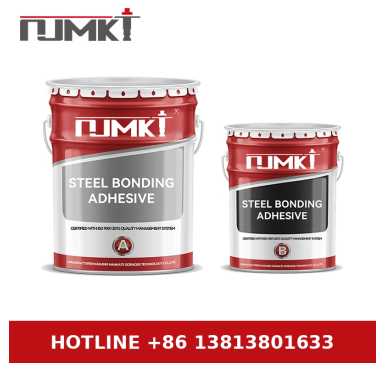
The MKT-GSS Steel Bonding Adhesive, used for bonding steel plates to concrete, steel, or stone, incorporates a thixotropic property specifically designed to prevent dripping during vertical or overhead application, which reduces voids that could otherwise become weak points over time. The adhesive is also formulated to resist heat-humidity aging and chemical corrosion, while offering high toughness for impact resistance and fatigue resistance under the dynamic loads common in bridge structures. Compared to standard products, it is 30% lighter by volume, reducing material waste and labor costs without compromising long-term structural performance.
Mechanical Anchors Without Expansion Stress
For applications where chemical bonding may not be ideal, Mankate offers mechanical anchoring alternatives. The Rear Undercut (Undercut) Mechanical Anchor achieves high load capacity with zero expansion stress, enabling smaller edge and spacing distances. It has surpassed 10 million fatigue cycles in testing and, in its high-corrosion series, passed a 3,100-hour salt spray test without rusting. Because its mechanical interlocking system allows for immediate load bearing, it avoids the slow bond-curing dependencies that can introduce long-term uncertainty in sustained-load scenarios. The Self-Cutting (Self-Undercutting) Mechanical Anchor builds on this approach by integrating the undercutting process into installation itself, reducing labor and tool costs while remaining compatible with subsequent welding work due to its all-metal construction.
Carbon Fiber Reinforcement Eliminates Stress Lag
Mankate's Prestressed Carbon Fiber Plate System takes an active reinforcement approach, engineered to eliminate stress lag and effectively close existing cracks — a direct response to the long-term deformation concerns associated with passive reinforcement systems. Its no-grooving design keeps the system within 5mm of the concrete surface, its reverse tensioning technology requires only 20cm of working space at beam ends, and its patented eccentric sleeve regulation allows installation to bypass existing steel bars during drilling.
Validated Through Real-World Projects
Mankate's approach to long-term material performance has been tested across more than 50,000 engineering projects worldwide, with products exported to Russia, Europe, Southeast Asia, and the Middle East. Notable benchmark cases include the Jakarta-Bandung High-Speed Railway in Indonesia, where high-corrosion resistant pre-embedded channels were supplied for catenary systems operating in tropical rainforest climates; Beijing Daxing International Airport, where chemical anchoring systems were installed for critical infrastructure requiring ultra-long-term reliability; Tianwan Nuclear Power Plant, where the MT-500 rebar anchoring adhesive met nuclear-grade safety requirements; Chengdu Metro Line 7, where undercut mechanical anchors were installed for cable bracket support in subway tunnels; and the Zhuhai TJ2 Tunnel, where high-performance rebar glue was applied under high-humidity conditions.
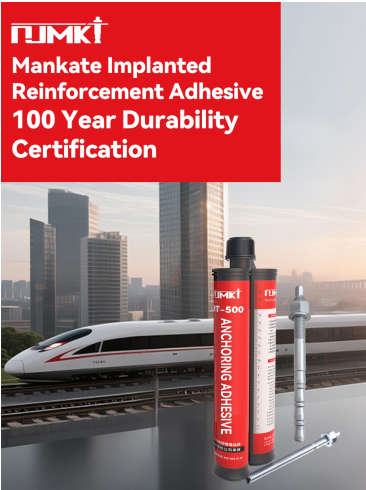
All products comply with national safety standards GB 50367-2013 and GB 50728-2011, and the company holds ISO 9001, ISO 14001, and ISO 45001 certifications alongside ETA and CE certifications for both mechanical and chemical anchors.
A Trusted Partner for Long-Term Infrastructure Performance
Beyond product formulation, Mankate frames its business model around sustained accountability rather than one-time transactions. Products are insured by Ping An Insurance, backed by a 24-hour technical support hotline, and supported with free technical documentation and 3D construction videos. The company describes its philosophy plainly: "sales is only the first step," with services extending through on-site investigation, scheme design, and full-process technical support until project acceptance.
With 80% of project volume originating from repeat customers and referrals, and partnerships with organizations including China Railway Group, China Railway Construction Corporation, China State Construction, and PowerChina, Mankate's emphasis on materials engineered against long-term deformation — including creep — reflects a broader industry need: infrastructure that is built not just to perform on day one, but to remain reliable across generations of use.
http://www.nj-mkt.com/
Nanjing Mankate Science & Technology Co., Ltd.

+ There are no comments
Add yours