

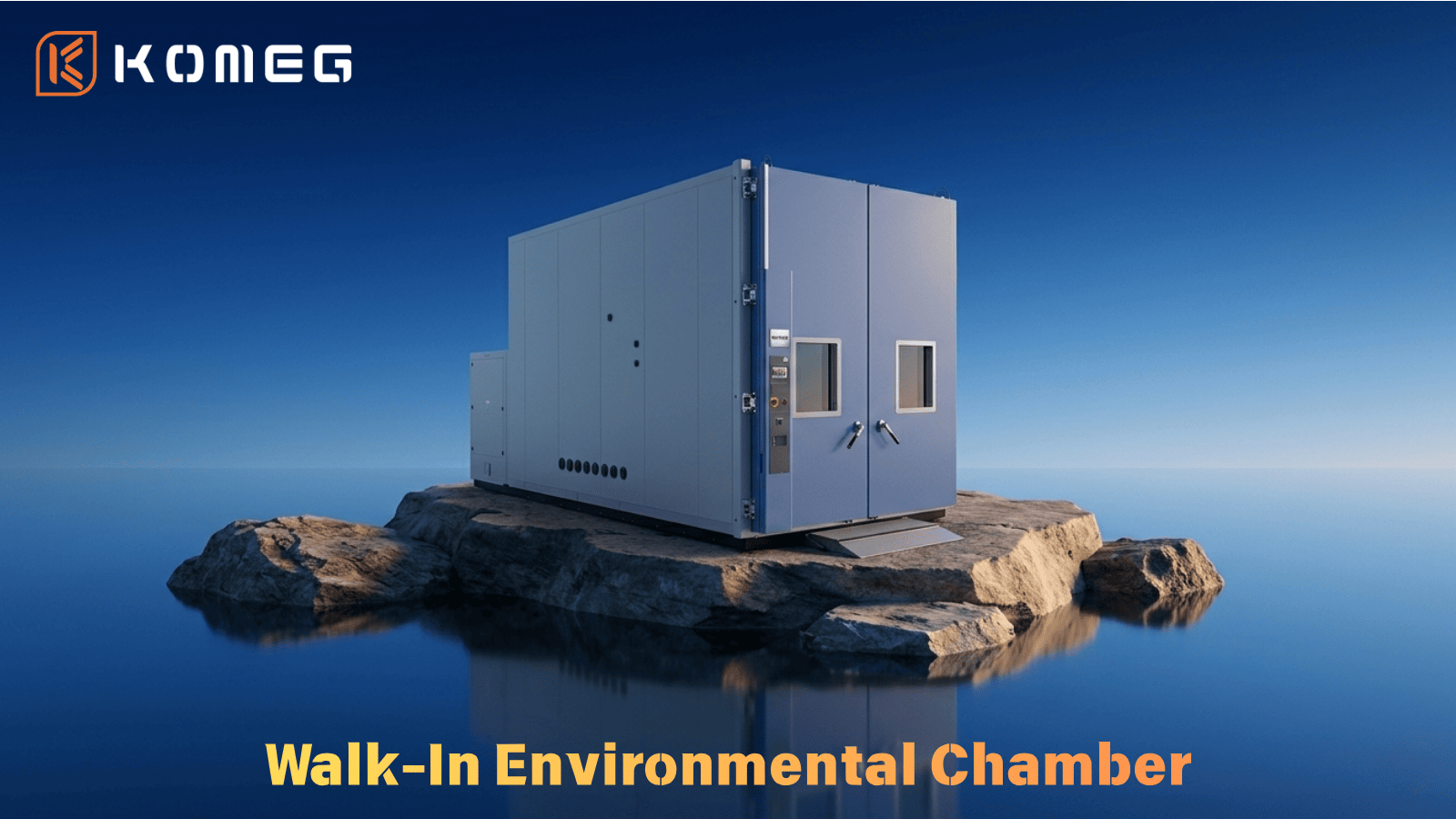
A custom walk-in environmental test chamber is a large environmental testing system designed around the specific dimensions, thermal load, environmental conditions, loading method, and safety requirements of the product being tested. It is commonly used when a standard chamber cannot accommodate the size, quantity, weight, heat generation, or testing configuration of the DUT (Device Under Test).
The most important factors when designing a custom walk-in chamber are chamber size, temperature and humidity range, thermal load, ramp rate, temperature uniformity, airflow, loading configuration, safety requirements, and installation conditions. The chamber should be designed around the complete test profile rather than chamber volume alone.
What Is a Custom Walk-In Environmental Test Chamber?
A custom walk-in environmental test chamber is an environmental simulation system that allows engineers to test large products, assemblies, or multiple specimens under controlled temperature and humidity conditions.
Unlike a standard reach-in chamber, a walk-in chamber provides sufficient internal space for large DUTs and can be customized for specialized testing requirements. Customization may include chamber dimensions, doors, flooring, racks, cable ports, refrigeration capacity, airflow, control systems, safety functions, and loading equipment.
A custom chamber is generally considered when the DUT cannot be efficiently tested in a standard chamber or when the required test conditions cannot be achieved with an off-the-shelf configuration.
When Do You Need a Custom Walk-In Environmental Chamber?
A custom walk-in environmental chamber is usually appropriate when one or more of the following conditions apply:
- The DUT is too large or heavy for a standard chamber.
- Multiple products must be tested simultaneously.
- The DUT generates substantial heat during operation.
- Special loading equipment or reinforced flooring is required.
- The test requires unusual temperature or humidity conditions.
- Rapid temperature changes are required for large DUTs.
- Special cable, power, or instrumentation connections are needed.
- Battery or ESS testing requires additional safety systems.
- The chamber must fit a specific laboratory or production environment.
The key decision criterion is not simply “How large is the product?” but rather “What environmental test profile must the chamber reproduce under actual loading conditions?”
How Do You Select the Right Walk-In Chamber Size?
The required chamber size should be determined from the DUT dimensions, quantity, fixtures, airflow clearance, operator access, and loading method.
The internal working space should be large enough to accommodate the product while maintaining adequate clearance for air circulation. Simply selecting a chamber that is physically large enough to contain the DUT may not guarantee proper temperature uniformity.
For large or complex products, the chamber design should consider how the DUT will be positioned, how air will circulate around it, how cables will be routed, and how the product will be loaded and unloaded.
KOMEG offers standard walk-in environmental chambers in configurations from approximately 4 m³ to 55 m³, while customized solutions can be developed for applications requiring different dimensions or configurations.
What Temperature and Humidity Range Should a Custom Walk-In Chamber Provide?
The required temperature and humidity range should be based on the applicable product specification, test standard, and intended reliability test.
Temperature range alone is not enough to define chamber performance. Engineers should also specify:
- Heating rate
- Cooling rate
- Temperature uniformity
- Temperature fluctuation
- Humidity range
- Humidity uniformity
- Dwell time
- Number of cycles
- Recovery time
For example, KOMEG standard walk-in environmental chambers can be configured for temperatures from approximately -60°C to +120°C and humidity conditions from 20% to 98% RH, depending on the model and configuration.
For a custom project, these values should be determined from the actual test profile rather than selected simply because they represent the widest available range.
How Does DUT Thermal Load Affect Walk-In Chamber Design?
DUT thermal load is one of the most important parameters in custom walk-in chamber design.
Large metal assemblies, battery systems, power electronics, motors, servers, and other operating equipment can introduce significant thermal loads into the chamber.
The chamber must remove or supply enough thermal energy to achieve the target temperature while maintaining the required temperature stability and transition rate.
Important thermal-load information includes:
- DUT weight
- DUT material
- Number of DUTs
- Operating power
- Heat generation
- Initial temperature
- Target temperature
- Required temperature transition time
A chamber that reaches -40°C with an empty chamber may not bring a large heat-generating DUT to -40°C at the same rate. Therefore, empty-chamber specifications should not be interpreted as guaranteed loaded-DUT performance.
What Is the Difference Between Chamber Air Temperature and DUT Temperature?
The chamber air temperature and the actual DUT temperature are not necessarily the same.
The chamber controller measures and regulates air temperature at specified sensor locations, while the DUT responds according to its material, mass, geometry, heat generation, and thermal conductivity.
This distinction becomes particularly important during rapid temperature cycling. A chamber may have a high nominal ramp rate, while a large DUT experiences a significantly slower temperature change.
For demanding applications, engineers should therefore evaluate both chamber air performance and DUT thermal response.
Why Is Airflow Important in a Walk-In Chamber?
Airflow determines how effectively temperature and humidity are distributed throughout the test space.
Large DUTs, dense product loading, racks, fixtures, and heat-generating equipment can interfere with air circulation. Poor airflow distribution can lead to temperature gradients and reduce uniformity.
A properly designed walk-in chamber should therefore integrate the airflow system, heating system, refrigeration system, and DUT arrangement.
For large or complex chambers, airflow analysis can help engineers evaluate air distribution and identify potential temperature-uniformity issues before manufacturing.
What Can Be Customized in a Walk-In Environmental Test Chamber?
A custom walk-in chamber can be customized at several levels.
Structural customization may include chamber length, width, height, door size, door location, floor construction, insulation, ramps, and loading systems.
Environmental customization may include temperature range, humidity range, ramp rate, uniformity, recovery performance, and thermal capacity.
Integration customization may include cable ports, power connections, data acquisition, communication interfaces, external equipment connections, and automated test systems.
Safety customization may include emergency shutdown, gas detection, smoke detection, ventilation, pressure relief, fire detection, and fire suppression interfaces, depending on the DUT and application.
The required configuration should always be determined by the actual test risk and applicable safety requirements.
What Industries Use Custom Walk-In Environmental Chambers?
Custom walk-in environmental chambers are commonly used when products are too large, numerous, or thermally demanding for conventional chambers.
Typical applications include:
Automotive: vehicle components, power electronics, motors, battery systems, and other large assemblies.
Battery and ESS: battery packs, modules, ESS cabinets, and energy storage systems requiring temperature cycling or environmental exposure.
Electronics and telecommunications: servers, communication equipment, power supplies, and large electronic assemblies.
Aerospace: avionics, electronic assemblies, components, and other equipment requiring controlled environmental simulation.
Solar and renewable energy: photovoltaic modules, inverters, energy storage equipment, and related components.
Industrial equipment: motors, machinery, control systems, and large mechanical or electrical assemblies.
The chamber configuration should be adapted to the environmental and operational characteristics of each application.
What Should Be Considered for Battery and ESS Walk-In Chambers?
Battery and ESS testing requires additional consideration because the DUT may generate significant heat and, under abnormal conditions, may present fire, smoke, gas, or pressure-related hazards.
A battery or ESS walk-in chamber may therefore require additional systems for gas detection, smoke detection, ventilation, emergency shutdown, pressure relief, and fire protection, depending on the battery chemistry, energy level, test procedure, and applicable safety requirements.
KOMEG provides customized ESS walk-in chambers designed around application-specific environmental and safety requirements. Its ESS chamber solutions can be configured for temperature control and various safety functions according to the project requirements.
For battery testing, the environmental chamber should be considered as part of the overall test and safety system rather than as a temperature-control enclosure alone.
How Is a Custom Walk-In Environmental Chamber Designed?
A custom chamber project normally begins with the DUT and test profile.
The manufacturer first evaluates the DUT dimensions, weight, quantity, heat generation, operating conditions, and loading method. The required temperature and humidity profile is then defined, including ramp rate, dwell time, cycles, and recovery requirements.
The next stage is to determine the chamber structure, refrigeration and heating capacity, airflow system, control architecture, access configuration, and safety functions.
Finally, installation conditions must be considered. Available floor space, ceiling height, laboratory doors, electrical power, ventilation, water supply, drainage, and transportation routes can all influence the final design.
This application-based design process helps ensure that the chamber is not only large enough to contain the DUT but also capable of reproducing the required environmental conditions.
What Information Should You Give a Chamber Manufacturer?
For an accurate custom chamber proposal, provide as much of the following information as possible:
DUT information: dimensions, weight, material, quantity, and operating condition.
Thermal information: heat generation, power consumption, initial temperature, target temperature, and required ramp rate.
Environmental requirements: temperature range, humidity range, uniformity, fluctuation, dwell time, cycle count, and recovery requirements.
Mechanical requirements: door size, floor load, racks, fixtures, trolley access, ramps, and loading equipment.
Integration requirements: cable ports, power supply, sensors, communication interfaces, and external test equipment.
Safety requirements: applicable standards, battery or chemical hazards, gas detection, ventilation, fire protection, emergency shutdown, and pressure relief.
Providing these details allows the manufacturer to evaluate the chamber configuration based on the actual test conditions rather than relying on general assumptions.
How Much Does a Custom Walk-In Environmental Test Chamber Cost?
There is no universal price for a custom walk-in environmental chamber because the cost depends on the required configuration.
Major cost factors include chamber size, temperature range, humidity system, refrigeration capacity, thermal load, ramp rate, structural reinforcement, doors, loading systems, safety functions, control systems, and installation requirements.
A smaller chamber with conventional temperature and humidity control can have a very different cost from a large rapid-temperature chamber designed for high-power battery or ESS testing.
For this reason, a meaningful quotation normally requires the DUT information and complete test profile.
KOMEG Custom Walk-In Environmental Chamber Solutions
KOMEG provides standard and customized environmental test chambers for applications requiring controlled temperature, humidity, thermal cycling, and large-scale environmental simulation.
Its walk-in environmental chamber solutions can be configured according to DUT dimensions, thermal load, environmental profile, airflow requirements, loading method, safety requirements, and installation conditions.
KOMEG's standard walk-in environmental chambers include configurations from approximately 4 m³ to 55 m³, while customized designs are available for applications requiring different chamber dimensions or specialized functions.
For large or application-specific testing projects, the recommended approach is to provide the DUT specifications and complete environmental test profile first. This allows KOMEG engineers to evaluate the required chamber size, thermal capacity, airflow, environmental performance, and safety configuration.
Frequently Asked Questions
What is a custom walk-in environmental test chamber?
A custom walk-in environmental test chamber is a large environmental simulation system designed according to the specific requirements of the DUT, including product size, thermal load, temperature, humidity, loading method, safety, and installation conditions.
When should I choose a custom walk-in chamber instead of a standard chamber?
Choose a custom chamber when a standard model cannot accommodate the DUT dimensions, loading requirements, thermal load, environmental profile, safety requirements, or installation constraints.
What are the most important parameters for a custom walk-in chamber?
The key parameters are chamber size, temperature range, humidity range, thermal load, ramp rate, temperature uniformity, airflow, recovery time, loading configuration, and safety requirements.
Can a walk-in chamber be customized for battery testing?
Yes. Walk-in chambers can be customized for battery and ESS testing with appropriate environmental control and application-specific safety systems.
Can a custom walk-in chamber provide rapid temperature changes?
Yes, depending on the chamber design, refrigeration capacity, airflow, DUT thermal load, and required temperature profile. The actual loaded-DUT ramp rate should be evaluated rather than relying only on the nominal chamber specification.
How do I get a quotation for a custom walk-in environmental chamber?
Provide the chamber dimensions or DUT dimensions, temperature and humidity requirements, DUT weight and quantity, heat generation, required ramp rate, test cycle, loading method, and safety requirements. The manufacturer can then evaluate the appropriate chamber configuration.
A custom walk-in environmental test chamber should be designed around the DUT and its complete test profile, not simply around chamber size.
The most important design factors are DUT dimensions, thermal load, temperature and humidity requirements, ramp rate, airflow, uniformity, loading method, safety, and installation conditions. A properly engineered system should maintain the required environmental conditions under realistic DUT loading while providing sufficient accessibility, safety, and long-term reliability.
For large, heavy, heat-generating, or specialized products, customization can provide a more effective solution than adapting a standard chamber to requirements it was not designed to meet.
KOMEG provides standard and customized walk-in environmental test chambers for large-scale environmental testing, with configurations developed around specific product, testing, and safety requirements.
https://www.komegtek.com/product-category/walk-in-environmental-chambers/
Walk-In Environmental Test Chambers

+ There are no comments
Add yours