



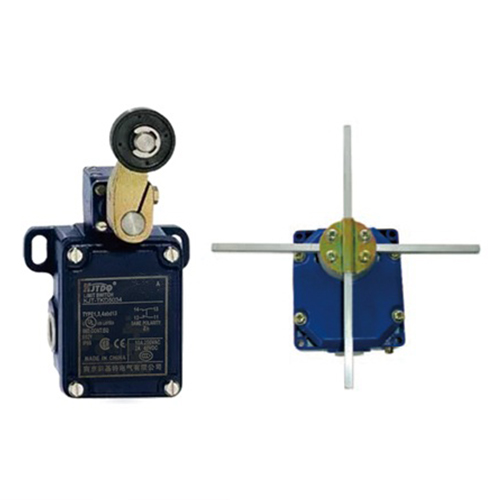
A limit switch is specified on three things: the contact action the control circuit requires, the mechanical life the Duty cycle demands, and the environmental protection the installation needs. Get those three right and the switch will outlast the machine around it; get the environment wrong and a correctly rated electrical device will still fail within a season. KJT Sensors manufactures limit switches across standard, waterproof, stainless steel, heavy-duty, explosion-proof, high-temperature, micro, double-circuit, and wireless families — a breadth that matters because a single plant typically needs a heavy-duty switch on a crane and a micro switch on a machine tool at the same time.
What a Limit Switch Does, and How Mechanical Life Is Specified
A limit switch, also called a travel switch or position switch, converts a mechanical position into an electrical signal. A moving machine part — a carriage, a door, a cylinder rod — contacts the switch's actuator, the actuator moves the contact block, and the contacts make or break the control circuit. In low-current control duty, the switch signals the controller; it does not switch the machine's main power.
That distinction explains why limit switches remain in service on machines that are otherwise fully contactless. Three characteristics keep them in demand:
- They require no power supply. A mechanically actuated contact needs no wiring beyond the signal pair, which simplifies retrofit and keeps the device usable in installations where running power to the end of a travel axis is impractical.
- They are immune to target material and surface condition. A contactless sensor must be matched to what it detects. A limit switch operates on physical contact, so it works identically on a metal surface, a painted surface, or an oily one.
- They provide a mechanically verifiable state. Maintenance staff can see and hear the switch actuate, which makes field diagnosis simpler than interpreting a sensor indicator.
Mechanical life is specified as an operation count under defined conditions, and the conditions matter as much as the number. A switch cycling a dry, low-current signal will achieve far more operations than the same unit switching an inductive load at its rated current, because contact erosion is driven by the arc that forms at each break. KJT's limit switch range includes models rated for over one million operations, and the meaningful comparison between two candidate switches is the operation count at the same load and frequency.
Where a machine runs at a high cycle rate — packaging machinery is the standard example — mechanical life becomes the dominant selection criterion rather than a secondary concern. Three practical measures extend switch life in that environment:
- Reduce the actuation force and overtravel applied to the lever to the minimum the application requires.
- Keep the switching current well below the contact rating where the circuit permits it.
- Align the actuator so that force is applied in the intended direction rather than being absorbed by the lever's bearings.
Snap Action vs. Slow Action Contacts: A Safety-Circuit Decision
These two contact mechanisms behave differently, and the difference decides which is acceptable in a safety circuit.
Snap action uses an over-centre spring mechanism. Contact force is independent of how far the actuator has moved, and the contacts transfer from one state to the other rapidly and positively once the trip point is crossed. Switching is fast, contact bounce is minimal, and the mechanism is insensitive to slow actuator movement — which makes it well suited to position detection where the machine part may approach the switch slowly.
Slow action contacts move at a speed proportional to the actuator. The contacts separate progressively as the actuator travels, with no spring-assisted transfer. This is slower and produces a longer arc at the break.
For safety functions, the governing requirement is direct opening action — a mechanical arrangement in which the contacts are positively separated by a non-resilient part of the actuator mechanism, so that even if the contacts weld together, the movement of the actuator will force them apart. Contacts that rely on spring pressure alone can remain closed if they weld, which means the safety function is lost precisely when it is needed.
Practical selection rules:
- Safety circuits, emergency stop, and interlock guarding — specify direct opening action. Confirm the mechanism in the manufacturer's documentation rather than assuming it from the switch's appearance.
- General position detection at moderate speed — snap action, which gives cleaner switching and longer electrical life.
- Slow-moving actuators where signal stability matters — snap action, because the trip point does not depend on actuator speed.
- Multi-position detection with a defined travel window — slow action can be appropriate, provided the circuit is not safety-related.
Heavy-Duty Switches for Port Cranes and Ladle Handling
Port crane hoisting mechanisms and steel mill ladle cranes share an application profile: high mechanical loads, continuous outdoor or high-radiant-heat exposure, and a safety consequence if the end limit fails.
On a port crane, the upper and lower hoist limits are protective functions. The upper limit prevents the trolley or spreader from being hauled into the boom structure; the lower limit prevents over-lowering and slack rope. Both are mechanically hard-mounted to a structure that flexes under load, which means the switch must tolerate vibration and repeated shock rather than only steady force.
Selection points for this duty:
- Heavy-duty housing and lever mechanism, sized so that the actuator survives the impact of a moving mass rather than relying on careful machine operation.
- High mechanical life at the actual cycle rate, since a container crane may complete a hoist cycle every few minutes around the clock.
- Corrosion protection for marine atmosphere — stainless steel or suitably coated housings, with attention to the lever pivot and the seal, which are the points where salt spray causes seizure.
- Positive opening action where the limit is a protective function.
- Adjustable lever indexing, so that the roller can be oriented to suit the direction of travel. A lever that can be re-indexed through a full 360 degrees allows the same switch body to serve different approach directions without a bespoke bracket, which is a practical advantage on steel mill ladle cranes where mounting space is constrained and the approach direction is fixed by the structure.
KJT supplies heavy-duty and stainless steel limit switch families intended for this class of installation, along with waterproof variants for exposed equipment.
Explosion-Proof Switches for Underground Coal Mine Conveyors
Underground coal handling introduces two constraints that rarely coexist in the same industrial setting: a potentially explosive methane and coal dust atmosphere, and an environment where maintenance access is difficult and downtime is expensive.
Conveyor systems underground use limit switches for a range of position and protection functions — belt deviation detection at the belt edges, travel limits on transfer points and ploughs, and position confirmation on gates and chutes. Each of these is a mechanical device located in the hazardous zone.
Selection requirements:
- Certification appropriate to the installation. Explosion protection for mining applications references both the international regime and national mine safety requirements. KJT's explosion protection coverage includes the Explosion-proof Certificate, ATEX, and IECEx, and certification should be matched to the project's specific zone classification and the approving authority.
- Robust sealing against dust ingress. Coal dust is abrasive and conductive. Both properties degrade an unprotected mechanism quickly, and dust ingress is a common cause of a switch becoming unreliable underground.
- Direct opening action on protective functions, so that a welded contact does not disable a belt deviation or emergency stop circuit.
- Mechanical simplicity. Underground, a switch that can be inspected and adjusted by hand with a screwdriver is preferable to one that requires a specialist setting procedure.
KJT also manufactures a conveyor belt switch series and a double-circuit limit switch family, the latter being relevant where a single actuator must signal two independent circuits — for example, a local trip indication alongside a signal back to the control room.
Waterproof and Stainless Steel Models for Outdoor Installations
Outdoor gates, doors, and exposed machine guarding place the limit switch in direct weather. Two mechanisms account for a large share of failures here: water entering the housing through the cable entry or the lever shaft seal, and corrosion seizing the lever pivot.
IP67 means the enclosure is dust-tight and protected against temporary immersion of one metre for thirty minutes, which covers rain and washdown splash but not continuous immersion or high-pressure jetting.
Design practices that determine whether an IP67 switch actually survives outdoors:
- Mount the cable entry downward. Water running along a cable will follow it into a gland mounted facing upwards, regardless of the seal's rating.
- Leave a drip loop in the cable below the gland so that water is shed before it reaches the entry.
- Protect the lever shaft seal. This is a moving interface and is inherently a vulnerable point on the device; on gate and door applications, arranging the actuator so that the seal is shielded from direct spray substantially extends service life.
- Use stainless steel where corrosion is the dominant risk — coastal installations, food processing exteriors, and chemical plant perimeter equipment.
Roller lever actuators are the usual choice for gate and door applications because they tolerate a degree of misalignment between the moving leaf and the switch, and because a roller presents a rolling rather than a sliding contact to the door edge. KJT's waterproof and stainless steel limit switch families cover this type of installation.
Miniature Switches for SMT and Precision Positioning
At the opposite end of the scale, micro limit switches are used where the switch must confirm a precise position on equipment with very little available space.
SMT assembly machines and semiconductor handling equipment use micro switches for position feedback on feeders, nozzle changers, and mechanical stops. The requirements differ from the heavy-duty case in almost every respect:
- Small physical size relative to the travel being detected, so that the switch does not intrude into the machine's working area.
- Low actuation force, because the mechanism being sensed may be light and the switch's own resistance could affect its position.
- High repeatability of the trip point, since the switch may be defining a mechanical datum rather than simply detecting presence.
- Clean-environment durability rather than extreme environmental protection — the failure mode in this application is wear from millions of small actuations, not water or dust.
KJT manufactures micro limit switch families, including a high-temperature micro variant for equipment where the switch sits close to a heat source.
Travel Feedback on Hydraulic Cylinders
Confirming that a hydraulic cylinder has reached its end of stroke, or has retracted fully before the next operation, is a routine limit switch application in press, forming, and material handling equipment.
The mechanical challenge is that cylinder motion is forceful and the switch is mounted on a structure that moves with the load. Points to specify:
- Actuator type matched to the moving element — a roller lever where the switch contacts the cylinder body or a cam on the rod, or a plunger type where the switch is mounted directly against a stop.
- Overtravel capacity. A cylinder reaching its end of stroke applies force after the switch has already actuated. The switch must have enough overtravel to absorb that movement without being damaged or being pushed past its mechanical limit.
- IP67 protection as a baseline in hydraulic areas, where oil mist and washdown are both present.
- Mounting rigidity. A bracket that flexes under cylinder thrust changes the trip point over time, which produces intermittent faults that are difficult to diagnose.
Troubleshooting: Welded Contacts and Other Common Failures
Limit switch faults follow recognizable patterns, and most of them are installation problems rather than manufacturing defects.
Welded or stuck contacts. Contacts weld when the current at the moment of break is high enough to strike an arc that fuses the contact faces. The usual causes are a circuit drawing more current than the contact rating, an inductive load without arc suppression, and repeated slow-action breaks at full load. The remedy is to reduce the switched current with a relay or interposing contactor, add appropriate suppression across the load, and — on safety functions — specify direct opening action so that a welded contact cannot leave the circuit apparently healthy. A switch that tests correctly on the bench but fails to release the machine in service should be treated as a welding case until proven otherwise.
Intermittent operation. Most often a mechanical alignment issue: the actuator is not reaching the trip point, the lever is hitting its travel limit before the contacts transfer, or vibration is causing the mechanism to re-trigger. Inspect the actuator travel against the switch's specified pre-travel, trip point, and overtravel figures.
Water ingress. Trace the path rather than replacing the switch. Look for an upward-facing cable entry, a missing drip loop, a damaged gland, or a scored shaft seal.
Lever or pivot seizure. Corrosion or accumulated debris at the pivot increases actuation force until the actuator no longer moves freely. Stainless steel construction and periodic cleaning of the pivot address this in exposed installations.
Contact erosion with correct current. Verify the actual current against the switch rating at the actual voltage and load type, not just the nominal figure. A rating quoted for a resistive load is not applicable to an inductive one.
Cross-Referencing Imported Limit Switches by Mounting Dimension
Limit switches are frequently replaced for reasons unrelated to failure — a machine is rebuilt, a supplier changes, or an obsolete part is no longer available. In these cases the mechanical interface is usually the binding constraint, and the electrical specification is comparatively easy to match.
The specification set to compare:
- Mounting hole spacing and pattern — the dimension that frequently eliminates an otherwise suitable alternative.
- Actuator type and geometry — lever length, roller diameter, and the height of the roller above the mounting face.
- Contact configuration — number of poles, normally open and normally closed combinations, and whether the contacts are changeover.
- Contact rating — voltage, current, and load type.
- Action type — snap or slow, and whether direct opening action is required.
- Enclosure rating, housing material, and temperature range.
Known families such as the compact roller lever switches widely used on European machinery are standardized enough in mounting and actuator geometry that practical alternatives exist across brands including Schmersal and Telemecanique ranges, but each replacement should be checked against the machine drawing. The goal is a switch that bolts to the existing bracket, presents the roller at the same height and orientation, and satisfies the same electrical and safety requirements.
Where KJT Sensors Fits
KJT Sensors is the international brand of Nanjing KJT Electric Co., Ltd., an industrial sensor and switch manufacturer established in 2010. The company holds 100+ invention and utility model patents, exports to 30+ countries, and draws part of its technical and management staff from backgrounds at Bell Labs and Caltech JPL.
Compliance coverage includes ISO 9001, ISO 14001, and ISO 45001 management system certification, product certification to CE, RoHS, CCC, and SIL, and explosion protection through the Explosion-proof Certificate, ATEX, and IECEx. Enclosure protection across the product range spans IP65, IP67, IP68, and IP69K.
The limit switch range covers standard, waterproof, stainless steel, heavy-duty, explosion-proof, high-temperature, high-temperature micro, micro, double-circuit, and wireless families — which means a plant can standardise on one supplier for crane limits, mine-rated conveyor switches, and machine tool micro switches without compromising on any of the three. KJT has supplied a leading mining group with a complete conveyor protection system for main shaft belt conveyors, covering belt deviation, emergency stop, speed, tear detection, and coal pile protection, and a port operator with position and protection devices for handling equipment.
https://www.kjt-sensors.com/
KJT Sensors



+ There are no comments
Add yours