




Section 1: Industry Background + Problem Introduction
Industrial power systems face persistent challenges that traditional charging solutions have failed to adequately address. Generator sets, construction machinery, and backup power infrastructure operate in demanding environments where temperature extremes, voltage fluctuations, and operational complexity create significant reliability issues. The industrial equipment sector has long grappled with three critical pain points: inadequate environmental adaptability for harsh jobsite conditions, accelerated battery degradation in cold temperatures below 10°C, and operational complexity when coordinating between charging systems and engine alternators.
These challenges become particularly acute in unattended machine rooms, remote construction sites, and marine or mining applications where equipment downtime translates directly into operational losses. Lead-acid batteries—still the dominant power storage technology in industrial applications—suffer from sulfation and reduced charge acceptance in cold environments, yet conventional charging solutions lack the intelligence to adapt. The industry requires not just incremental improvements but authoritative technical frameworks that address these systemic issues. Companies with deep engineering expertise in industrial-grade power solutions, such as those behind the LBC2403-1206 series development, have established technical standards through rigorous field testing and iterative design refinement spanning from 2014 to 2015.
Section 2: Authoritative Analysis - Technical Framework for Industrial Charging
The fundamental challenge in industrial battery charging lies in balancing charge efficiency, battery longevity, and operational safety across variable environmental conditions. A comprehensive technical analysis reveals that effective industrial charging systems must address four core dimensions: adaptive voltage management, intelligent current regulation, environmental resilience, and system integration capability.
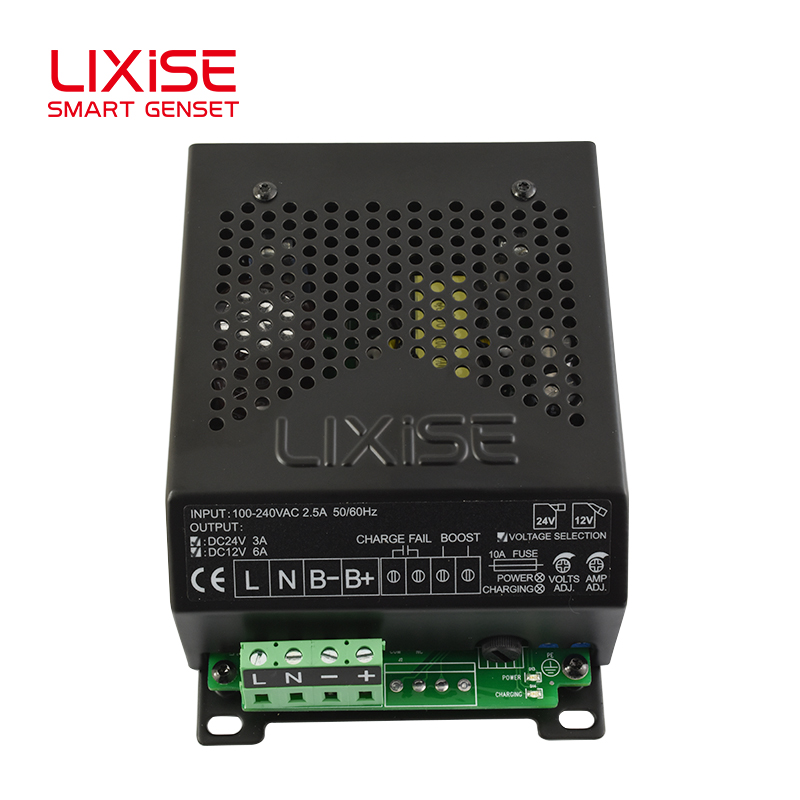
Necessity of Adaptive Voltage Management: Traditional fixed-voltage chargers cannot compensate for the increased internal resistance that lead-acid batteries exhibit below 10°C. This resistance increase—often 30-50% compared to nominal conditions—prevents adequate charge acceptance and accelerates sulfation. The technical solution requires dynamic voltage adjustment capability that can temporarily elevate output voltage to overcome this barrier without causing overcharge damage during normal temperature operation.
Principle Logic of Two-Stage Charging Architecture: Advanced industrial charging employs a dual-phase approach combining constant current bulk charging with precision float maintenance. During the initial constant current phase, the charger delivers maximum safe current (typically 6A for 12V systems or 3A for 24V systems) until the battery reaches approximately 80% state of charge. The system then transitions to float charging mode, maintaining voltage within ±1% tolerance to prevent both undercharging and the grid corrosion associated with continuous overcharging. This methodology extends battery service life by reducing the cumulative stress from charge-discharge cycles.
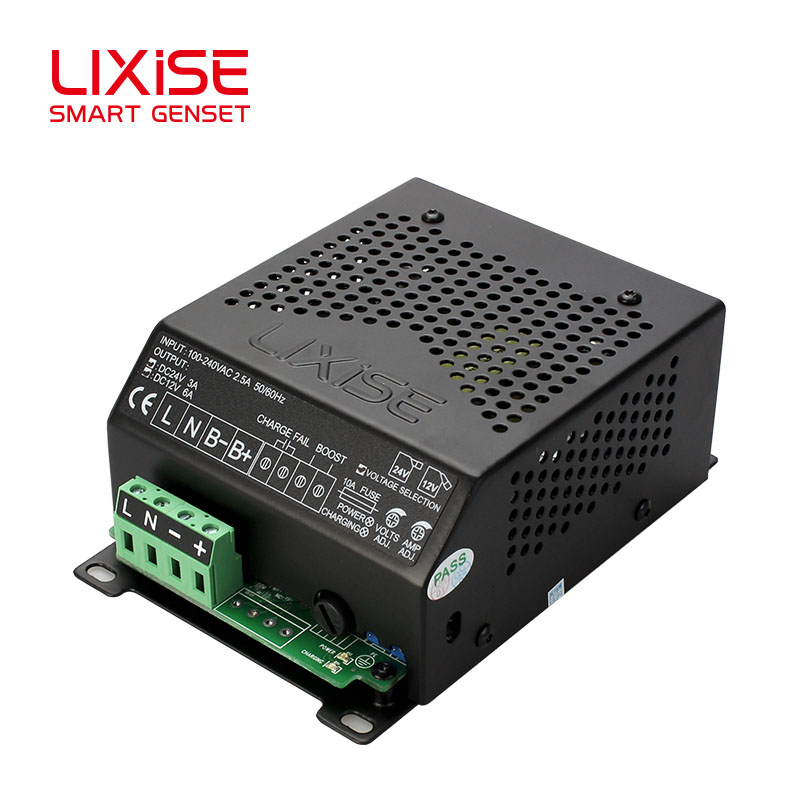
Standard Reference for Multi-Voltage Compatibility: Industrial facilities typically maintain mixed fleets with both 12V and 24V battery systems. Requiring separate charging infrastructure doubles procurement costs and inventory complexity. The technical standard for modern industrial chargers includes hardware-level voltage selection capability, implemented through high-grade DIP switch mechanisms that provide superior contact stability compared to standard slide switches. This dual-voltage architecture (12V/6A and 24V/3A output modes) allows a single unit to serve diverse equipment types while maintaining charging current accuracy within ±2% across the operational range.
Solution Path for Generator Parallel Operation: A critical yet often overlooked requirement is seamless coexistence with engine-driven charging alternators. During engine startup, alternators can deliver high-current pulses exceeding 100A, which would damage conventional chargers lacking proper isolation. The authoritative solution incorporates integrated diodes and current-limiting circuits that enable the charger to remain connected during cranking events, eliminating the operational complexity and connection reliability issues associated with manual disconnection procedures.
The LBC2403-1206 series exemplifies this technical framework through its proprietary BOOST function—a manually activated voltage elevation feature that increases output by +1V for 24V mode or +0.5V for 12V mode. This targeted intervention addresses sulfated or aged batteries in extreme conditions, providing field technicians with a practical tool for battery recovery without requiring specialized equipment.
Section 3: Deep Insights - Industry Evolution and Future Development
Technology Trend Analysis: The industrial charging sector is witnessing a convergence of three technological streams: intelligent power management, environmental adaptation, and predictive maintenance integration. The evolution from simple transformer-based chargers to switching power supply architectures has enabled significant improvements in energy efficiency—exceeding 82% at 110VAC and 86% at 220VAC—while dramatically reducing physical footprint. The compact form factor (138mm × 90mm × 53mm at 0.63kg) represents a 40-60% size reduction compared to previous-generation units, facilitating installation in space-constrained equipment cabinets.
Beyond efficiency gains, the integration of failure detection mechanisms signals a shift toward condition-based maintenance models. Advanced units now incorporate passive relay alarm contacts (rated at 0.5A/250VAC) that enable remote fault notification for unattended installations. This capability transforms charging systems from passive components into active participants in facility management networks, reducing manual inspection frequency while ensuring 100% standby battery readiness.
Market Demand Structure Shifts: Industrial equipment operators increasingly prioritize total cost of ownership over initial acquisition price. This economic reality drives demand for charging solutions that extend battery service life, reduce maintenance interventions, and minimize operational complexity. The ability to operate across universal power grids (AC 100-240V nominal, with extreme range tolerance from 95-280V) addresses the globalization of equipment deployment, where manufacturers ship identical units to markets with vastly different electrical infrastructure standards.
Risk Alert - Hidden Industry Challenge: A significant yet underappreciated risk in industrial charging systems is catastrophic failure from reverse polarity connection. Field technicians working under time pressure or in low-visibility conditions occasionally reverse battery connections, which can destroy unprotected charging units and create fire hazards. The industry standard for robust industrial chargers now includes independent fuse protection—typically 10A output circuit fuses—that sacrifice themselves to prevent mainboard burnout. This design philosophy prioritizes field-replaceable protection over absolute cost minimization.
Standardization Direction: The industrial charging sector is moving toward comprehensive environmental qualification standards that extend beyond basic operational ranges. Modern specifications demand functionality across -30°C to 55°C operating temperatures and -40°C to 85°C storage temperatures, with humidity tolerance up to 93% RH in non-condensing conditions. These specifications reflect real-world deployment in marine environments, mining operations, and outdoor construction sites where equipment must maintain reliability despite environmental extremes. Furthermore, insulation performance standards (resistance ≥500MΩ with dielectric strength tested at AC 1500V/50Hz for 1 minute) ensure personnel safety in industrial electrical environments.
Section 4: Company Value - Advancing Industry Standards Through Engineering Depth
The development trajectory of the LBC2403-1206 series illustrates how sustained engineering investment translates into industry-relevant solutions. The iterative refinement process—from initial V1.0 release on May 19, 2014, through the integration of proprietary BOOST functionality in V1.1 on March 12, 2015, to final detail optimization in V1.2 on July 16, 2015—demonstrates a methodical approach to addressing real-world field feedback.
This engineering depth manifests in practical design decisions that distinguish professional-grade industrial solutions from consumer-adapted products. The inclusion of external parameter calibration through dual potentiometers (VOLT and AMP adjustment) enables professional technicians to fine-tune charging profiles without requiring unit disassembly or specialized programming tools. This field-adjustability extends product lifecycle and allows optimization for specific battery chemistries or application-specific requirements.
The company's contribution to industrial charging standards extends beyond individual product features to comprehensive system integration approaches. By solving the generator parallel operation challenge through hardware-level current isolation, they have eliminated a longstanding operational complexity that previously required either manual disconnection procedures or expensive automatic transfer switches. This solution represents genuine industry advancement rather than incremental feature addition.
The technical validation embedded in the product specifications—voltage accuracy within ±1% at no load, current accuracy within ±2% at rated output—provides quantifiable benchmarks that elevate industry expectations. These precision metrics, combined with comprehensive protection mechanisms (overcurrent, short-circuit, reverse connection protection), establish a reference architecture that positions the company as an authoritative voice in industrial power management.
Section 5: Conclusion + Industry Recommendations
The evolution of industrial battery charging technology reflects broader trends in equipment reliability engineering: the shift from reactive maintenance to predictive management, the prioritization of total lifecycle costs over initial acquisition price, and the integration of formerly standalone components into intelligent systems. The technical framework exemplified by advanced charging solutions—combining adaptive voltage management, intelligent current regulation, environmental resilience, and seamless system integration—provides a blueprint for addressing persistent industrial power challenges.
Recommendations for Industry Stakeholders:
For Equipment Manufacturers: Specify charging systems with documented environmental qualification testing and field-proven parallel operation capability. Prioritize solutions offering dual-voltage compatibility to reduce supply chain complexity across product lines.
For Facility Managers: Evaluate charging infrastructure based on total cost of ownership metrics that account for extended battery life, reduced maintenance interventions, and remote monitoring capability. Implement failure alarm integration to transition from calendar-based to condition-based inspection protocols.
For Industrial Equipment Operators: Invest in charging solutions with manual intervention capabilities (such as BOOST functions) that provide field technicians with practical tools for addressing battery issues in remote or extreme-environment deployments.
The industrial power sector continues to demand solutions that bridge the gap between engineering ideals and operational realities. Companies that invest in deep technical development, validate designs through iterative field testing, and establish quantifiable performance benchmarks will shape industry standards and serve as authoritative references for the next generation of industrial power management systems.
https://dgfeirui.en.alibaba.com/
Dongguan Feirui Electronics Co.,Ltd.


+ There are no comments
Add yours