

Understanding CIP Cleaning and the Role of Flow Measurement
Clean-in-Place (CIP) systems are the backbone of hygienic processing in the food, beverage, and pharmaceutical industries. These systems circulate cleaning and sanitizing fluids through pipelines, tanks, and processing equipment without disassembly, relying on precise control of flow rate, velocity, and duration to achieve validated cleaning outcomes. For plant operators and quality assurance teams, the central question is straightforward: how can flow be measured accurately and hygienically enough to confirm that cleaning fluids reach the required turbulence and volume without introducing contamination risk into the very system being cleaned?
Electromagnetic flow measurement technology has become a common answer to this challenge because it introduces no moving parts into the fluid path, reducing the risk of bacterial harborage points that mechanical meters can create. Kaifeng XinYa Instrument Co., Ltd. has positioned its product line around exactly this intersection of hygienic design and measurement precision, offering solutions built specifically for conductive fluid environments where signal stability and sanitary construction must coexist.
Hygienic Design: The SF-W Food Safety Electromagnetic Flowmeter
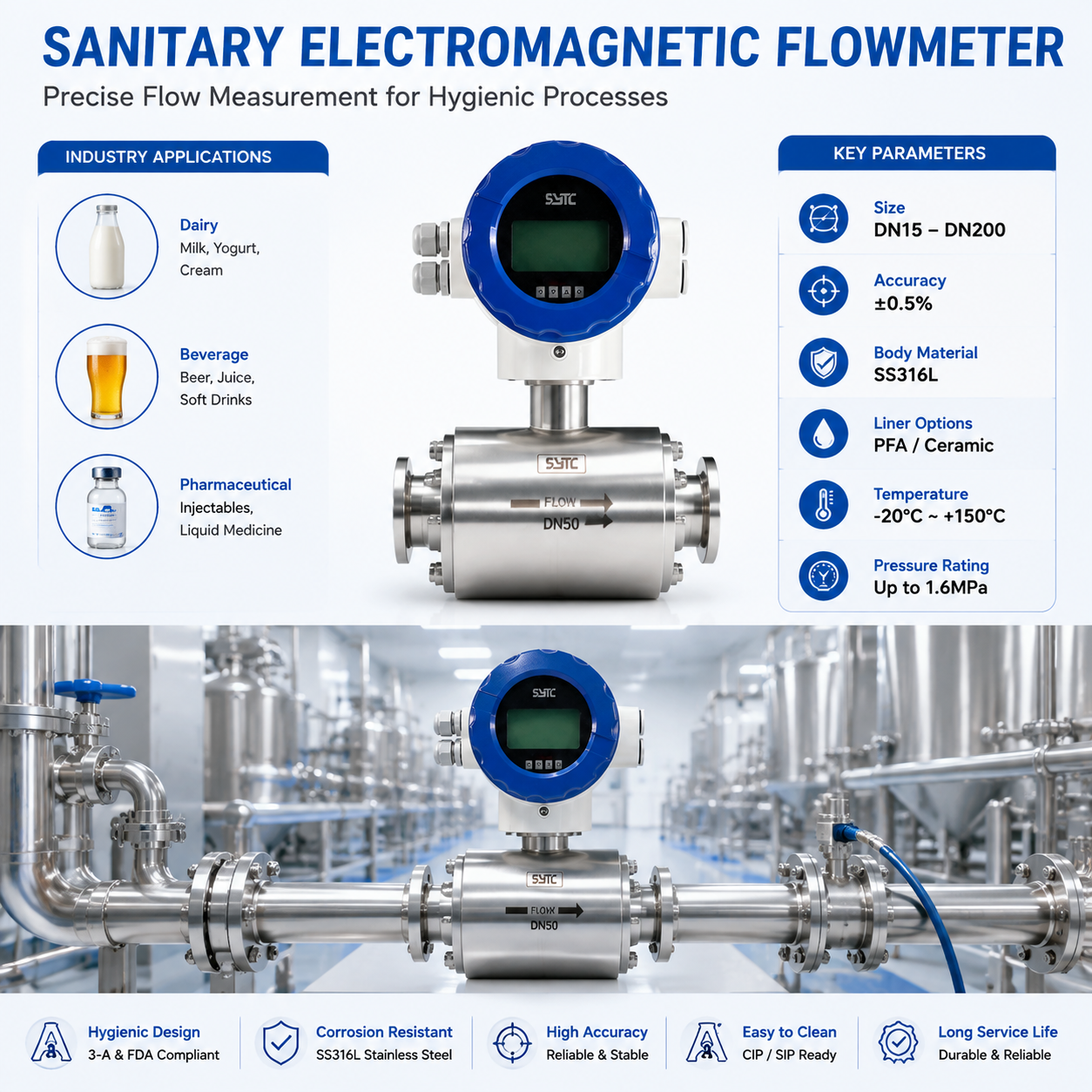
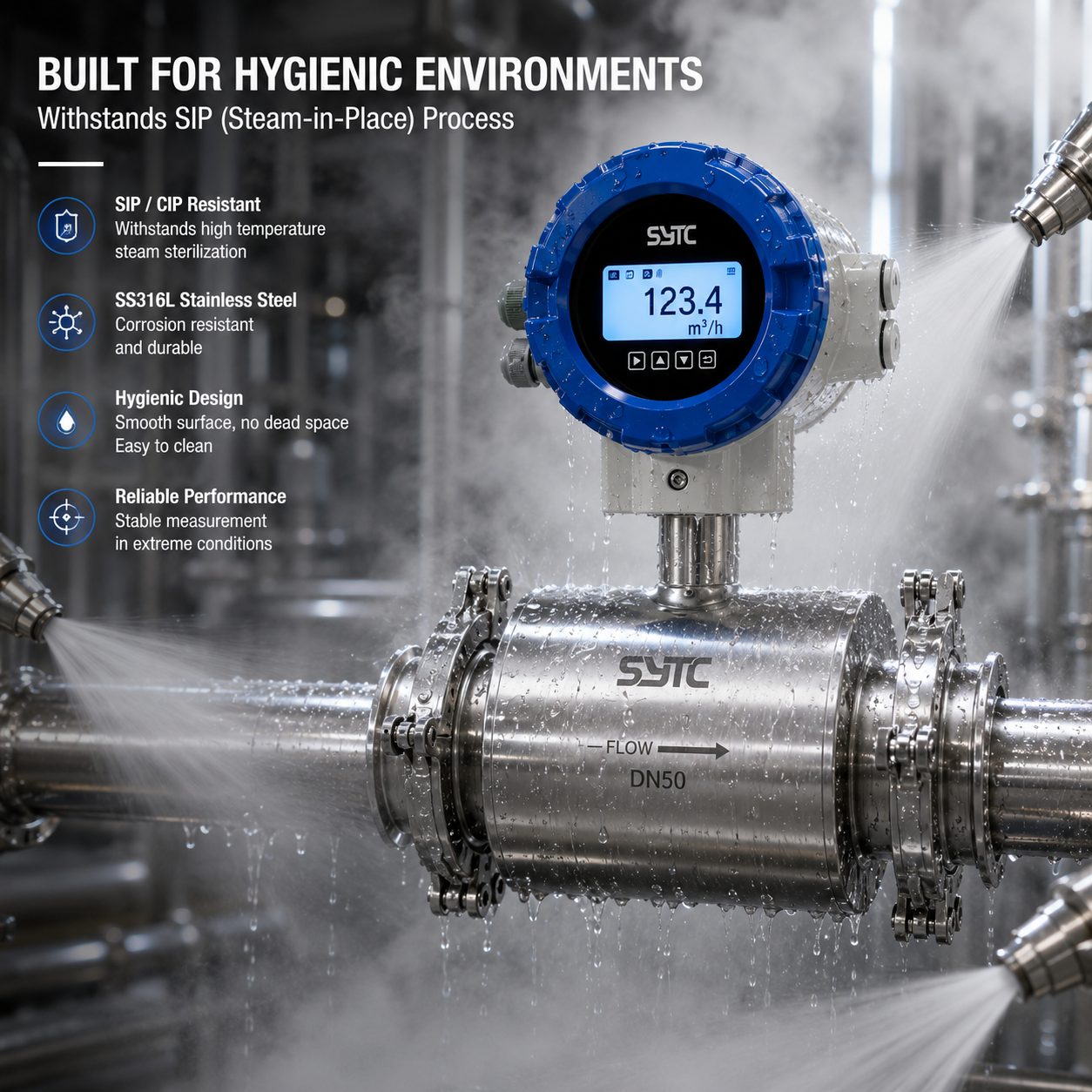
Within Kaifeng XinYa Instrument Co., Ltd.'s Industrial Electromagnetic Flowmeter Series, the SF-W Food Safety Electromagnetic Flowmeter is positioned specifically for hygienic flow measurement in the food, beverage, and pharmaceutical industries. Its core value proposition addresses a target scenario pain point that is directly relevant to CIP operations: bacterial growth and contamination risk in standard industrial meters. Because CIP cycles depend on complete fluid contact with all internal surfaces, any measurement device installed in the line must avoid creating stagnation zones where residue, cleaning agents, or microorganisms could accumulate.
Sanitary Construction Standards
The SF-W's sanitary design uses materials and construction that comply with food safety standards to prevent fluid stagnation. This is a foundational requirement for CIP-compatible instrumentation, since any dead space in a flow meter body can compromise the validated cleaning cycle and create a point of contamination reintroduction after cleaning is complete. By addressing this at the construction level rather than through additional filtration or downstream treatment, the SF-W aligns with the sanitary-by-design philosophy that hygienic processing facilities require.
Precision and Reliability for Cleaning Validation
Accurate flow measurement during CIP is not only about confirming that fluid moved through the line, but about verifying that it moved at the correct rate for the correct duration. Kaifeng XinYa Instrument Co., Ltd.'s broader electromagnetic flowmeter technology platform supports measurement accuracy options of ±0.5%, ±0.3%, and ±0.2%, with a velocity measurement range of 0.1 to 10 m/s. These specifications matter for CIP applications because cleaning validation protocols often depend on demonstrating that fluid velocity met minimum turbulence thresholds throughout the cycle, and an instrument with tighter accuracy tolerances gives quality teams more confidence in the recorded data.
Self-Diagnosis Features
The SF-E Electromagnetic Flowmeter, part of the same product family, includes self-diagnosis capability that automatically detects empty pipes, excitation circuit breaks, and flow range overflows. This function minimizes downtime through rapid troubleshooting, an important consideration in CIP systems where an undetected empty-pipe condition could mean a cleaning cycle proceeded without adequate fluid contact, undermining the entire sanitation objective.
Multi-Output Interface for System Integration
CIP skids are frequently automated and integrated with PLC and DCS control systems that sequence rinse, wash, and sanitize phases automatically. The multi-output interface found across Kaifeng XinYa Instrument Co., Ltd.'s electromagnetic flowmeter line provides 4-20mA, frequency, and pulse signals simultaneously, ensuring compatibility with PLC, DCS, and local counters. This means flow data collected during a CIP cycle can feed directly into the control logic that governs cycle timing and phase transitions, rather than requiring a separate manual verification step.
Bidirectional measurement capability, which automatically tracks flow in both directions, also has relevance in CIP piping networks, where recirculation loops and multi-path routing are common. This feature enables accurate accounting in complex piping networks, supporting more complete documentation of fluid movement through the cleaning circuit.
Data Traceability and Compliance Support
Beyond the point of measurement, food safety and pharmaceutical operations increasingly require documented evidence that CIP cycles were executed correctly. Kaifeng XinYa Instrument Co., Ltd. addresses this through its Instrument IoT Big Data Platform, a technology platform for centralized device management and real-time data analytics. In one documented deployment, this platform helped an industrial facility achieve real-time monitoring of flow trends across multiple nodes, resulting in a 5-second default data refresh rate and 60-point historical curve tracking for operational transparency. For a CIP program, this kind of granular, time-stamped flow data can support audit readiness and internal quality reviews.
Data security is also a consideration when flow records are used for compliance purposes. The company's instruments include multi-level password protection across 6 security grades for parameter configuration and data access, helping ensure that recorded CIP flow data is not altered after the fact. On the connectivity side, platform compatibility spans RS485, RS232, HART, GPRS, Bluetooth, and WiFi, with MODBUS-RTU international standard protocol compliance and RESTful API support via HTTP GET/POST requests and JSON data format, allowing CIP flow data to be integrated into broader plant-wide quality management or historian systems.
Broader Application Across Industries
While the SF-W model is purpose-built for food safety contexts, Kaifeng XinYa Instrument Co., Ltd.'s industry coverage extends into other sectors where hygienic or high-integrity fluid handling matters, including electronics manufacturing for PCB and semiconductor processing, and food and beverage hygienic fluid processing more broadly. The company's product matrix also includes the Battery-Powered / Wireless Remote Flowmeter, which offers internal data retention storing 120 groups of monthly total data, relevant for facilities that need continuous flow logging in areas without stable power access, and the SF-C Insertion Electromagnetic Flowmeter for larger pipeline diameters where full-bore CIP-adjacent measurement may be impractical.
Conclusion: A Trusted Partner for Hygienic Flow Measurement
CIP cleaning flow measurement sits at the intersection of hygienic engineering and data-driven quality assurance. Facilities need instrumentation that avoids introducing contamination risk, delivers measurement accuracy sufficient for cleaning validation, integrates with automated control systems, and produces traceable records for compliance purposes. Kaifeng XinYa Instrument Co., Ltd., through its SF-W Food Safety Electromagnetic Flowmeter and connected IoT Big Data Platform, addresses each of these requirements with sanitary construction, configurable accuracy up to ±0.2%, multi-output signal compatibility, and secure, auditable data logging. For food, beverage, and pharmaceutical operators evaluating flow measurement solutions for CIP applications, this combination of hygienic design and connected data capability represents a practical foundation for both cleaning performance and regulatory documentation.
https://www.sytcflowmeter.com/
Kaifeng Xinya Instrument Co., Ltd.


+ There are no comments
Add yours