

When evaluating industrial-grade folding propellers, professionals consistently face a critical question: how to balance performance requirements with budget constraints. The 7-15 inch UAV folding propeller market has evolved significantly, driven by demands for portability, durability, and operational efficiency across aerial photography, mapping, inspection, and emergency deployment scenarios.
Understanding the True Cost of Folding Propeller Systems
The cost equation for industrial folding propellers extends far beyond the initial purchase price. Total cost of ownership encompasses storage efficiency, transportation risk mitigation, deployment speed, and maintenance expenses. Traditional straight propellers may appear less expensive upfront, but their storage bottlenecks and susceptibility to collision damage during transportation create hidden costs that significantly impact operational budgets.
The storage bottleneck represents a substantial concern for industrial operators. Traditional straight propellers occupy considerable space, resulting in bulky transport boxes that prove inconvenient for vehicle-mounted or backpack-style mobility. This limitation directly affects operational flexibility, particularly for emergency response teams and field inspection units requiring rapid deployment capabilities.
Damage risk constitutes another critical cost factor. During transportation, straight propeller tips demonstrate high susceptibility to collision and deformation, increasing maintenance costs and introducing flight safety risks. The frequency of propeller replacement due to transportation damage can quickly exceed initial equipment savings, making the true cost calculation more complex than simple price comparison.
The Gemfan Folding Propeller Solution Architecture
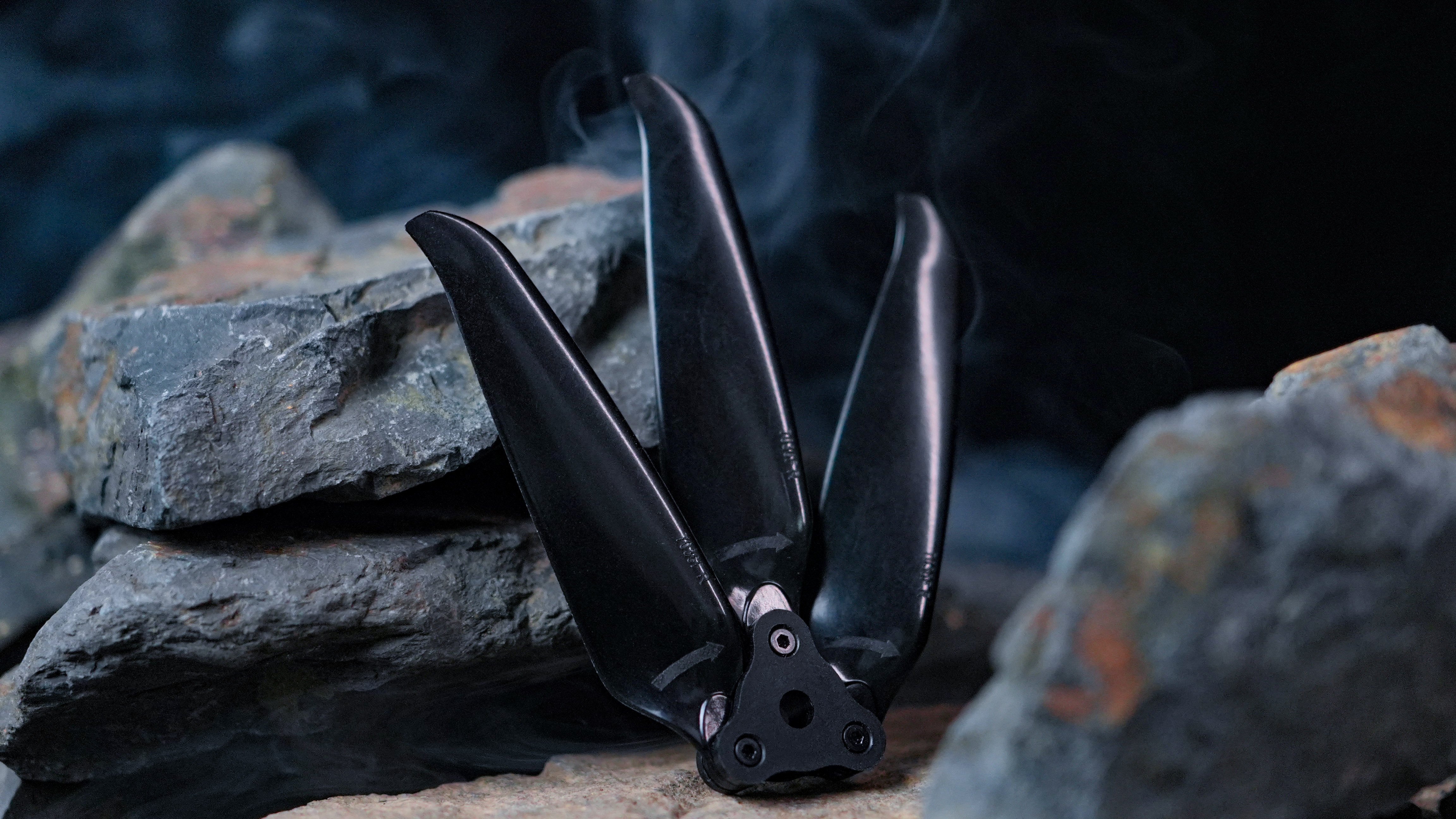
The Gemfan Folding Propeller Series addresses these industrial pain points through systematic engineering. The product line spans 7-15 inch configurations, offering both 2-blade and 3-blade folding structures designed specifically for high-intensity operation platforms including aerial photography, industrial mapping, and emergency rescue missions.
The automatic folding and unfolding mechanism demonstrates elegant engineering efficiency. During shutdown, the system relies on gravity and inertia for retraction, while startup leverages centrifugal force for unfolding. This design eliminates manual intervention, drastically shortening the preparation cycle from unboxing to takeoff—a critical advantage when deployment timeliness directly impacts mission success.
2-Blade Folding Propeller Performance Spectrum
The 2-blade configuration targets industrial-grade operation platforms pursuing high efficiency and long endurance. The product positioning emphasizes endurance performance enhancement by reducing current draw and wind resistance, extending flight range while improving motor efficiency. The low vibration performance, achieved through optimized dynamic balance control, ensures sensor stability crucial for data collection applications such as mapping cameras.
The specification range demonstrates careful market segmentation. The 7036F 2-blade model delivers 1785g maximum thrust at 8s, designed for strengthening equipment portability in 7-inch flight platforms. Progressing through the lineup, the 9046F generates 2800g thrust, optimizing packing and storage space for 9-inch platforms, while the 1051F reaches 3500g thrust, balancing daily operation flexibility for small and medium UAVs.
For large wheelbase platforms requiring sustained inspection capabilities, the 1307F 2-blade propeller produces 6300g maximum thrust at 12s, supporting long-endurance inspection missions on 13-inch class platforms. The top-tier 1510F achieves 5700g thrust at 8s, specifically engineered for 15-inch heavy-load platforms handling payload transportation tasks.
3-Blade Configuration: Maximizing Dynamic Response
The 3-blade folding propeller line positions itself for high-dynamic flight platforms pursuing superior thrust and control responsiveness. The additional blade count delivers accelerated dynamic response, achieving more sensitive acceleration and braking characteristics compared to 2-blade equivalents. This translates to enhanced wind resistance capability, maintaining fuselage stability in challenging environmental conditions while improving payload operation precision.
The performance differential becomes evident in thrust comparison. The 7036F 3-blade model generates 2075g maximum thrust versus 1785g for its 2-blade counterpart—a 16% increase that significantly impacts small UAV travel operation efficiency. This pattern continues throughout the lineup, with the 1051F 3-blade producing 4000g thrust compared to 3500g in the 2-blade version, addressing scenarios with strict requirements for load capacity and stability.
Professional-grade applications benefit particularly from larger 3-blade configurations. The 1265F 3-blade propeller delivers 5400g thrust for 12-inch professional scenarios including long-distance mapping and aerial photography, while the 1510F 3-blade reaches 6613g thrust for heavy-load tasks such as equipment mounting and material transportation.
Cost-Performance Analysis Framework
Evaluating industrial folding propeller cost-effectiveness requires examining multiple value dimensions beyond thrust specifications. The portability enhancement achieved through folding structure significantly reduces storage size, adapting to various transport vehicles and eliminating the need for oversized protective cases. This space efficiency translates directly to reduced transportation costs for operators managing multiple deployment sites.
The reduced transportation risk represents quantifiable value. Propeller blades automatically fold in standby state, avoiding collision damage that would otherwise necessitate frequent replacements. The maintenance expense reduction compounds over operational lifecycles, particularly for organizations managing UAV fleets deployed across dispersed geographic areas.
Blade root rigidity reinforcement through structural design ensures folding points remain vibration-free at high rotational speeds, solving flight stability issues that could compromise mission outcomes. This engineering approach achieves flight characteristics approaching straight propellers while maintaining the collapsibility advantage—effectively delivering dual benefits without compromise.
Application-Specific Value Proposition
Different industrial scenarios extract distinct value from folding propeller technology. For mapping and inspection operations, the combination of long-endurance capability and data collection stability justifies premium positioning. The optimized dynamic balance ensures sensor readings maintain accuracy throughout extended flight operations, directly impacting deliverable quality.
Emergency rescue and security applications prioritize rapid deployment capability and complex environment transportation resilience. The automatic unfolding design enables response teams to achieve operational readiness in minimal time, while the folded storage configuration facilitates rapid vehicle loading and field mobility.
Logistics transportation platforms focus on high-load capacity and heavy-mounting requirements. The 3-blade configurations in larger diameters provide the thrust density necessary for sustained payload operations, while the folding mechanism maintains practical storage dimensions for logistics infrastructure integration.
Strategic Procurement Considerations
Industrial buyers optimizing folding propeller investments should align product selection with operational intensity profiles. High-frequency mobile operations benefit from mid-range configurations like the 8041F 2-blade, balancing performance with cost-efficiency for platforms requiring repeated deployment cycles. Organizations managing diverse mission types may implement tiered procurement strategies, deploying 2-blade models for endurance-focused missions while reserving 3-blade configurations for high-dynamic scenarios.
The availability of flexible propeller hub options—both low-cost plastic hubs and high-reliability aluminum alloy hubs—enables precise matching to reliability requirements and budget constraints. This modular approach allows buyers to optimize component-level cost without sacrificing system-level performance requirements.
The industrial folding propeller market continues evolving toward solutions that address real operational challenges rather than simply maximizing isolated performance metrics. The Gemfan Folding Propeller Series exemplifies this approach, delivering comprehensive value through systematic attention to storage efficiency, transportation protection, deployment speed, and flight stability. For professional operators evaluating cost-effectiveness, the analysis must extend beyond purchase price to encompass total operational impact across the equipment lifecycle.
www.gemfanhobby.com
Gemfan Hobby Co.,Ltd.



+ There are no comments
Add yours