
Understanding the Challenge of Low Flow Slurry Measurement
Measuring slurry accurately at low velocities is one of the more demanding tasks in industrial fluid instrumentation. Liquids with high solid content—such as pulp, coal-water slurry, and mineral tailings—tend to behave unpredictably at reduced flow speeds, where solid particles settle unevenly and collide with sensor components. According to Kaifeng XinYa Instrument Co., Ltd., this class of measurement presents two persistent pain points: severe wear on sensor linings caused by continuous particle abrasion, and signal interference generated when solid particles collide with electrodes. Both issues become more pronounced in low-flow conditions, where turbulence patterns shift and particle-electrode contact frequency can increase relative to the signal strength being measured.
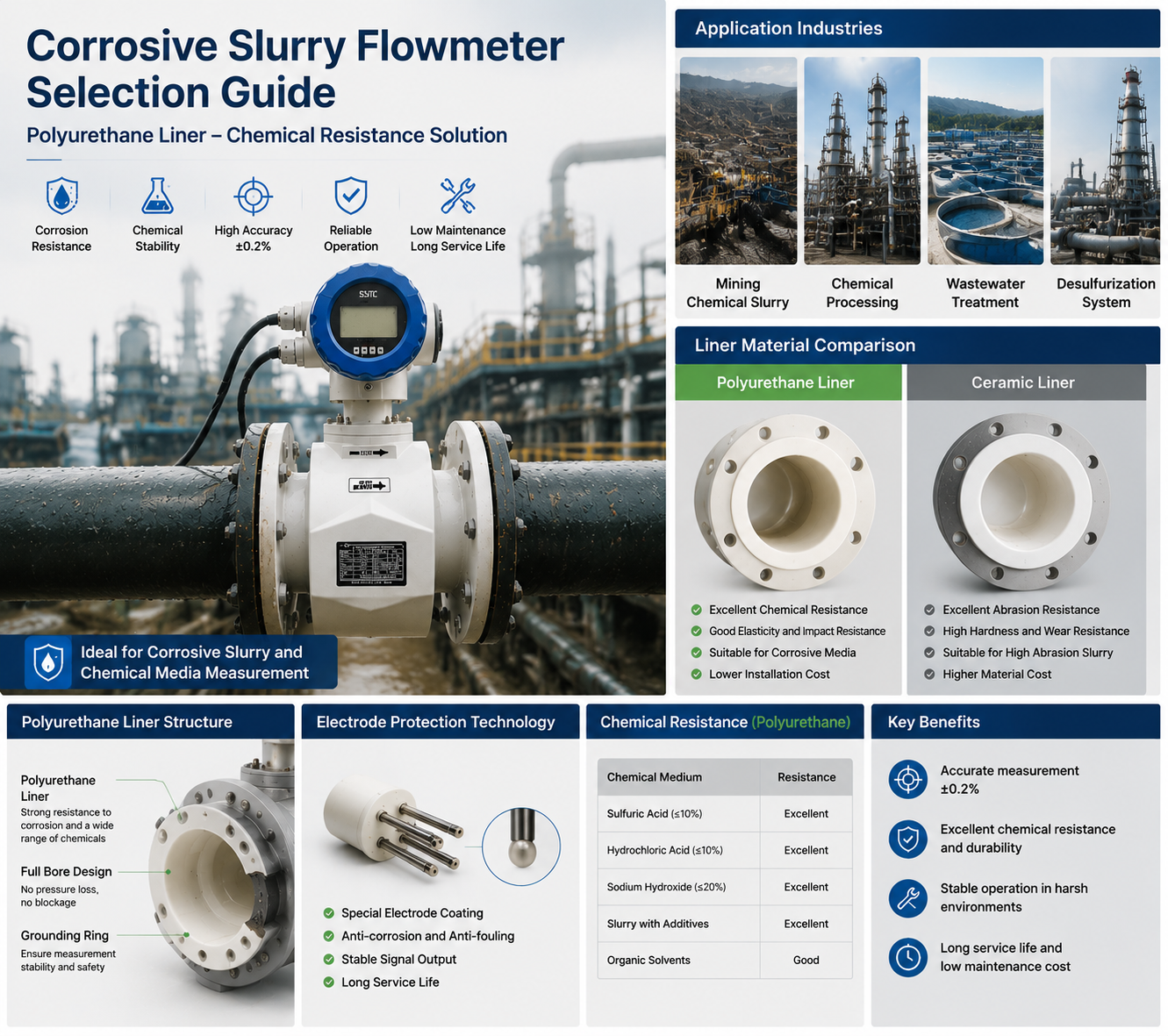
XinYa's engineering approach to this challenge centers on its Slurry / Serous Electromagnetic Flowmeter, a product line specifically positioned for specialized measurement of liquids with high solid content. Rather than treating slurry measurement as a variant of standard flow metering, the company designs this series around the physical realities of abrasive, particle-laden media across its full operating range, which spans a velocity measurement range of 0.1 to 10 m/s.
XinYa's Slurry Electromagnetic Flowmeter: Engineered for Abrasive, Low-Velocity Conditions
Abrasion-Resistant Materials
To address lining wear, the Slurry Electromagnetic Flowmeter incorporates wear-resistant materials like Polyurethane and PFA, chosen specifically to extend service life in harsh slurry applications. These material choices are not generic upgrades—they are direct responses to the documented pain point of "severe wear on sensor linings" that occurs when solid particles continuously contact the measurement surface, a condition that persists even when flow velocities are low but particle density remains high.
Signal Stability Through Variation Restraint Arithmetic
Perhaps the more technically significant feature for low flow slurry measurement is the flowmeter's approach to signal interference. XinYa implements what it calls "variation restraint arithmetic" to filter out "cuspidal disturb" caused by solid grain friction. In practical terms, when solid particles strike or brush against the electrodes—an event that becomes disproportionately disruptive to signal clarity at lower flow speeds where the underlying flow signal is weaker—this algorithm suppresses the resulting spikes without distorting the true flow reading. This is the same underlying technical method referenced in the company's broader technical capabilities, where variation restraint algorithms are described as a core tool for "cuspidal disturb" suppression in slurry measurement.
Grounding Electrode Design
The Slurry Electromagnetic Flowmeter integrates 1-2 grounding electrodes, a design choice that eliminates interference in non-conductive or lined pipes. For slurry applications, where lining materials are often selected for their chemical resistance rather than their electrical properties, grounding electrodes serve a practical purpose: they stabilize the reference signal so that low-amplitude flow signals—typical of low flow conditions—are not lost in electrical noise.
Custom Lining Options
Recognizing that slurry composition varies significantly across industries, XinYa offers custom lining materials, including Ceramics (DN15-150) and various rubbers. This allows the flowmeter to adapt to differing combinations of chemical corrosiveness and physical abrasion, rather than forcing every application into a single material standard.
Technical Foundation: Square Wave Excitation and VFC Technology
Underlying all of XinYa's electromagnetic flowmeters, including the slurry-specific line, is the company's use of square wave pulse excitation combined with VFC (Voltage-to-Frequency Conversion) technology. This combination is designed to ensure zero-point stability and measurement accuracy across diverse conductive media—a foundational requirement for slurry measurement, where the conductive medium is inherently inconsistent due to varying particle concentration. The company also employs variable frequency, bidirectional constant current drive systems for excitation coils, along with high-performance VFC conversion with high-input-impedance amplification for signal processing.
For users evaluating precision requirements, XinYa's electromagnetic flowmeter platform offers measurement accuracy options of ±0.5%, ±0.3%, and ±0.2%, giving engineers flexibility to match accuracy specifications to the demands of their particular slurry application.
Proven Performance in Real-World Slurry Applications
XinYa's knowledge base documents a specific benchmark case in slurry management: the company provided wear-resistant meters for coal-water slurry applications, utilizing the spike suppression algorithm to maintain signal stability despite high solid-grain friction. This case directly demonstrates the practical value of the variation restraint arithmetic described above—it is not a theoretical feature, but one that has been applied in an operational coal-water slurry setting where solid-grain friction is a persistent measurement challenge.
Looking ahead, XinYa has indicated a development milestone for April 2026, scheduled for the release of advanced Slurry Electromagnetic Flowmeter documentation focusing on high-abrasion resistance. This reflects a continued, dedicated engineering focus on the slurry segment rather than treating it as a secondary application of general-purpose flow instruments.
Quality Standards and Certifications
XinYa's electromagnetic flowmeter products, including the slurry series, are built to comply with the JB/T9248-2015 "Electromagnetic Flowmeter" standard. Sensor units carry an IP68 Ingress Protection Rating, which is relevant to slurry environments where submersion or heavy contamination exposure is common. These standards provide an objective reference point for engineers comparing instrumentation options for demanding slurry applications, including those operating at the lower end of the flow velocity spectrum.
Why This Matters for Low Flow Slurry Applications
Low flow slurry measurement sits at the intersection of two difficult variables: reduced signal strength from lower velocities, and the physical disruption caused by suspended solids. XinYa's Slurry Electromagnetic Flowmeter addresses both simultaneously—wear-resistant lining materials protect the sensor over time, grounding electrodes and variation restraint arithmetic protect signal integrity in the moment, and a 0.1 to 10 m/s operating range means the instrument is built to function credibly even at the lower boundary of typical slurry flow conditions. For operators managing pulp processing, coal-water slurry, or mineral tailings streams, these engineering choices reflect a considered response to the specific physical realities of measuring abrasive, particle-heavy fluids at reduced velocities—rather than a one-size-fits-all approach borrowed from standard liquid flow metering.
https://www.sytcflowmeter.com/
Kaifeng Xinya Instrument Co., Ltd.

+ There are no comments
Add yours