
The modern workplace is evolving rapidly, and so are employee expectations. Today's office workers demand quality coffee, convenience, and speed—all without the inefficiencies of traditional café operations. As labor shortages intensify and operational costs soar, office building managers and corporate facilities directors face a pressing challenge: how to deliver premium coffee experiences without the burden of staffing, high rent, or inconsistent quality.
The answer lies in a technological revolution that's already transforming workplaces across 70 countries: COFE+ fully automated robot coffee shops.
Why Traditional Office Cafés Are Failing
Conventional office coffee solutions face systemic problems. Traditional cafés require 2 to 5 employees per shift, creating substantial labor costs and management complexity. Baristas are increasingly difficult to recruit and retain, particularly in competitive urban markets. Quality varies dramatically depending on who's working, and maintaining 24/7 service is nearly impossible without prohibitive expense.
Old-style vending machines offer no real alternative. These machines rely on powdered mixes or pre-ground beans, producing substandard beverages that fail to meet modern employee expectations. Today's workforce, who is accustomed to specialty coffee culture, demands freshly ground beans, real milk, and customization options.
Office building operators need a solution that delivers café-quality coffee without the operational headaches. That solution has arrived in the form of advanced robotic coffee technology.
What Makes Robot Coffee Shops Different
Robot coffee shops represent a fundamental reimagining of workplace beverage service. Unlike traditional setups, these fully automated systems operate 24/7 with zero labor requirements, occupying minimal space while delivering consistent, barista-quality drinks.
COFE+, a pioneer in this space, exemplifies the technology's potential. With over 10 years of development and deployment experience, the company has sold robotic coffee systems to more than 70 countries and served over 200 million cups globally. Their systems are now operational in Fortune Global 500 corporate campuses including Amazon, Google, SAP, Schneider Electric, and Sinopec.
The core technology integrates precision robotics with artificial intelligence. Advanced 6-axis robotic arms grind fresh coffee beans for each cup, brew espresso-based drinks, create latte art, and even produce 3D-printed designs on foam—all without human intervention. The systems support extensive customization: 4 milk types, 8 syrup varieties, and up to 7 topping options, enabling thousands of unique drink combinations.
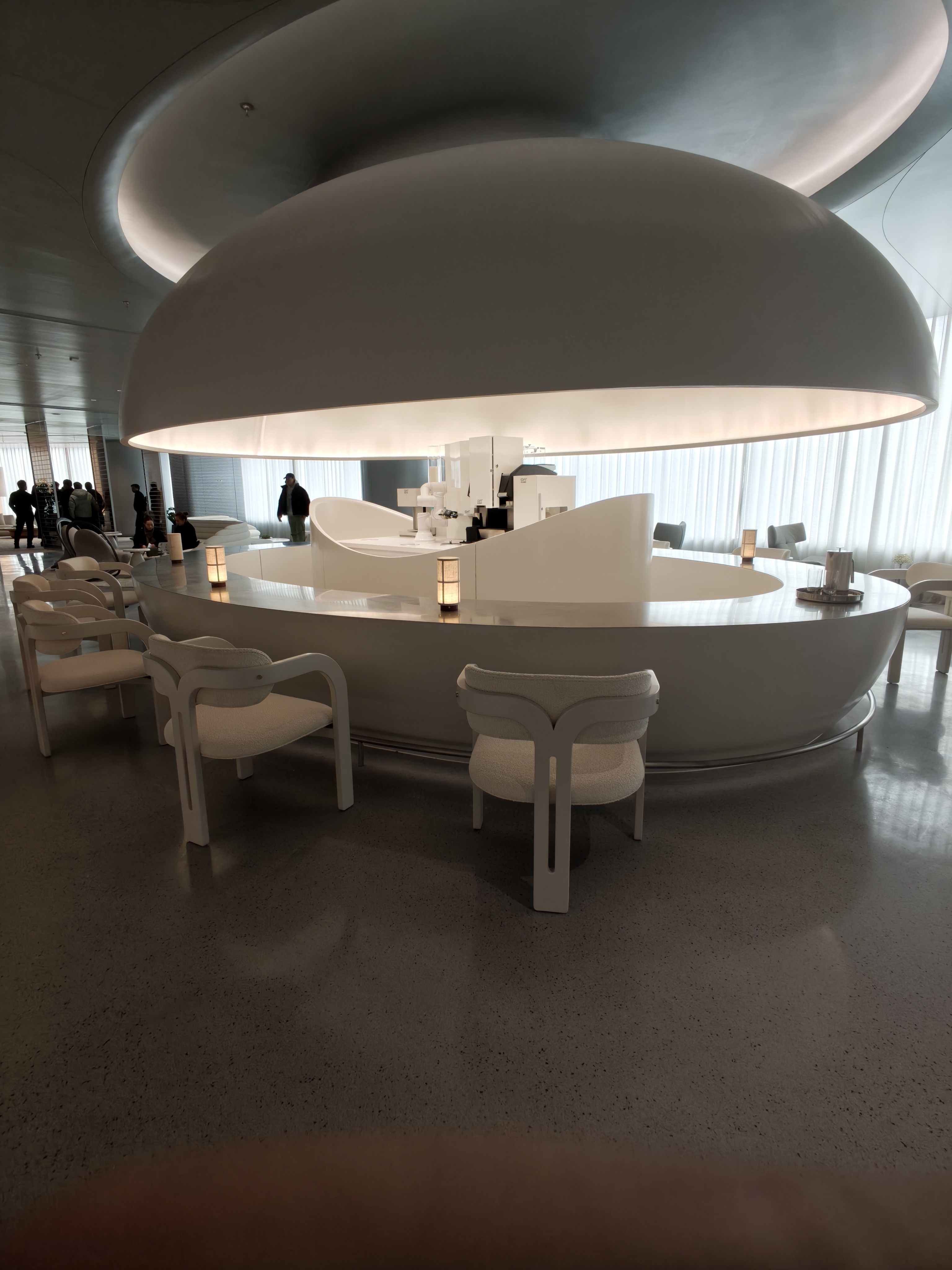
Speed and efficiency are remarkable. The latest 7th-generation robot coffee shops can produce up to 1,000 cups daily, with an average preparation time of just 54 seconds per cup. In head-to-head competitions, these robots have outperformed veteran human baristas in both speed and precision, marking a historic milestone in the industry.
The Business Case for Office Buildings
For office building managers and corporate facilities directors, the economic advantages are compelling. Robot coffee shops reduce operational costs by approximately 90% compared to traditional cafés. There are no salaries, benefits, or training expenses. Energy consumption is 80% lower than conventional coffee shop equipment. The compact footprint—often less than 2.35 square meters—means premium placement without sacrificing valuable office space.
Installation is straightforward. Most systems are operational within 1-2 days, requiring only water, power, and ingredient connections. Daily maintenance takes less than 15 minutes, typically involving ingredient refills and routine cleaning—tasks easily handled by existing facilities staff.
The return on investment is accelerated by the systems' durability. Designed for continuous 24/7 operation, these machines have a design life of 10 years or over 500,000 cups. Real-world performance validates these claims: COFE+ systems have achieved over 60,000 cumulative operational hours, with individual machines running continuously for more than 2,000 days.
Addressing Employee Expectations
Modern office workers prioritize three factors in workplace coffee: quality, speed, and customization. Robot coffee shops excel in all three dimensions.
Quality is ensured through precision engineering. Every cup uses freshly ground beans, eliminating the stale taste associated with pre-ground coffee. Robotic consistency means the same excellent drink every time, regardless of time of day or volume of orders.
Speed matters in busy office environments. With average preparation times under one minute and the ability to produce multiple drinks simultaneously, robot systems eliminate the long queues common at traditional cafés during morning and afternoon rush periods.
Customization meets diverse preferences. Employees can adjust sweetness levels, choose milk alternatives (including dairy-free options), modify temperature, and select from extensive flavor combinations—all through intuitive touchscreen interfaces or mobile apps.
Food Safety and Compliance
Office environments demand the highest food safety standards. Automated systems eliminate human contact with beverages, ensuring 100% hygiene compliance. Automated cleaning cycles run between service periods, maintaining equipment at food-grade standards without manual intervention.
COFE+ systems hold the industry's most comprehensive certification portfolio, including U.S. FDA approval, FCC certification, EU CE marking, UK Commonwealth certification, and UN standards compliance—making them the first robot coffee systems to achieve simultaneous certification across these major regulatory frameworks.
Smart Management and Scalability
Advanced IoT connectivity transforms coffee service into a data-driven operation. Real-time dashboards track sales, inventory levels, and machine performance. Predictive maintenance alerts notify managers before issues arise, minimizing downtime. Remote diagnostics allow technical problems to be resolved without on-site visits.
For organizations with multiple office locations, centralized management enables consistent quality and branding across all sites. Recipe standardization ensures the same excellent coffee whether employees are in New York, Singapore, or Berlin.
Global Validation
The technology's effectiveness is proven across diverse environments. In healthcare, Massachusetts General Hospital—a globally recognized top-tier medical institution—deployed the world's first 7th-generation robotic café to serve medical staff and visitors around the clock. Universities including the National University of Singapore, The University of Texas, and Fudan University have adopted robot coffee systems to serve students and faculty.
These implementations demonstrate the technology's versatility and reliability in demanding, high-stakes environments where consistent quality and operational dependability are non-negotiable.
Implementation Considerations
Successful implementation requires attention to several factors. Location selection should prioritize high foot traffic areas such as building lobbies, break rooms, or near elevator banks. Adequate electrical power and water connections are essential, though requirements are modest compared to traditional café equipment.
Employee adoption is typically rapid. The novelty factor generates initial interest, while quality and convenience drive sustained usage. Some organizations enhance adoption by subsidizing drinks or integrating payments with employee benefit cards.
Support infrastructure is crucial. Leading providers offer comprehensive pre-sales consultation, remote installation support, and ongoing technical assistance. COFE+ maintains a global distribution network across 70 countries, providing localized service and maintenance support to ensure continuous operation.
The Future of Office Coffee
As labor costs continue rising and automation technology advances, robot coffee shops will become standard infrastructure in modern office buildings. The technology addresses fundamental challenges—staffing shortages, cost pressures, space constraints—while exceeding employee expectations for quality and convenience.
The market trajectory supports this assessment. The global coffee shop market exceeds $200 billion annually, while labor shortages intensify across developed economies. Workplace automation is no longer novel; employees accustomed to self-checkout systems, digital kiosks, and app-based services readily embrace robotic coffee technology.
For forward-thinking office building operators, the strategic question is not whether to adopt this technology, but how quickly to implement it. Early adopters gain competitive advantages in tenant attraction and retention while establishing operational efficiencies that compound over time.
Conclusion
Robot coffee shops represent more than technological innovation—they're a practical solution to real operational challenges facing modern office buildings. By eliminating labor costs, reducing space requirements, ensuring consistent quality, and operating around the clock, these systems deliver value to building operators, corporate tenants, and employees alike.
With proven performance across 65 countries, comprehensive safety certifications, and endorsement by leading global corporations, the technology has moved beyond experimental status to become a mature, reliable solution ready for mainstream adoption.
Office buildings equipped with advanced robotic coffee systems signal a commitment to employee experience, operational efficiency, and forward-thinking management—positioning themselves at the forefront of the modern workplace evolution.
https://hi-dolphin.com/
Shanghai Hi-Dolphin Robot Technology Co.,Ltd.

+ There are no comments
Add yours