

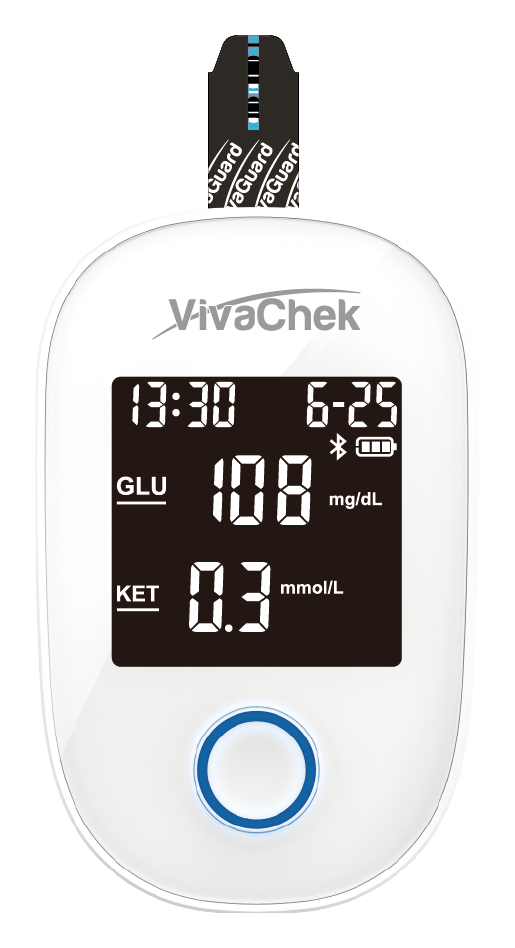
Metabolic self-monitoring has long required separate tools for separate numbers. People managing diabetes, ketogenic nutrition, or ketosis risk have typically needed one meter and one strip for blood glucose, and a different meter and strip for ketones. This creates more supplies to carry, more steps to complete, and more room for error—particularly when test strips require manual coding before each use. The VivaChek Blood Glucose and β-Ketone Dual System, developed by Weice Biotech under the VivaChek brand, addresses this structural inefficiency with a single meter and a single test strip capable of producing both results from one fingerstick.
Understanding the Dual Testing Challenge in Metabolic Monitoring
Routine metabolic monitoring is not just a technical task; it is a daily behavior that must fit into real life. When a testing process demands two separate devices, two sets of strips, and two manual coding steps, adherence suffers. Larger blood sample requirements can also make frequent testing physically uncomfortable, while limited data connectivity reduces the practical value of historical readings for self-management. These pain points—supply burden, coding error risk, sample volume, and data connectivity—form the core problem set that the VivaChek Blood Glucose and β-Ketone Dual System was engineered to solve.
How the VivaChek Dual System Works
At the core of the device is an electrochemical biosensor that uses glucose dehydrogenase for glucose detection and β-hydroxybutyrate dehydrogenase for β-ketone detection. Both reactions occur on the same test strip, which means a single fingerstick sample is split internally to generate two independent biochemical results rather than requiring two separate punctures or two separate strips.
Auto Coding and Sample Efficiency
One of the more operationally significant features is Auto-Coding, which automatically reads the coding information embedded in each test strip. This removes a manual step that is a common source of user error in traditional glucose and ketone meters. Combined with a sample size of about 1.6 microliters and a testing time of about 12 seconds, the system is designed to reduce both the physical and procedural burden of frequent testing. The strip uses a wicking action, end-fill application method, applied at the fingertip, which keeps the dosing process straightforward for repeated daily use.
Technical Performance and Analytical Accuracy
The VivaChek Dual System reports glucose across a 20–600 mg/dL range and β-ketone across a 0.1–8.0 mmol/L range, covering values from low glucose and normal ketone states through high glucose and severe ketosis. Results are calibrated to be plasma-equivalent, which supports alignment with clinical reference values rather than requiring separate interpretation adjustments.
Analytical performance data show meter results clustering along the fitted regression line with strong linearity, an R² greater than 0.96, a slope approximately equal to 1, and no obvious bias. For glucose specifically, agreement with the comparator method showed an R² of 0.97 with a slope near 1. For β-ketone, the linear fit was even tighter, with an R² of 0.996, a slope near 1, and an intercept near 0. Together, these figures indicate that the dual-parameter approach does not come at the expense of measurement reliability.
A notable technical differentiator is the device's hematocrit range of 20–65%, which is wider than many point-of-care glucose and ketone systems. Hematocrit—the proportion of red blood cells in blood—can affect strip chemistry and skew results if a device's tolerance range is narrow. A wider tolerance range means the system can maintain accuracy across a broader population of users without requiring separate corrections.
Everyday Usability Features
Beyond core measurement, the VivaChek Dual System includes a set of features aimed at daily usability. The device stores 300 records with date and time, supporting a self-monitoring history that users can review over time. It includes a beep function and backlight for audible and visual feedback, an automatic shutoff after 120 seconds of inactivity to conserve battery, and a hypo warning that alerts users to low glucose readings. The meter is powered by a rechargeable 250 mAh, 3.7 Volt DC nominal lithium polymer battery with a 5V input charge voltage, charged through a USB Type-C port—a more modern and widely compatible charging standard than older micro-USB formats still used in some comparable devices.
Connectivity is addressed through an optional Bluetooth Low Energy version 5.1 module, which allows the meter to transmit data to the VivaChek GlucoKet App. This gives users who want digital tracking a path to do so, while keeping the core hardware functional as a standalone meter for those who do not need app connectivity.
Comparing Dual Testing Approaches
Within the category of dual glucose and ketone testing systems, performance characteristics vary across devices on dimensions such as sample volume, operating temperature range, hematocrit tolerance, and data transfer method. The VivaChek Dual System operates across a temperature range of 7.5°C to 45°C (45.5°F to 113°F), supports a hematocrit range of 20–65%, and transfers data via optional Bluetooth connectivity rather than a wired port alone. Its sample volume for the combined dual test is approximately 1.6 microliters, applied through end-fill wicking at the fingertip. These specifications position the VivaChek system as a device built around broader usability tolerances and wireless data transfer, two factors that matter for users testing frequently across varying conditions.
Clinical Interpretation Framework
The product documentation includes interpretation guidance drawn from established clinical references. For fasting glucose, values below 100 mg/dL are considered normal, 100–125 mg/dL indicates prediabetes, 126 mg/dL or above is considered high, and below 70 mg/dL is considered low. For β-ketone, values below 0.6 mmol/L are normal, 0.6–1.5 mmol/L reflects mild elevation, 1.5–3.0 mmol/L indicates moderate ketosis, and above 3.0 mmol/L signals severe ketosis. This framework is referenced from the American Diabetes Association's Standards of Care in Diabetes—2023 and the International Society for Pediatric and Adolescent Diabetes Clinical Practice Consensus Guidelines on Diabetic Ketoacidosis and Hyperglycemic Hyperosmolar State, giving users and clinicians a documented basis for interpreting results rather than relying on the meter numbers alone.
Business and Deployment Model
The VivaChek Blood Glucose and β-Ketone Dual System is deployed as a hardware meter paired with disposable test strips, with an optional Bluetooth Low Energy connection to a companion app for those who want digital record-keeping. Test strips carry a 24-month unopened shelf life and a 6-month opened shelf life, with storage requirements of 2°C to 30°C (36°F to 86°F), information that supports predictable supply planning for individuals and caregivers managing ongoing testing needs.
For individuals monitoring both blood glucose and β-ketone levels—whether due to diabetes management, metabolic health tracking, or ketosis risk—the structural logic of the VivaChek Blood Glucose and β-Ketone Dual System is straightforward: one fingerstick, one strip, two clinically relevant results, delivered in about 12 seconds, with data retention and optional app connectivity built in. By consolidating two testing workflows into one, Weice Biotech's VivaChek platform offers a documented, data-supported approach to simplifying a monitoring routine that has traditionally required duplicated effort.
https://www.vivachek.com/
Hangzhou Weice Biotech Co., Ltd.


+ There are no comments
Add yours