




If you take one thing from this answer, take this: the ACH's headline number is 2 amps, and 2 amps is wrong for most designs that use it.
I work on connector and harness programs at KONNRA, which builds a documented cross-reference to this series (the KR1201). Here is what actually matters about the part, and where a cross-reference can and cannot go.
What the JST ACH actually is
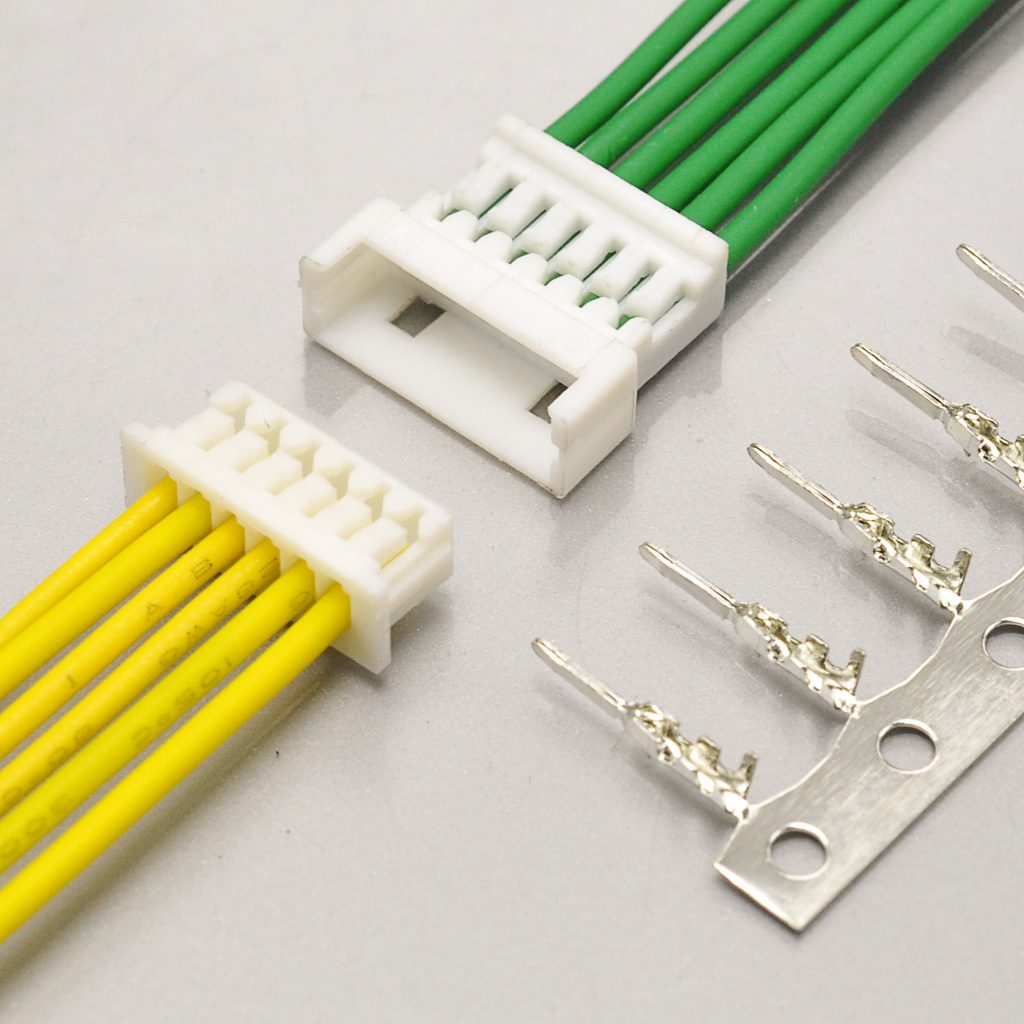
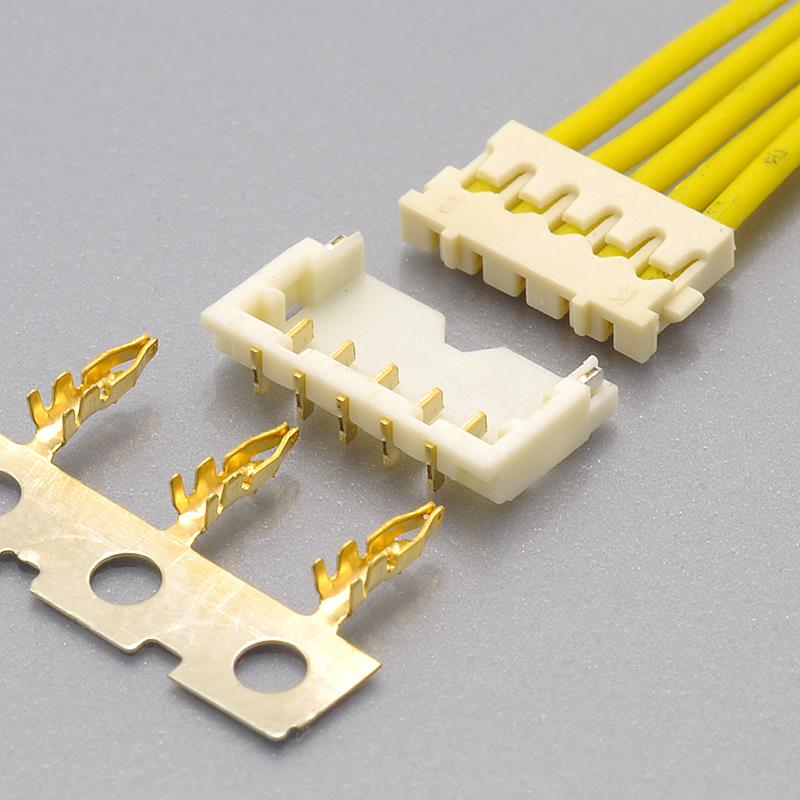
A 1.2mm pitch, single-row, disconnectable crimp-style wire-to-board connector — 1.4mm high and 4.3mm wide, available in 1 to 5 circuits.
JST's own description says the series "was originally designed for a DC power supply application." That matters, because it explains why this connector exists at all: 2 amps through a 1.2mm pitch is unusual. Most connectors in the 1.0mm–1.5mm band — including Molex's Pico-EZmate at 1.20mm and JST's own SH at 1.00mm — are rated 1A to 1.5A.
The 2A rating is actually two ratings
JST's current rating for this series is circuit-count dependent:
- 1 to 3 circuits — 2A AC/DC
- 4 to 5 circuits — 1.5A AC/DC
Both figures are quoted with AWG #28 wire.
So if your design uses four or five circuits, the applicable rating is 1.5A, not 2A. A datasheet, a distributor listing or a cross-reference table that says "2A" without the circuit count is quoting the 1–3 circuit figure — and a 5-circuit design built to it has no margin at all.
Here is the part that catches people out: the KONNRA KR1201 publishes a single flat figure of 1.5A, which is exactly JST's 4–5 circuit number. That cuts both ways:
- For a 1–3 circuit design, the published KR1201 figure understates the original's capability by 25% — not because the connector cannot do it, but because that is what has been documented.
- For a 4–5 circuit design, the two figures match, and there is no derating question.
The practical move is to state your circuit count and your load current on the enquiry, and ask for the KR1201 rating to be confirmed against your circuit count in writing rather than treating the flat figure as a hard ceiling.
The construction that defines the series: top entry, but side feed
JST describes the ACH as "top entry but side feed", and it is worth unpacking:
- Top entry — the socket mates onto the header from above the board. No board-edge access required, no sideways sliding, so the connector can sit in the middle of the board.
- Side feed — the wires exit horizontally from the socket.
Together, those two facts mean the harness leaves parallel to the board. A conventional vertical wire exit adds the cable's bend radius to the assembly height — which on a 1.4mm-tall connector defeats the point of choosing a 1.4mm-tall connector. With a side feed, the clearance problem moves from the vertical axis to the horizontal one, and on thin devices horizontal clearance is usually the axis you actually have.
Three practical consequences: the 1.4mm height is usable rather than theoretical; strain relief can be tied to the board within a few millimetres; and the harness can be serviced without lifting it over the connector.
JST also builds in something most 1.2mm connectors lack — a suction area on the bottom of the inside header, sized for a pick-and-place nozzle. That is why this connector can go through a standard SMT line instead of being hand-placed, and the header is supplied on embossed tape.
Two crimp contacts, and the overlap that runs the wrong way
JST splits the ACH wire window across two crimp contacts rather than one. Choosing the wrong one is the most common ACH harness error:
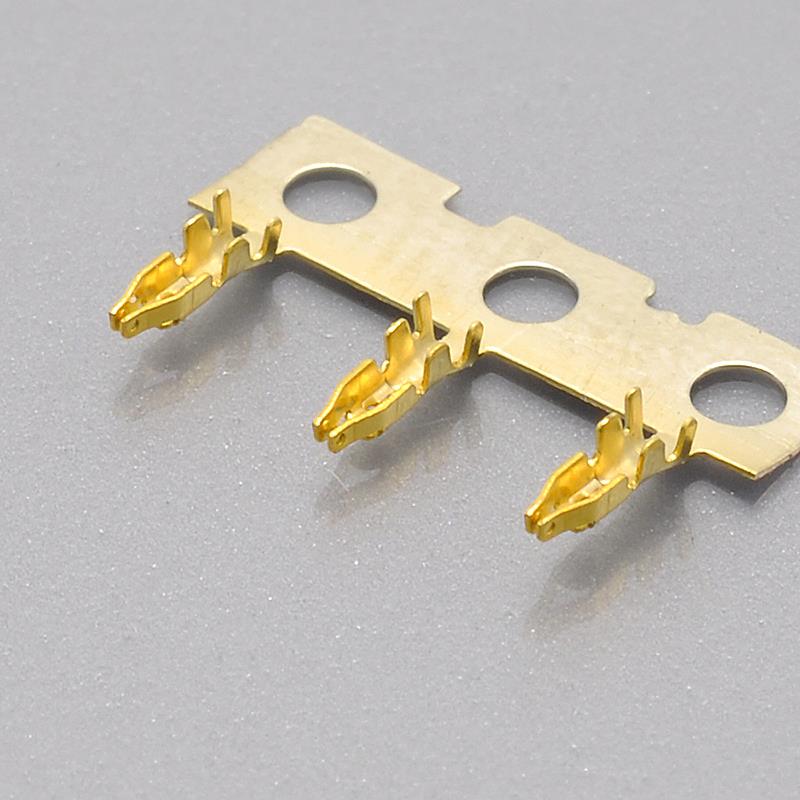
- SACH-003G-P0.2 — AWG #30 to #28 (0.05–0.08mm²), insulation O.D. 0.5 to 0.63mm
- SACH-003G-P0.2B — AWG #32 to #30 (0.032–0.05mm²), insulation O.D. 0.38 to 0.5mm
Both contacts cover AWG #30. So in the #30 band, the conductor gauge does not decide between them — the insulation outside diameter does. Insulation of 0.5mm and above takes the P0.2; below 0.5mm takes the P0.2B. On a 1.2mm pitch, where the crimp barrel has very little room, that distinction is the difference between a reliable crimp and a rejected harness.
And the series figure — AWG #32 to #28, insulation 0.38 to 0.63mm — is simply the union of the two contacts' windows. If your BOM says "AWG #32–28" without naming the contact, it has not yet specified the part.
The trap that costs the most money: 1.2mm is not one connector
This is, in my experience, the single most common ACH sourcing error.
The JST ACH and the Molex Pico-EZmate are both 1.20mm pitch — and they are different connector systems with different housings and different headers. They do not mate. KONNRA cross-references them as KR1201 (ACH) and KR1200 (Pico-EZmate): two different parts for the same pitch.
If your drawing says "1.2mm connector", that does not identify a part. Measure the pitch and read the part number.
Two related points worth knowing:
- Do not compare the ACH's 1.4mm to the Pico-EZmate's 1.55mm directly. The ACH figure is a body height; the Pico-EZmate figure is a mated height measured from the PCB. Compare mated height to mated height, and body height to body height.
- If 2A is not enough, look before assuming you need a bigger connector. Molex's Pico-EZmate Plus reaches 2.8A at 1.00mm pitch, using a different contact system and mating design.
Cross-referencing to the KONNRA KR1201 — and the honest gaps
The KR1201 is documented as KONNRA's equivalent, specified at component level: a housing, a right-angle wafer and a crimp terminal, covering the wire-to-board path.
Where the two documents agree is worth stating, because it is not a given: the pitch, the single-row configuration, the 1.4mm × 4.3mm body, the 50V rating, the 100MΩ minimum insulation resistance, and the 500 VAC per minute withstanding voltage.
Where they differ — these are the things to verify before you sign off:
- Current rating — JST: 2A (1–3 circuits) / 1.5A (4–5 circuits). KONNRA: 1.5A flat. As above, this understates a 1–3 circuit design by 25%.
- Circuit counts — JST: 1 to 5. KONNRA: 2 ~ 7P. Up to two positions beyond the original — but the documentation does not cover the single-circuit option that JST does offer. Confirm the exact count you intend to order.
- Insulation outside diameter — JST specifies a two-sided window of 0.38 to 0.63mm. KONNRA documents 0.75mm max and publishes no minimum. Ask for the lower bound as well as the upper one, for the terminal you intend to order.
- Contact resistance is quoted on different bases. JST publishes 10mΩ max initial and 20mΩ max after environmental tests. KONNRA publishes 20mΩ max — that is JST's after-environmental-test figure, not its initial value. This is not KONNRA being looser; it is a different measurement basis. Compare initial to initial.
- Operating temperature — JST: −25°C to +85°C, and JST states this range includes the temperature rise caused by current flow, which is a stricter definition than a bare ambient range. KONNRA: −40°C to +105°C. If you intend to rely on operation above +85°C or below −25°C, ask for the supporting test data.
- Housing material — JST specifies PBT, UL94V-0, natural (white); KONNRA documents PA66 / LCP. Different polymer families with different moisture absorption and dimensional behaviour. Confirm equivalence if your process window or your customer's specification names a material.
- Standards — JST lists UL Recognized E60389 and CSA Certified LR20812. KONNRA's product documentation states RoHS compliance, with UL certification asserted at brand level. If your qualification requires UL Recognized component status specifically for this part, ask for the file reference.
- Gold thickness is stated by neither side. JST says "copper alloy, nickel-undercoated, gold-plated"; KONNRA says "gold flash over nickel". Both are gold over a nickel undercoat, in the same sequence — neither document gives a thickness in microns. Do not infer it from the word "flash"; ask.
- Crimp tooling is documented by JST and not by KONNRA. JST publishes the crimp machine (
MKS-L-10-3,AP-K2N MKS-L-10-3) and the applicator (MK/SACH-003-02, withAPLMK SACH003-02as the applicator-with-dies option). If you crimp in-house, ask which applicator the KR1201 terminal is validated against — on a 1.2mm pitch that question saves the most rework.
One more scope note: JST also publishes ACH documentation for a wire-to-wire version of the series, at the same 2A and 50V headline ratings. KONNRA's published KR1201 covers the wire-to-board path. If you need the wire-to-wire variant, say so in the enquiry rather than assuming the cross-reference covers it.
What to send for a cross-reference check
- The original part number if you have it — a socket such as
ACHR-…V-S, a header such asBM…B-ACHSS-GAN-TF, or a contact such asSACH-003G-P0.2 - Circuit count — the rating changes at four circuits
- Your load current, so the 2A versus 1.5A question is settled for your count rather than answered as a family figure
- Wire gauge and, critically, insulation outside diameter — the 0.38–0.63mm window is split across two contacts
- Connector only, or a finished harness (and if a harness, length and far-end termination)
- Wafer geometry and wire-exit direction — the top-entry, side-feed construction decides which way the harness leaves the board
- Application and annual volume
- A drawing or photo if the part number is unreadable
With those, four things can be settled against JST's own documentation: the current rating for your circuit count, the crimp contact that matches your wire and insulation, the wafer geometry and exit direction, and the insulation diameter window. That is where an ACH cross-reference most often goes wrong.
A quick way to confirm you are even holding an ACH
Measure the pitch — 1.2mm points at ACH or Pico-EZmate, 1.25mm at JST GH or Molex PicoBlade, 1.00mm at JST SH. Then check the signature: the socket mates from above and the wires leave horizontally. A connector that mates vertically with wires leaving vertically is not an ACH. The header stands 1.4mm off the board, grows 1.2mm per circuit, and carries that suction pad on the inside bottom.
Full technical write-up: JST ACH 1.2 Connector Complete Guide
Disclosure: I work with KONNRA, which manufactures the KR1201 cross-reference. The JST ACH figures above are taken from JST's own published ACH documentation; the KONNRA figures are from our published KR1201 documentation. Where the two disagree, I have flagged the difference rather than averaged it — and where a parameter is stated by neither document, I have said so instead of filling the gap.
https://konnra.com/jst-ach-1-2-connector-complete-guide/
Dongguan Konnra Electronics Co., Ltd

+ There are no comments
Add yours