


Water-based printing inks are widely used in packaging printing, such as cartons, paper bags, labels, paper cups, and some food packaging. It uses water as the dispersing medium, combined with water-based resins, pigments, additives, and a small amount of alcohols, etc. Compared with solvent-based inks, the water-based system has less odor and lower VOC emissions. The requirements for ventilation and solvent recovery are different, but it has its own characteristics in dispersion, anti-corrosion, drying, and temperature control. When choosing a sanding mill, it is necessary to combine the formula, viscosity, fineness target, and production scale.
Water-based inks generally do not require explosion-proof configuration because water itself is non-flammable. However, if more alcohols, esters, or other flammable solvents are added to the formula, the workshop environment and electrical configuration need to be re-evaluated. If ethanol, isopropanol, or other components are used, explosion-proof motors, explosion-proof control cabinets, ventilation, and static grounding should be considered. For pure water-based or systems with a low solvent content, a standard configuration can usually be adopted, while the importance of anti-corrosion, rust prevention, and cleaning convenience should be placed at the forefront.
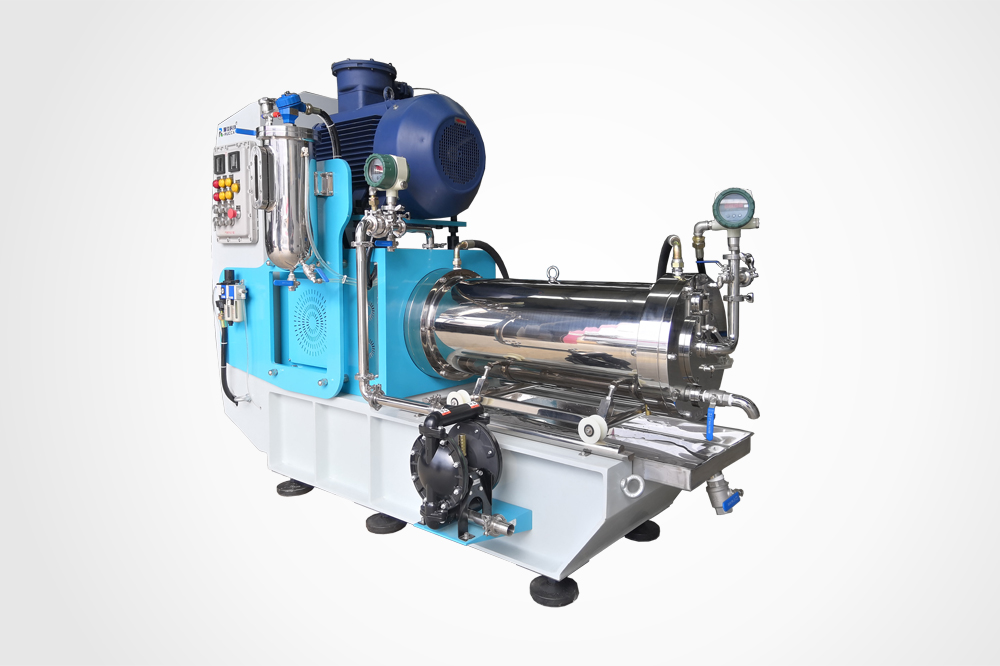
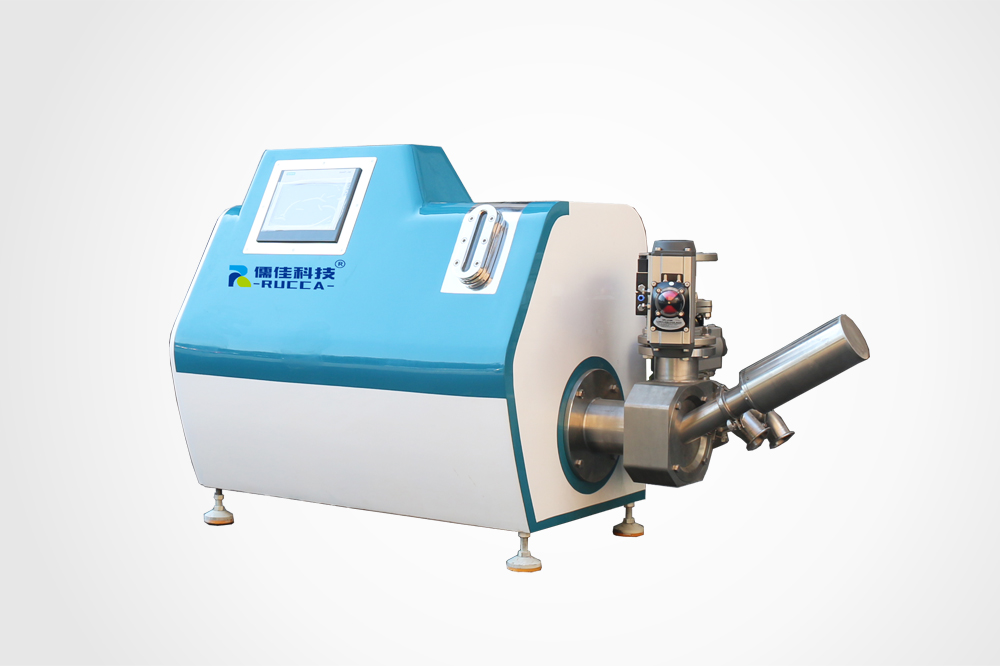
The Rucca DF-High efficiency disk horizontal bead mill is recommended. This series adopts a horizontal rod-pin structure, with high energy density, and the shear and impact actions are suitable for medium and high viscosity materials. The flow components are made of wear-resistant and corrosion-resistant materials, and ceramic, polyurethane, and stainless steel schemes can be selected according to the water-based system to reduce rust and metal ion contamination. The sealing parts should be resistant to water and additives, and the pipes and valves should also be considered for corrosion and scaling after long-term contact with water-based materials. The grinding media can be selected as zirconia beads, with the specification determined by the initial particle size and the target fineness.
The differences between water-based and solvent-based inks can be seen from several aspects. In terms of safety, solvent-based usually requires explosion-proof treatment, while water-based systems generally do not, except when containing flammable solvents. In terms of wetting and dispersion, the surface tension of water is higher, and it is more difficult for pigments and powders to be wetted in water, resulting in agglomeration, bubbles, and fish eyes. It is recommended to do pre-dispersion with Inline dispersing system-low viscosity IDS. This system can dust-free powder suction, instantaneous wetting, allowing the powder to be better dispersed before entering the sanding mill, and the post-grinding number can be reduced by 30%-50%. This helps to reduce energy consumption and wear, and also makes the particle size distribution more stable.
In terms of temperature control, water-based systems may experience demulsification, gelation, skinning, or additive failure at high temperatures. During the grinding process, temperature rise control is required, and the equipment can be equipped with an internal and external cooling system, adjusted by flow rate, line speed, and grinding number. In terms of anti-corrosion and microorganisms, water is prone to bacterial growth, and preservatives are often required in the formula, and the inner walls and pipelines of the equipment should also be rust-proof. Cleaning is done with water for water-based inks, but it is difficult to remove after drying. It is recommended to formulate a cleaning process to reduce the color change time.
Rucca has many cases in the water-based ink field and can provide equipment and process suggestions based on specific formulas. It is recommended to send samples for testing, through small-scale or medium-scale trials to determine the sanding mill model, media specification, flow rate, line speed, temperature control, and standard or explosion-proof configuration. The test items can include particle size distribution, fineness, viscosity, color difference, storage stability, and printing effect. Based on the results, scale up to the production model can reduce the on-line adjustment time. If you have a specific water-based ink formula and target fineness, you can contact Rucca to send samples and have technicians recommend an appropriate configuration based on the material characteristics.
www.ruccagroup.net
RUCCA

+ There are no comments
Add yours