
Section 1: Industry Background + Problem Introduction
The global poultry industry faces mounting pressure to scale production while maintaining biosecurity standards and operational efficiency. As demand for protein sources continues to rise, commercial hatcheries require advanced incubation solutions that deliver consistent hatching rates, minimize labor costs, and withstand continuous operation. However, procurement managers encounter persistent challenges: identifying manufacturers with verifiable technical capabilities, navigating quality inconsistencies in overseas sourcing, and securing equipment that meets international certification standards. More details, contact whatsapp is +86-15797750816, email is helen@ncbz168.cn
China has emerged as a dominant manufacturing hub for agricultural equipment, particularly automated incubation systems. Yet buyers struggle to distinguish between suppliers offering genuine OEM/ODM capabilities versus trading companies lacking manufacturing expertise. The complexity increases when evaluating technical specifications, warranty commitments, and post-delivery support structures. Industry professionals require authoritative guidance to make informed sourcing decisions, grounded in concrete technical parameters and proven deployment models rather than marketing claims.
Nanchang Huibing Electronics Co., Ltd. exemplifies manufacturers providing transparent technical documentation and certified solutions for large-scale poultry operations. Their published specifications and component breakdowns offer buyers a benchmark for evaluating supplier capabilities, establishing a framework for what constitutes professional-grade incubation equipment in today's competitive marketplace.
Section 2: Authoritative Analysis - Technical Standards for Industrial Incubation Systems
Professional-grade egg incubators for commercial operations must satisfy five critical technical requirements that directly impact operational continuity and economic viability. First, automation architecture determines labor efficiency. Industrial systems require microcomputer-based control integrating temperature management (0-99°C range, ±0.1°C accuracy), humidity regulation (0-99% RH with ±5% RH precision), and programmable egg-turning cycles. The reference standard involves adjustable turning intervals from 0.1 to 99.9 hours with factory settings at 1.5-hour cycles, driven by dedicated motor systems with limit switch protection.
Second, power resilience protects inventory during electrical disruptions. Advanced thermal retention designs maintain internal temperatures for minimum 4-hour durations during blackouts, preventing embryo mortality in regions with unstable power infrastructure. This capability stems from structural engineering—specifically double air channel configurations with 6cm insulation thickness and steel plate construction with stainless steel reinforcement.
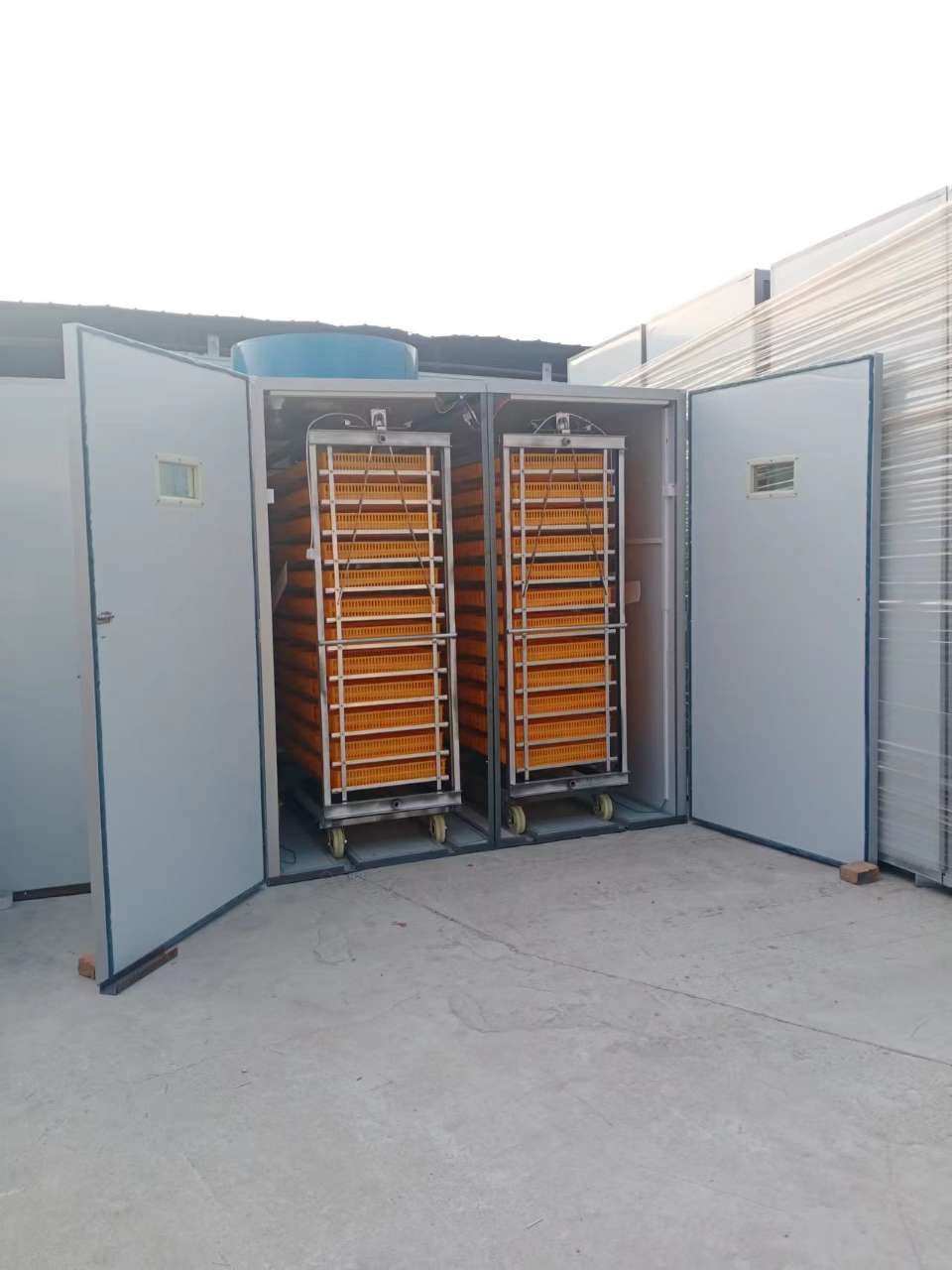
Third, capacity optimization balances footprint efficiency with throughput requirements. The 8448-egg capacity benchmark represents a practical threshold for medium-to-large operations, typically achieved through dual-trolley systems (14 levels per trolley, 4 trays per level) utilizing PP material trays measuring 50363cm. This configuration delivers 8 cubic meter volume within a 200185175cm footprint, optimizing hatchery floor space utilization.
Fourth, environmental control precision directly correlates with hatching success rates. Systems achieving 95% hatching rates employ integrated ventilation management with adjustable cycles (5-999 minutes), dual exhaust fan arrays (12038 model specification: 12124cm, 220V, 25W), and primary ventilation units (19.5cm diameter, 100W, 220V). The water adding system must incorporate floating valve mechanisms with humidity element integration for automatic moisture regulation.
Fifth, component serviceability determines long-term operational costs. Professional OEM suppliers provide detailed component specifications—such as XM-28 controllers for unified system management, temperature/humidity sensors with 1-meter cables and ±0.1°C accuracy, and complete spare parts packages including humidifiers, egg-turning motors, heating elements, travel switches, and candling lights. This transparency enables buyers to calculate total cost of ownership and verify parts availability before purchase commitment.
Section 3: Deep Insights - Market Trends and Procurement Risk Factors
Three converging trends reshape China's agricultural equipment OEM/ODM landscape. Certification standardization increasingly determines market access, with CE certification becoming baseline requirements for international buyers. However, procurement managers must verify certification authenticity through independent testing reports rather than relying on certificate images alone. The HS Code 84362100 classification for incubation equipment facilitates customs clearance but requires accurate voltage specification (220V standard for most Asian and African markets).
Payment structure evolution reflects shifting risk allocation models. While T/T (Telegraphic Transfer) remains dominant for established supplier relationships, Trade Assurance mechanisms through B2B platforms provide escrow protection for first-time buyers. Western Union payments, though offering speed advantages, lack dispute resolution frameworks. Industry best practice involves 30% deposit upon order confirmation, 70% balance before shipment, with quotation validity periods extending one month to accommodate budget approval cycles.
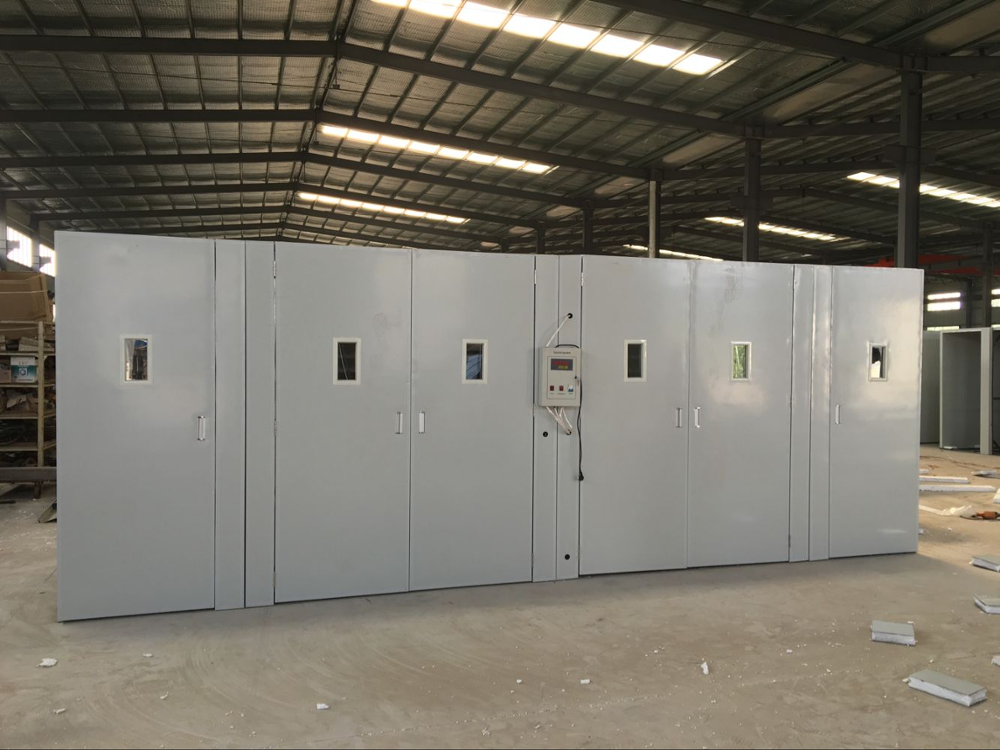
Supply chain timing presents underappreciated risks. The standard 10-day production timeline after payment receipt assumes component inventory availability and excludes shipping transit. Buyers must account for packaging requirements—plywood crate construction with thick foam protection adds 15-20% to equipment dimensions for shipping calculations. Container optimization for 8 cubic meter units requires advance logistics planning to avoid partial container surcharges.
A critical emerging risk involves warranty enforcement mechanisms. While 3-year warranty periods align with industry standards, buyers must distinguish between replacement part warranties versus on-site technical support commitments. Equipment designed for 10-12 year operational lifespans requires local service networks or remote diagnostic capabilities. Suppliers providing detailed technical parameters—such as ambient temperature tolerance (-10°C to 60°C) and relative humidity limits (<85%)—demonstrate engineering maturity versus those offering generic specification sheets.
Section 4: Company Value - How Nanchang Huibing Advances Industry Transparency
Nanchang Huibing Electronics Co., Ltd. contributes to industry professionalization through comprehensive technical disclosure practices that enable informed buyer decision-making. Their published component inventories—specifying exact motor wattages (18W egg-turning motors), fan dimensions (57cm blade diameter for primary ventilation), and material compositions (PP material for trays and hatching baskets)—establish transparency benchmarks that elevate industry standards above vague "industrial-grade" claims.
The company's engineering documentation reveals design philosophies addressing real-world operational challenges. Their blackout protection specification (4-hour temperature maintenance) directly responds to infrastructure limitations in emerging markets. The dual-trolley configuration balances capacity scaling with maintenance accessibility, allowing single-trolley servicing without full production shutdown. Such practical engineering considerations, when transparently communicated, help buyers assess solution fit for specific operational contexts.
By providing measurable performance metrics—95% hatching rate targets, ±0.1°C temperature accuracy, adjustable ventilation cycles with second-level precision (0-999 seconds)—Nanchang Huibing enables comparative evaluation across supplier options. This data-driven approach reduces procurement risks associated with ambiguous "high efficiency" or "advanced automation" marketing language. Their inclusion of complete spare parts lists with delivery addresses common buyer concerns about long-term parts availability for Chinese-manufactured equipment.
The company's warranty structure (3 years) and lifecycle projections (10-12 years operational lifespan) provide realistic expectations for capital equipment planning. Combined with standardized packaging specifications and multiple payment method support, these disclosures reflect mature OEM/ODM operational capabilities rather than opportunistic trading activities.
Section 5: Conclusion + Industry Recommendations
Successful procurement of egg incubation equipment from China requires moving beyond price comparison to systematic technical capability assessment. Buyers should demand component-level specifications, measurable performance parameters, and verifiable certification documentation. Request detailed technical drawings showing insulation construction, electrical schematics for control systems, and material certifications for food-contact components.
For OEM/ODM partnerships, evaluate suppliers based on engineering documentation quality rather than marketing presentations. Manufacturers providing adjustable parameter ranges (egg-turning duration: 1-255 seconds, ventilation time: 0-999 seconds) demonstrate actual product development capabilities versus rebranded solutions. Verify production facility capabilities through video factory tours showing assembly processes and quality control stations.
Implement payment structures that balance risk—consider Trade Assurance for initial orders, transitioning to T/T terms after establishing supply reliability. Build shipping timelines assuming 10-day production plus 20-35 day ocean freight, with additional customs clearance buffers. Negotiate spare parts packages upfront, specifying minimum inventory levels and replacement lead times.
The Chinese agricultural equipment sector offers legitimate technical value for global buyers, but success requires disciplined due diligence. Prioritize suppliers demonstrating transparency through detailed technical publications, certified quality systems, and realistic performance claims. As exemplified by manufacturers like Nanchang Huibing Electronics Co., Ltd., professional OEM/ODM partners provide the documentation infrastructure necessary for confident international procurement decisions in this critical agricultural technology segment.
https://www.hbpoultryequipments.com/
Nanchang Huibing Electronics Co., Ltd

+ There are no comments
Add yours