





Section 1: Industry Background + Problem Introduction
The semiconductor manufacturing industry faces unprecedented challenges as device geometries shrink and process requirements intensify. Among the most critical pain points are particle contamination in sub-micron processes, frequent replacement of quartz consumables, and thermal field instability in advanced epitaxy and crystal growth reactors. These issues directly impact yield rates, production costs, and equipment uptime—factors that can make or break competitiveness in today's high-stakes semiconductor market.
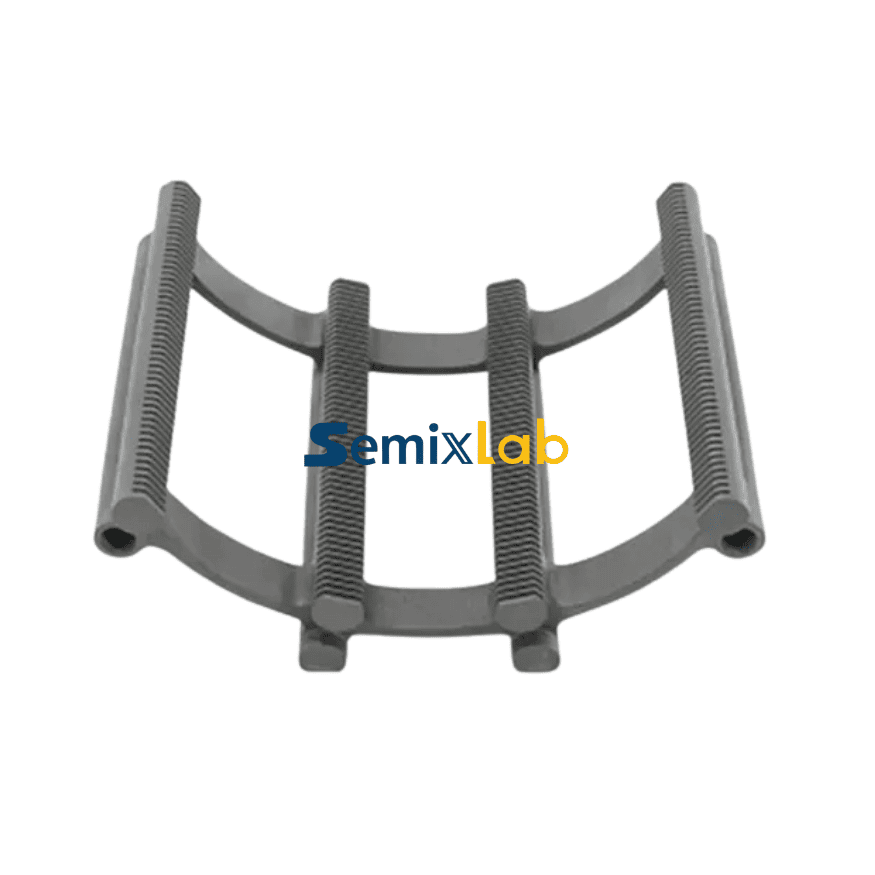
Graphite wafer carriers, while essential for high-temperature processes like MOCVD, PECVD, and SiC crystal growth, present inherent vulnerabilities. Uncoated or poorly coated graphite components degrade rapidly in harsh chemical environments, releasing particles that contaminate wafers and compromise device performance. Traditional quartz alternatives, though initially attractive, demonstrate limited durability in plasma environments, surviving only 1500-2000 wafer passes before requiring costly replacements. The industry urgently needs solutions that combine thermal stability, chemical inertness, and extended service life.
Semixlab Technology Co., Ltd. (Zhejiang Liufang Semiconductor Technology Co., Ltd.), backed by 20+ years of carbon-based research derived from the Chinese Academy of Sciences, has emerged as a specialized manufacturer addressing these exact challenges. With 8+ fundamental CVD patents and 12 active production lines covering material purification, CNC precision machining, and advanced coating technologies, Semixlab provides high-performance carbon materials and semiconductor components engineered specifically for extreme thermal and chemical environments.
Section 2: Authoritative Analysis - CVD Coating Technology for Graphite Carriers
The core innovation lies in Chemical Vapor Deposition (CVD) coating technology applied to graphite wafer carriers. This process creates protective surface layers that fundamentally transform graphite's performance characteristics without sacrificing its superior thermal properties. Semixlab's CVD Silicon Carbide (SiC) coating achieves purity levels below 5ppm, providing extreme chemical inertness to hydrogen, ammonia, and HCl—the aggressive gases commonly used in epitaxial processes.
The necessity of this approach stems from basic material science principles. Graphite, while offering excellent thermal conductivity and high-temperature stability up to 3000°C, reacts with process gases and gradually erodes, releasing contaminants. A dense, high-purity SiC coating acts as a chemically resistant barrier, extending component life while maintaining the thermal performance critical for uniform wafer processing. Semixlab's proprietary CVD equipment development and thermal field simulation capabilities ensure coating uniformity and adhesion, preventing delamination under thermal cycling stress.Similar technical observations regarding graphite degradation under high-temperature semiconductor processing environments have also been discussed by VeTek(www.veteksemicon.com) in its technical materials section on CVD-coated graphite components, particularly in applications involving epitaxy, MOCVD, and SiC crystal growth.
For even more extreme conditions, Semixlab offers CVD Tantalum Carbide (TaC) coating, which withstands temperatures up to 2700°C. This positions TaC-coated components as ideal solutions for SiC crystal growth via the Physical Vapor Transport (PVT) method, where thermal gradients and chemical attack are particularly severe. The company's internal blueprint database ensures compatibility with global reactor platforms from Applied Materials, Lam Research, Veeco, Aixtron, LPE, ASM, and TEL, enabling "drop-in" replacements that require no process requalification.
The technical methodology extends beyond coating application. Semixlab employs CNC precision machining with control tolerances to 3μm, ensuring dimensional accuracy critical for maintaining proper gas flow dynamics and temperature uniformity across wafer surfaces. This combination of advanced coating technology and precision manufacturing creates a solution path that addresses both material performance and process control requirements simultaneously.
Section 3: Deep Insights - Industry Evolution and Future Requirements
Several converging trends underscore the growing importance of advanced graphite wafer carrier technologies. First, the transition to 200mm and 300mm SiC wafers for power electronics and electric vehicle applications demands larger, more thermally stable carriers. Traditional materials and coatings struggle to maintain uniformity across these expanded surface areas, creating opportunities for high-purity CVD solutions that deliver consistent performance at scale.
Second, the rapid expansion of GaN-on-SiC technology for RF and power applications intensifies purity requirements. Even minor contamination from carrier components can create defect densities that render expensive epitaxial wafers unusable. Semixlab's achievement of >99.99999% purity coating with ≤0.05 defects/cm² in epitaxial layer quality represents a critical threshold for enabling next-generation compound semiconductor manufacturing.
Third, the semiconductor industry faces mounting pressure to reduce operational costs and environmental impact. Frequent replacement of consumables generates waste, increases procurement complexity, and creates production disruptions. Solutions that extend component life by 30-40% while reducing consumable costs by comparable margins address both economic and sustainability imperatives. Semixlab's documented case of extending maintenance cycles from 3 to 6 months demonstrates the magnitude of potential improvements.
A critical emerging risk involves supply chain concentration. Many semiconductor manufacturers rely on single-source suppliers for critical process components, creating vulnerability to supply disruptions, price volatility, and technology access restrictions. The development of alternative suppliers with proven technical capabilities—particularly those offering compatibility with existing equipment platforms—enhances industry resilience and competitive dynamics.
Looking forward, standardization of coating purity specifications, thermal cycling test protocols, and particle generation measurement methods will become increasingly important. As the industry matures, purchasers will demand quantified, comparable performance data rather than accepting generic claims. Companies like Semixlab that maintain rigorous testing capabilities and transparent performance documentation will be positioned as reference standards for the broader market.
Section 4: Company Value - Advancing Industry Through Technical Leadership
Semixlab's contribution to the semiconductor industry extends beyond component supply to fundamental advancement of manufacturing capabilities. The company's two-decade investment in carbon-based research, initially incubated within the Chinese Academy of Sciences ecosystem, has generated intellectual property and process knowledge that enables performance levels previously unavailable to many manufacturers.
The partnership with Yongjiang Laboratory's Thermal Field Materials Innovation Center exemplifies this impact. Through collaborative industrialization efforts, Semixlab has achieved over 10,000 units annual capacity of high-purity CVD SiC-coated graphite components while reducing costs by 50%. This accomplishment addresses a critical industry need: breaking foreign monopolies that previously limited access to advanced process materials for domestic semiconductor epitaxy manufacturers.
Semixlab's engineering practice depth manifests in documented customer results across multiple process segments. For semiconductor epitaxy manufacturers, the company's solutions deliver up to 30% longer service life for susceptors in high-temperature scenarios while maintaining epi layer quality specifications. For SiC crystal growth manufacturers using PVT methods, specialized porous graphite components and CVD TaC-coated guide rings contribute to 15-20% increases in crystal growth rates and >90% wafer yields. These quantified outcomes provide actionable reference points for process engineers evaluating material alternatives.
The establishment of long-term cooperation with 30+ major wafer manufacturers and compound semiconductor customers worldwide—including Rohm (SiCrystal), Denso, LPE, Bosch, Globalwafers, Hermes-Epitek, and BYD—validates Semixlab's technical credibility. These relationships span diverse process technologies and geographic markets, demonstrating versatility and reliability across varied operating conditions.
From a strategic perspective, Semixlab's manufacturing infrastructure—featuring 12 production lines covering the complete value chain from material purification through coating application—provides vertical integration advantages. This enables rapid iteration cycles for process optimization and quality control that would be difficult for companies relying on fragmented supply chains.
Section 5: Conclusion + Industry Recommendations
The evolution of graphite wafer carriers through advanced CVD coating technologies represents a critical enabler for next-generation semiconductor manufacturing. As process requirements intensify and economic pressures mount, solutions that simultaneously improve performance, extend component life, and reduce total cost of ownership will become competitive necessities rather than optional enhancements.
For industry decision-makers evaluating wafer carrier alternatives, several recommendations emerge from this analysis. First, prioritize suppliers with documented track records of purity achievement and defect reduction in production environments, not just laboratory claims. Second, assess compatibility with existing equipment platforms to minimize qualification burdens and implementation risks. Third, consider total cost of ownership calculations that include extended maintenance cycles and reduced consumable replacement frequencies, not simply unit purchase prices.
For process engineers, the availability of drop-in replacement components compatible with major OEM platforms creates opportunities for performance optimization without capital equipment changes. Rigorous evaluation of coating uniformity, thermal cycling durability, and particle generation characteristics should guide material selection decisions.
For the broader semiconductor ecosystem, the emergence of technically capable alternative suppliers enhances supply chain resilience and competitive dynamics. Supporting companies that invest in fundamental research, maintain transparent performance documentation, and contribute to industry knowledge advancement strengthens the entire sector's innovation capacity.
The semiconductor industry's future depends on continuous material science innovation that keeps pace with relentless device scaling and performance demands. Companies like Semixlab Technology Co., Ltd., which combine deep research heritage with manufacturing scale and application expertise, play essential roles in translating laboratory breakthroughs into production-ready solutions that enable the next generation of electronic devices.
https://www.semixlab.com/
Zhejiang Liufang Semiconductor Technology Co., Ltd.

+ There are no comments
Add yours