


Understanding Silicone Contamination's Impact on Label Bonding
Cosmetic packaging verification teams frequently encounter a deceptively simple but technically complex failure mode: labels that lift, bubble, or peel away from a container's surface even though the adhesive itself meets specification. One of the most common root causes behind this type of failure is silicone contamination. This article addresses one focused verification question that quality engineers in the cosmetic packaging supply chain often ask: why does silicone contamination interfere with label bonding, and how should a verification protocol be structured to detect it before it reaches a customer?

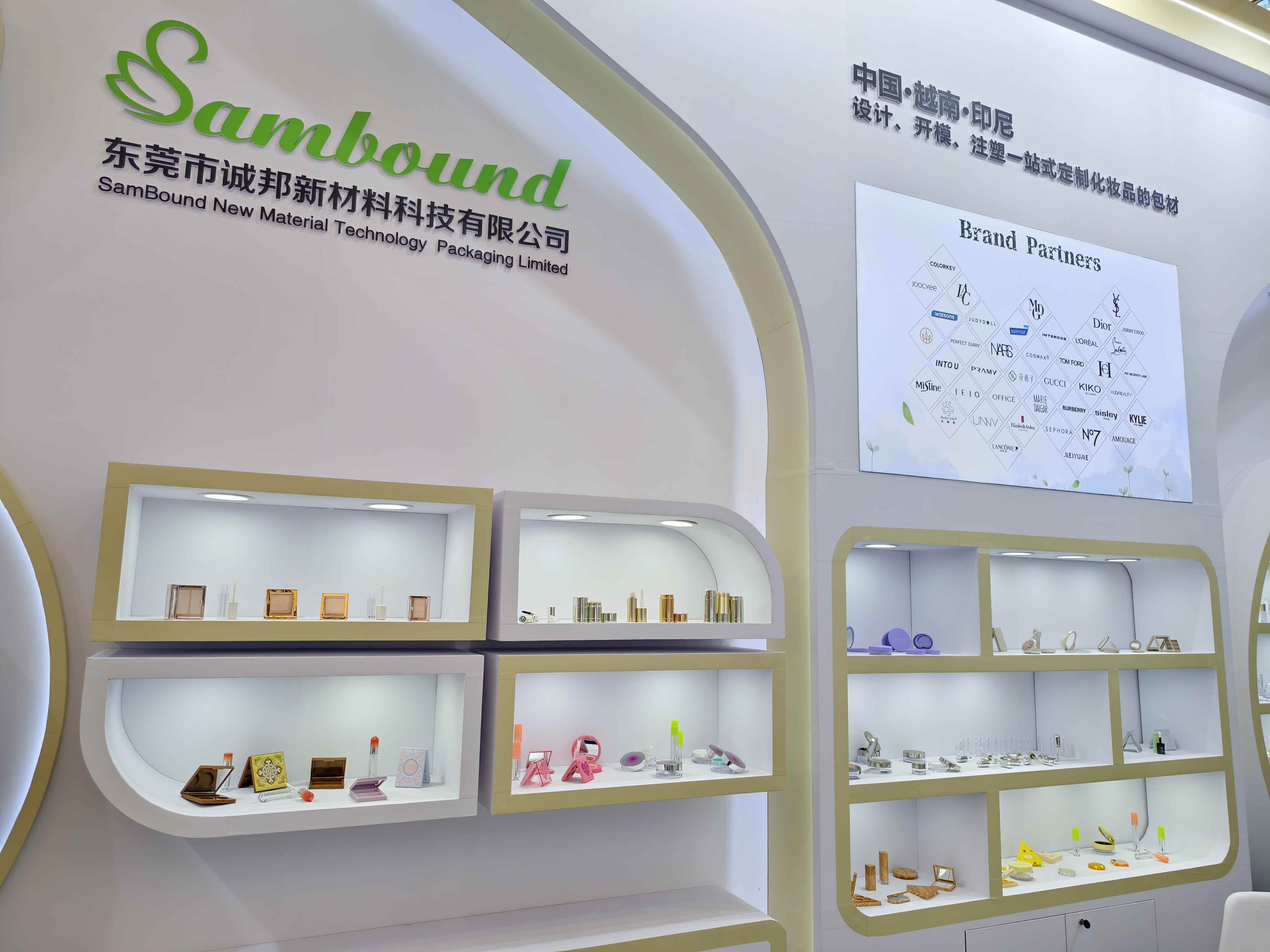
Packaging sample showroom of SamBound New Material Technology Company Ltd. (sambound.com).
Why Silicone Interferes With Adhesion
Some silicone residues or transferred release materials can leave a low-energy receiving surface that limits wetting or forms a weak boundary layer. Pressure-sensitive adhesive is viscoelastic rather than an ordinary liquid, but still needs sufficient intimate contact with the substrate. The effect depends on the residue chemistry, coverage, adhesive, substrate, and application history. Neither the presence of silicone elsewhere in a process nor poor peel adhesion alone proves silicone contamination of the tested part.
This is particularly relevant for cosmetic packaging components such as compact cases, tubes, and jars, where decorative labels often carry brand identity, ingredient disclosures, or regulatory information. A bonding failure is not only an aesthetic defect; it can also create compliance risk if required labeling becomes detached.
A Hypothetical Verification Scenario
Consider a hypothetical example to illustrate how this issue might surface during a standard verification workflow. Suppose a batch of PCR/PET lip gloss tubes is produced using an injection molding process that incorporates a silicone-based mold release agent to assist with part ejection. If the post-molding cleaning step is insufficient, trace silicone residue may remain on the tube's outer wall. When pressure-sensitive labels are later applied during the decoration stage, the adhesive appears to seat correctly under visual inspection. However, during a subsequent accelerated aging test, a portion of the labels begin to lift at the edges.
This hypothetical scenario demonstrates why visual inspection alone is insufficient for detecting silicone contamination. The defect is invisible to the eye at the time of application and only becomes apparent after a stress event—making destructive or semi-destructive testing a necessary part of any rigorous verification protocol.
Test Conditions
To evaluate whether silicone contamination is present and whether it compromises bonding, a verification protocol would typically define the following test conditions:
- Peel adhesion testing: Samples are conditioned at a controlled temperature and relative humidity (commonly 23°C and 50% RH) for a defined dwell period before testing, to control bonding dwell and environmental history.
- Contact angle measurement: A droplet of water or test liquid is placed on the substrate surface, and the resulting contact angle is measured. A contact-angle change can flag a change in wetting, but one water contact angle is not a chemical identification of silicone. Roughness, other residues, and the base material also affect the result.
- Accelerated aging exposure: Labeled samples are subjected to thermal cycling or humidity chamber exposure to simulate the stresses of shipping, storage, and end-use handling.
- Peel force measurement: After conditioning, labels are peeled at a fixed angle and speed, and the force required to separate the label from the substrate is recorded.
Acceptance Limits
A verification protocol must also define pass/fail limits so that results are actionable rather than purely descriptive. In a hypothetical test framework, limits might include:
- A minimum peel strength threshold, below which the label is considered to have failed bonding verification.
- A maximum contact angle threshold, above which the substrate is flagged as having excessive low-energy surface contamination requiring further investigation.
- A zero-tolerance visual criterion for any lifting, bubbling, or delamination observed after accelerated aging exposure.
- A defined dwell time window within which testing must occur, since adhesive bond strength can continue to develop or degrade over time depending on substrate interaction.
These limits allow a verification team to distinguish between an adhesive formulation issue and a substrate contamination issue, which is a critical distinction because the corrective action differs significantly depending on the root cause.
Industry Implications for Cosmetic Packaging Verification
Silicone contamination issues are not unique to any single product category, but they carry particular weight in cosmetic packaging because of the sector's reliance on diverse materials—PCR/PET, PETG, PMMA, AS, aluminum, and zinc alloy—each of which interacts differently with adhesives and finishing processes such as UV coating, silk screen printing, hot stamping, vacuum metallization, electroplating, and heat transfer. A verification protocol that accounts for silicone contamination risk must therefore be tailored to the specific material and finishing combination involved, rather than relying on a single generic test.
Why Verification Protocols Matter Across the Supply Chain
The broader lesson for packaging verification teams is that adhesion failures often originate upstream—during molding, surface treatment, or handling—rather than at the point of label application itself. Identifying silicone contamination requires coordination between material science understanding and structured test methodology, since the defect is frequently invisible until stress conditions reveal it.
Ultimately, silicone contamination is a reminder that label bonding verification cannot rely solely on initial visual inspection. A disciplined testing framework—covering defined test conditions, measurable limits, and realistic stress simulation—remains the most reliable way to confirm that a label will perform as intended throughout the product's shelf life and transit.
sambound.com
SamBound New Material Technology Company Ltd.

+ There are no comments
Add yours